
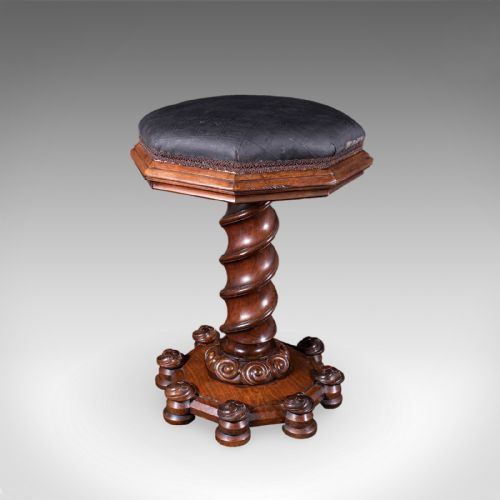


Dark Walnut Piano Stool
These dark walnut piano stool examples combine sturdy hardwood frames with practical height adjustment for the music room.
Dark Walnut Piano Stool
A dark walnut piano stool serves players at the keyboard with a stable, often adjustable seat designed for regular practice. The listings show forms ranging from revolving pedestal designs to tripod frames and music riser variants.
Most pieces seen here belong to the Victorian era, spanning dates from the mid nineteenth century through to the Edwardian period. Alongside standard piano stools, the selection includes music stools, dressing stools, and chapel organist variants.
Revival aesthetics frequently shape these items, with styles referencing George II, William IV, and Louis XV designs. Buyers encounter everything from carved hardwood frames to Scottish pieces and French influenced models.
Materials and construction methods
Makers utilised walnut as the primary timber, complemented by secondary hardwoods and supported by iron, brass, and metal mechanisms for adjustable heights. Seats incorporate upholstered surfaces finished in leather, velvet, or woven fabric.
Carved detailing defines the woodwork, appearing on pedestal shafts, tripod legs, and friezes. Metal components allow the top to rotate or raise via a threaded screw mechanism concealed within the column.
Organists demanded sturdy seating that could endure hours of energetic footwork while keeping the sheet music close at hand.
Assessing quality in dark walnut piano stools
The refinement of the carving separates standard workshop output from finer examples, particularly on tripod bases and revolving pedestals. Crisp detail in the woodwork indicates superior hand labour by the maker.
Smooth operation of the adjustable mechanism marks the better pieces, where iron screws turn cleanly without excessive play in the column. The weight and density of the walnut timber also influence the overall substance of the stool.
The Dark Walnut Piano Stool Glossary
- Revolving stool
- A seat with a top that spins on a central wooden or metal screw to alter its height. This mechanism allows the player to find a comfortable playing position quickly.
- Tripod base
- A three-legged support structure commonly found beneath pedestal piano stools. It provides stable contact on uneven floors.
- Music riser
- An integrated rack or mechanism designed to hold sheet music near the seating platform. It offers added utility for organists and pianists.
- Pedestal stool
- A single-column design rising from a branched base rather than four independent legs. This form dominates nineteenth-century music seating.
- Revival style
- A design approach that copies historical periods such as George II or Louis XV. Makers applied these older motifs to contemporary Victorian seating.
Dark Walnut Piano Stool: Frequently Asked Questions
How do I adjust the height?
Many examples feature a revolving top that winds up and down on a central metal screw hidden inside the column. Turning the seat clockwise or anticlockwise changes the vertical position.
Other variants rely on side handles or simple riser mechanisms to alter the height for different players at the keyboard.
Were these only used for pianos?
While primarily built for musicians at the piano or chapel organ, many forms double as dressing table stools or occasional seating. The listings show items identified variously as music stools, dressing stools, and chapel organist seats.
Their compact proportions and decorative carved walnut frames made them suitable for multiple rooms in the nineteenth-century home.
How can I tell the period?
Dating relies on stylistic clues like George II or Louis XV revival motifs combined with construction traits such as iron and brass mechanisms. Pieces span from the mid nineteenth century through to the Edwardian era.
Tool marks, timber selection, and the presence of upholstery fabrics also help narrow down the decade of manufacture.
Are walnut and hardwood the same?
Walnut is a specific timber prized for its dark tone and grain, whereas hardwood is a broad category encompassing various deciduous trees. Makers utilised walnut alongside other sturdy hardwoods for these frames.
Checking the grain beneath the polish helps confirm whether the primary wood is walnut or another hardwood.