

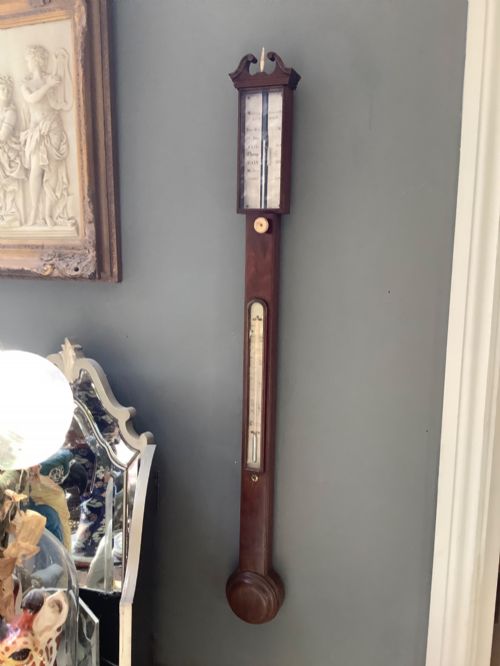


Dark Mahogany Wall Barometer
These dark mahogany wall barometers combine practical weather prediction with refined domestic joinery across Georgian, Regency, and Victorian interiors.
Dark Mahogany Wall Barometer
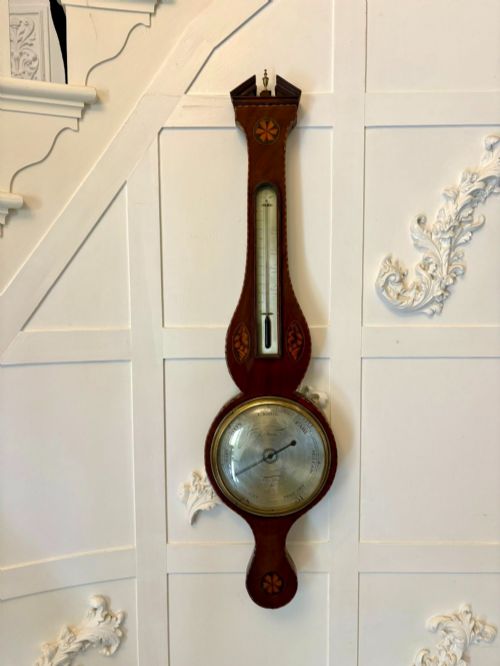
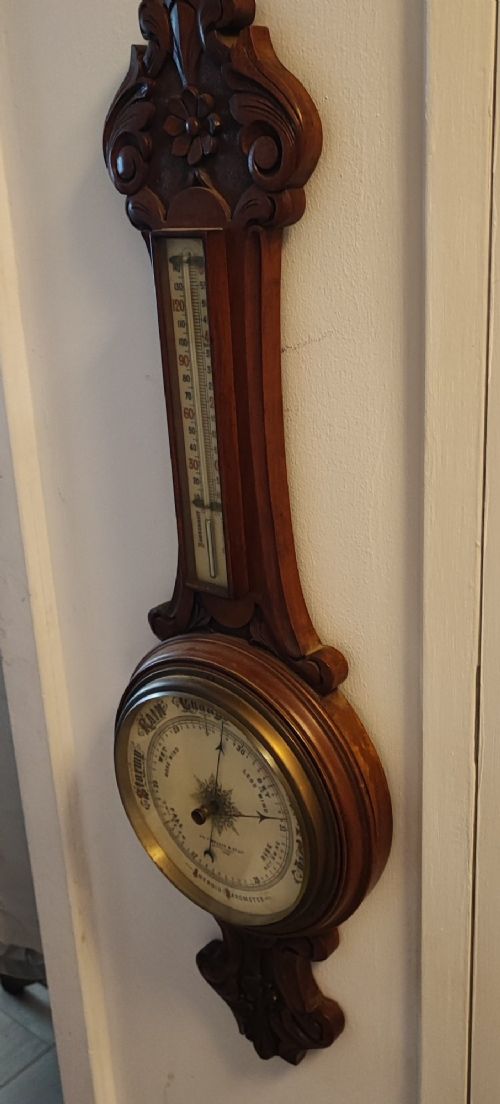
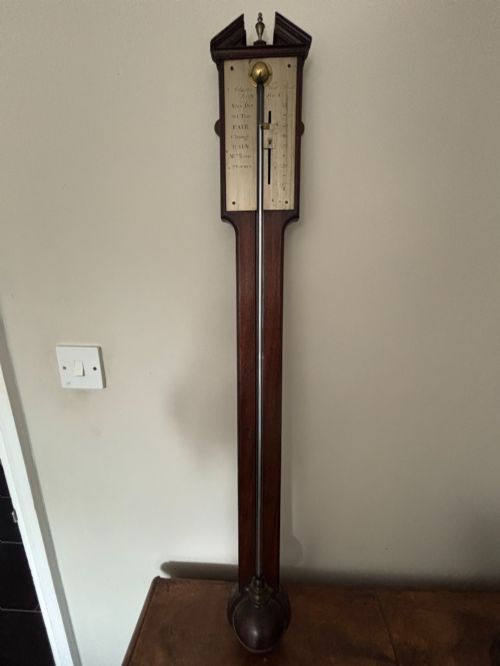
A dark mahogany wall barometer is an instrument housed in rich timber cases designed to measure atmospheric pressure inside domestic rooms and hallways. These instruments appear primarily in banjo, wheel, and stick configurations spanning the Georgian, Regency, and Victorian eras.
The versions most common on this page include banjo and wheel barometers featuring circular dials alongside mercury or aneroid stick barometers framed in slender timber profiles. Makers constructed these pieces using dense tropical hardwoods, often incorporating lighter stringing and shell marquetry to accentuate the grain.
Originating as scientific instruments for maritime and domestic observation, these wall barometers evolved into decorative fixtures for elite parlours and entrance halls. Surviving examples reflect the shifting aesthetic preferences of instrument makers and cabinet makers working across British workshops.
How They Were Made
Craftsmen built these cases from solid and veneered mahogany, frequently selecting stock with deep figuration for the primary body. Workshops accented the dark timber fields with contrasting borders of boxwood, ebony, and satinwood stringing.
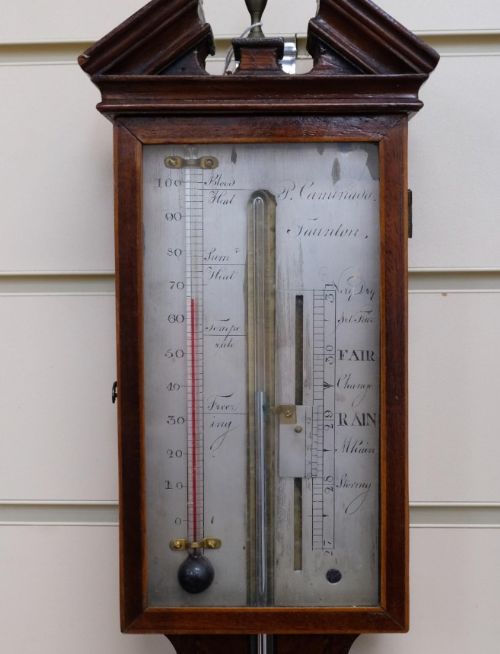
Dials and indicators utilised silvered brass, plain brass, and engraved bone plates protected by heavy curved or flat glass lenses. Makers mounted mercury tubes inside wooden channels or secured aneroid movements behind cast brassbezels.
Barometer makers frequently included thermometer scales on the trunk so households could monitor indoor heat alongside approaching storms.
What Varies in Quality
The distinction between standard production and top-tier execution rests in the subtlety of the case joinery and the precision of the dial engraving. Master makers employed delicate marquetry and proportioned mouldings that elevated a utilitarian instrument into a sophisticated piece of furniture.
Signatures inscribed upon the silvered brass plates separate workshop-built pieces from anonymous output. Instruments bearing the names of established makers typically exhibit superior internal mechanical complexity and cleaner exterior finishing.
P. Caminada·George Adams·Dollond·JB Bergna·Alexander Wright·Blake & Son·Roncoroni·Sandrino·Negretti & Zambra·Gilbert·Bate·Luisetti·Charles Aiano·Gowland·S. P. Cohen·J C Moretti·Russell
The Dark Mahogany Wall Barometer Glossary
- Barometer
- An instrument used to measure atmospheric pressure in order to forecast weather changes. These devices use either liquid columns or sealed metal chambers.
- Stick Barometer
- A vertical instrument configuration housing a long mercury tube protected by a wooden trunk. This format offers high reading precision.
- Banjo Barometer
- A domestic weather glass featuring a bulbous lower body surmounted by a circular dial beneath a triangular pediment. The shape resembles a stringed instrument.
- Aneroid Barometer
- A mechanical weather indicator utilising a sealed corrugated metal box that expands and contracts with pressure changes. This system removes the need for liquid mercury.
- Silvered Brass
- A sheet metal dial surface treated with a silver compound to create a bright background for engraved black lettering. The finish catches ambient light in dark hallways.
Dark Mahogany Wall Barometer: Frequently Asked Questions
What is an aneroid barometer?
An aneroid barometer measures atmospheric pressure using a flexible metal capsule rather than liquid mercury inside a glass tube. This mechanical internal setup allowed makers to build compact circular dials.
Such instruments became common during the Victorian era, offering reliable domestic weather tracking without the risk of mercury spills.
How do stick and wheel barometers differ?
Stick barometers present a long, narrow wooden trunk that houses the primary mercury column for direct pressure reading. Wheel barometers enlarge the lower portion into a circular body while placing the main dial near the top.
Both forms served domestic interiors, though stick models favoured vertical wall spaces while wheel versions dominated larger reception rooms.
Where should I hang a wall barometer?
Wall barometers require stable interior environments away from direct sunlight, open fires, and damp exterior walls. Placing them in hallways or studies protects the delicate internal mechanisms from rapid temperature shifts.
Securing the heavy mahogany case to a solid wall stud ensures the instrument hangs plumb for accurate readings.
How do I date a mahogany barometer?
Dating relies on stylistic clues within the woodwork, dial layout, and signature formats. Georgian examples often feature understated mahogany stick cases, while Regency and Victorian pieces lean towards inlaid banjo designs.
Makers' signatures inscribed on the brass plates provide direct links to working periods and workshop locations.