
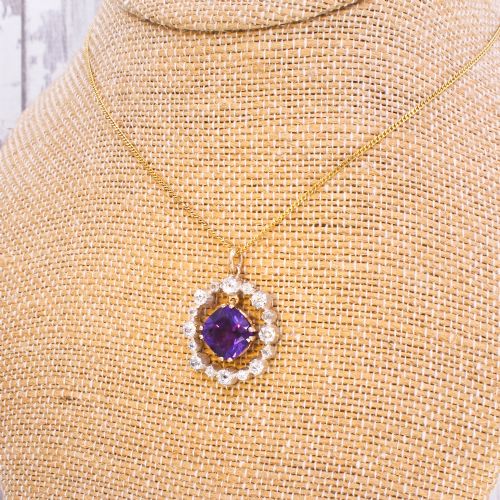
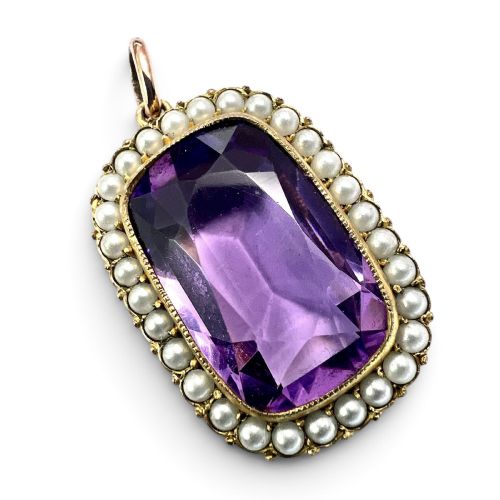


Cushion Cut Pendant
A cushion cut pendant offers a soft, pillow-like silhouette that catches the candle or daylight with distinct warmth.
Cushion Cut Pendant
A cushion cut pendant brings together rounded corners and larger facets, creating an antique brilliance found across Victorian, Edwardian, and mid-century examples.
You meet stones ranging from deep purple amethyst and vivid aquamarine to bright yellow sapphire and classic diamond set into yellow gold, white gold, or platinum.
The selection moves from delicate halo designs and cluster pendants to individual solitaire drops and cross forms.
Materials and construction
Metals span 9ct gold, 15ct gold, 18ct gold, silver, and platinum, providing secure settings for both large gemstones and delicate seed pearls.
Gemstones such as diamond, amethyst, aquamarine, sapphire, citrine, and tourmaline are shaped by hand with rounded edges that define the era's cutting style.
Some Victorian pieces secretly hide tiny seed pearls tucked tight against deep amethysts, proving earlier makers loved a subtle visual whisper.
Distinctions in quality
The value of the piece rests in the clarity of the central cushion cut stone and the precision with which smaller diamonds or seed pearls are balanced around it.
Subtleties in metalwork, from fine platinum scrollwork to robust gold settings, separate simple commercial work from master jeweler output.
The Cushion Cut Pendant Glossary
- Cushion cut
- A gemstone shape featuring a square or rectangular outline with rounded corners and curved sides. This historic cut softens the geometry of the stone while maximising light reflection.
- Halo pendant
- A central gemstone encircled by a ring of smaller stones, typically diamonds or pearls. This arrangement magnifies the visual presence of the main gem.
- Seed pearl
- A very small, naturally formed or cultured pearl often drilled and threaded in Victorian and Edwardian clusters. They lend a quiet texture to coloured stone centerpieces.
- Old cut diamond
- A diamond facet pattern cut by hand before modern machinery, featuring a smaller table and a higher crown. It produces a broad, warm candlelit sparkle.
Cushion Cut Pendant: Frequently Asked Questions
How do I date a cushion cut pendant?
Dating relies on the combination of metal purity marks, the cutting style of the central stone, and the surrounding mount. Earlier pieces often use closed-back settings or hand-cut silver over gold.
Later mid-century examples adopt cleaner platinum lines and standard commercial hallmarks that clarify the decade of production.
Are cushion cut pendants durable for daily wear?
Durability depends on the chosen gemstone and the strength of the metal prongs or bezel settings. Harder stones like diamond and sapphire handle daily routines easily.
Softer varieties like amethyst or pearls require more careful handling to protect the surface polish from knocks.
How should I care for antique gemstone pendants?
Gentle cleaning with warm soapy water and a soft brush maintains the brilliance of stones like diamond and aquamarine. Avoid harsh chemical dips, particularly if the piece incorporates softer organic elements like pearls.
Store the pendant separately in a lined box to prevent scratching against other jewellery.