
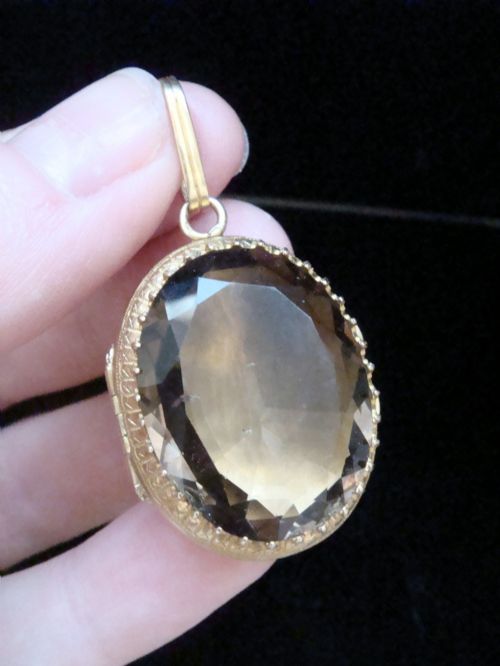


Gold Citrine Necklace
A gold citrine necklace brings warm honey and yellow quartz tones into antique and mid-century pendant designs.
Gold Citrine Necklace
A gold citrine necklace spans Victorian, Georgian, and mid-century designs, featuring golden quartz set in yellow gold mounts. These pieces range from simple drop pendants to multi-gem clusters and lockets.
The version most commonly encountered on this page pairs a faceted citrine with nine-carat yellow gold, often styled as a pendant necklace or spinner fob. Victorian and nineteen-fifties examples appear frequently among these listings.
How they were made
Goldsmiths worked primarily with nine-carat and eighteen-carat yellow gold to mount citrine stones, occasionally incorporating seed pearls, garnets, diamonds, and rubies. Stones were faceted to catch the light, secured in claw settings or enclosed in locket frames with chased floral motifs.
Listings feature periods spanning from the Georgian era through the Victorian period, nineteen-thirty, nineteen-fifty, and nineteen-sixty.
What varies in quality
Quality rests in the clarity and saturation of the citrine or yellow quartz, alongside the weight and purity of the gold mount. Heavier eighteen-carat gold settings and larger stones distinguish the finer examples from lighter nine-carat productions.
Design complexity also sets pieces apart, where hand-chased floral motifs, intricate coronet crowns, or combined gemstones such as diamonds and pearls elevate the craftsmanship of the necklace.
The Gold Citrine Necklace Glossary
- Citrine
- A yellow variety of quartz valued for its warm golden to amber colour. It has been used extensively in Georgian, Victorian, and mid-century jewellery.
- Spinner Fob
- A rotating pendant mounted within a swivel ring, frequently featuring a faceted stone that turns to display different faces or materials.
- Locket Pendant
- A hinged pendant designed to open and enclose a small portrait or memento, often decorated with chased motifs or gemstone bezels.
- Trillion Cut
- A triangular gemstone cut with multiple facets designed to maximise brilliance and light return within a modern or vintage setting.
Gold Citrine Necklace: Frequently Asked Questions
How do I date a gold citrine necklace?
Dating relies on stylistic clues such as the form of the yellow gold mount, the cut of the citrine, and associated materials like seed pearls. Victorian pieces often display chased floral motifs, whereas nineteen-fifties examples feature distinct cluster and pendant arrangements.
Examining the back of the pendant and the clasp structure reveals manufacturing methods specific to periods from the Georgian era through to the mid-century decades.
Are these necklaces made from solid gold?
The pieces listed utilise yellow gold across various purities, predominantly nine-carat and eighteen-carat yellow gold. These solid metal mounts hold the citrine stones securely within settings characteristic of their respective periods.
Checking hallmarks, where present, confirms the gold purity used by the maker for the chain, pendant, or clasp components.
What stones are often paired with citrine?
Citrine appears alongside pearls, seed pearls, garnets, diamonds, rubies, amethysts, and blue topaz in many multi-gem configurations. These complementary gems add contrast and colour variety to Victorian and mid-century pendant necklaces.
In some designs, whiskey quartz or yellow quartz is used alongside citrine to create tonal depth within cluster and star pendant arrangements.
How should I care for my necklace?
Maintenance involves gentle cleaning with warm soapy water and a soft cloth to remove dust from the citrine facets and gold mount. Avoid harsh chemical cleaners and ultrasonic devices, particularly when pearls or delicate seed pearls are present in the design.
Store the necklace flat in a lined box or separate pouch to prevent the gold chain from tangling and to protect the stones from scratching.