



Curule Armchair
A curule armchair antique brings ancient X-frame authority into a modern room through intersecting supports.
Curule Armchair
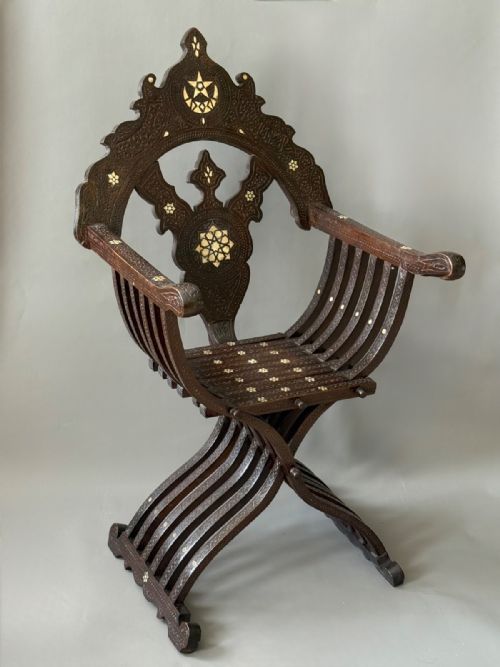
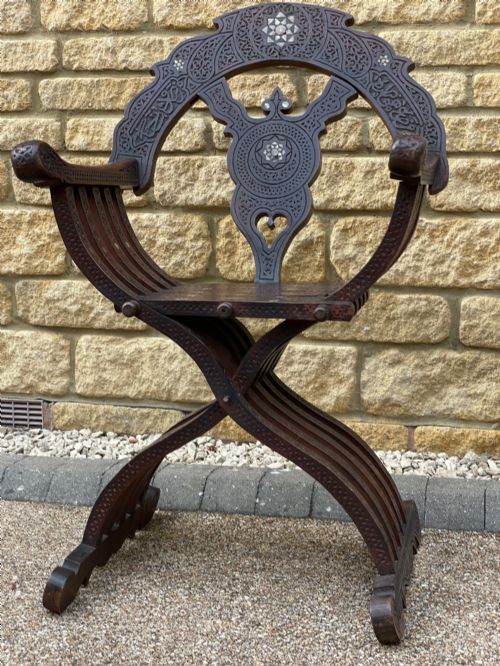
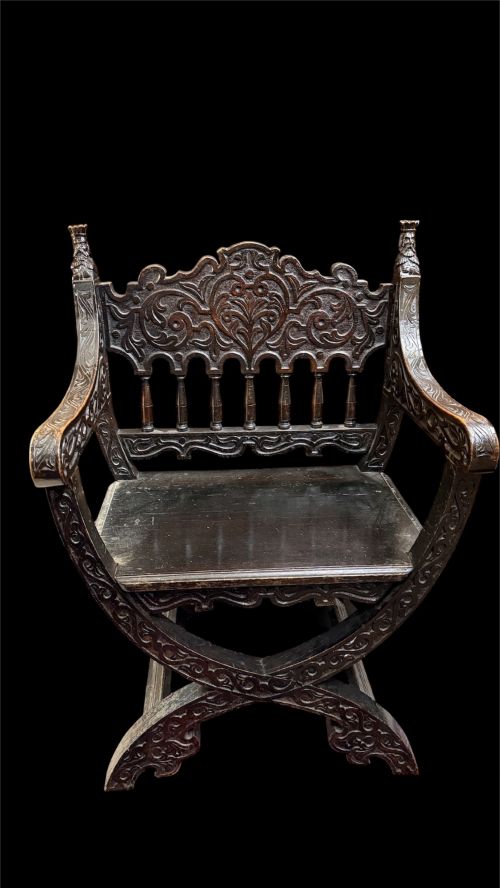
A curule armchair antique draws on ancient Roman folding stool designs, translating X-frame architecture into sturdy seating across several centuries. You encounter these across periods ranging from the eighteenth century through the Edwardian era, with nineteenth-century Revival examples forming the bulk of the selection.
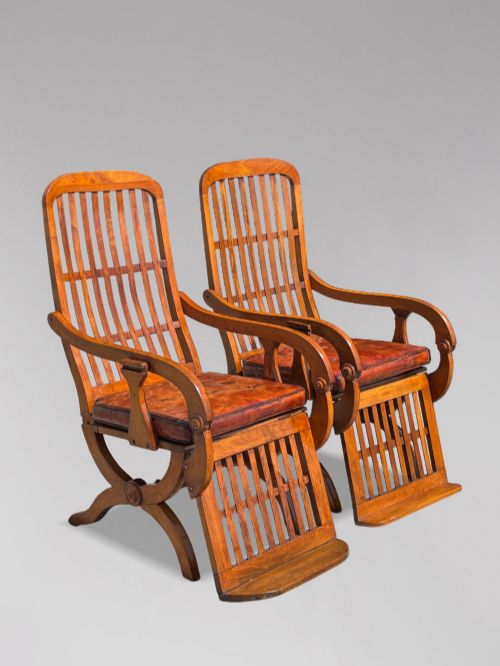
Makers adapted the cross-frame blueprint into diverse seating formats, including library armchairs, desk chairs, and hall chairs. Walnut, oak, and mahogany provide the primary wooden structures, often complemented by leather, fabric, or textile upholstery.
Regional interpretations shape the selection, spanning Renaissance Revival pieces, Syrian Ottoman mother-of-pearl work, and Venetian gondola seating. This variety ensures that structural X-frames manifest in forms from heavy Gothic Revival armchairs to lighter inlaid Edwardian seats.
How these X-frame seats were constructed
Makers fashioned these frames from dense hardwoods like walnut, oak, and mahogany, utilising intersecting curved legs that lock together to bear weight at the centre. Carpenters joined these intersecting members with pegged or dowel joints to maintain rigidity across the crossing point.
Surface enrichment involved intricate carving, inlay, and painted wood finishes, aligning with styles such as Gothic Revival and Renaissance Revival. Upholstery was secured over webbing or directly to wooden slats, utilising leather or woven textiles fastened with decorative tacks.
Curule Armchair Retail Price Guide 2026
Typical asking prices for curule armchair among the pieces listed under this phrase on Sellingantiques today, from the lower quarter to the upper quarter. They describe what is for sale here now, not the wider market.
Listings feature woods including walnut, oak, and mahogany, shaped into styles ranging from Gothic Revival to Syrian Ottoman.
What separates high-grade examples from ordinary pieces
Structural integrity at the intersecting cross-frame joint dictates the durability of the chair, separating solidly engineered frames from those compromised by loose joinery. The precision of the woodwork and the depth of hand-carved ornamentation reveal the artisan's skill.
The choice of primary timber and the condition of original surfaces, whether inlaid mother-of-pearl or patinated walnut, define the visual weight of the piece. High-grade examples maintain balanced proportions across the X-frame supports without relying on heavy modern reinforcement.
White, Allom & Co.·Gillows
The Curule Armchair Glossary
- Curule
- A form of X-frame seating derived from ancient Roman magistrate chairs, featuring intersecting curved legs that create a distinctive cross-brace silhouette.
- Savonarola
- A specific type of folding armchair constructed from multiple intersecting wooden slats forming an intricate lattice pattern, named after the Florentine friar.
- Glastonbury chair
- A nineteenth-century Gothic Revival form of wooden armchair with pegged joints, a sloping panel back, and a folding X-frame base.
- Gondola chair
- A curved-back armchair originating in Venice, often associated with neoclassical or regency designs that echo the sweeping lines of local watercraft.
- X-frame
- A structural furniture support formed by two diagonal members crossing each other to distribute weight evenly toward the floor.
Curule Armchair: Frequently Asked Questions
What is a curule armchair?
A curule armchair is a seat supported by intersecting curved legs that form an X-shape when viewed from the side. This ancient silhouette mimics portable folding furniture used by Roman officials.
Over the centuries, makers adapted this architecture into permanent armchairs, library seats, and desk chairs, utilising sturdy hardwoods like oak, walnut, and mahogany.
How do I identify a Victorian Gothic Revival model?
Victorian Gothic Revival examples typically feature heavy carved oak, pointed arch motifs, and structural elements inspired by medieval ecclesiastical architecture. You will often notice robust framing and paneled backs.
These pieces frequently appear alongside Glastonbury styles, utilising pegged wooden construction and austere lines that reflect nineteenth-century romanticism of the Middle Ages.
Are these chairs comfortable for daily use?
Many of these X-frame chairs offer surprisingly supportive seating, particularly library armchairs and desk chairs fitted with leather or padded fabric upholstery. The rigid intersecting base provides steady elevation.
However, earlier folding variants and decorative hall chairs prioritize architectural silhouette over deep cushioning, making them better suited for occasional sitting.
Where should I place an X-frame chair at home?
An X-frame chair works well as a statement piece in a study, library, or hallway where its sculptural silhouette can be viewed from multiple angles. The open framing prevents rooms from feeling visually crowded.
Pairing a walnut or mahogany desk chair with a traditional writing table highlights the geometric interplay of the intersecting wooden supports.