

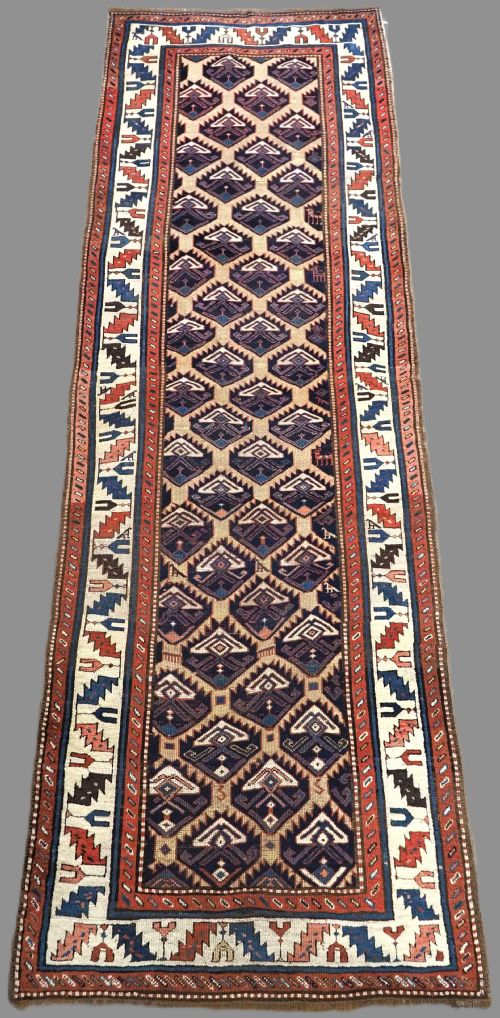


Cream Wool Hallway Runner
A cream wool hallway runner brings lasting character to a long passage through hand-knotted pile and traditional village designs.
Cream Wool Hallway Runner
When you search for a cream wool hallway runner, you encounter long, narrow floor coverings designed specifically for corridors and passages. These pieces originate from Persian tribal groups, Caucasian weavers, and Central Asian workshops across the nineteenth and early twentieth centuries.
The dominant examples on this page feature ivory or cream grounds woven in wool, often decorated with lattice patterns, boteh motifs, or tribal geometric fields. They span production dates from the mid-nineteenth century up to the 1920s.
Formats range from narrow corridor carpets to elongated village rugs shaped by traditional looms. Each item carries the distinct aesthetic of regional weaving traditions such as Kurdish, Hamadan, Malayer, Sarab, and Afshar.
Materials and construction
These runners are constructed primarily from wool pile on supporting foundations of cotton or wool. Weavers utilised natural dyes to colour the yarns, producing the characteristic soft cream, ivory, and contrasting field tones seen across the inventory.
The making involves hand-knotting techniques passed down through generations in tribal regions and village workshops. Structural durability relies on tight knot densities and sturdy selvedges designed to withstand heavy corridor footfall.
Listings feature wool runners from 1850 to 1920, showcasing Persian tribal, Caucasian, and Central Asian village weaving traditions.
Assessing quality and proportion
Quality in these runners depends on the precision of the hand-knotting and the integrity of the wool. Finer pieces demonstrate superior handle, resilient pile, and clarity within intricate geometric or floral motifs.
Proportion also defines the better examples, particularly those maintaining exceptionally long, narrow dimensions suited to residential hallways. The consistency of natural dye saturation across the ivory ground further separates standard village work from finer tribal weaving.
The Cream Wool Hallway Runner Glossary
- Runner
- A long, narrow carpet format specifically proportioned for corridors, staircases, and hallways. These pieces direct movement through domestic spaces.
- Boteh
- A traditional teardrop or almond-shaped motif with a curved upper end, frequently repeated across tribal and village carpets. It represents a floral or cypress sprout symbol.
- Kilim
- A flat-woven carpet or runner produced without a raised pile, relying on interlocking warp and weft threads. These lightweight textiles offer distinct geometric surface patterns.
- Kelleh
- A large format carpet or long rug with extended rectangular proportions. They serve similar spatial functions to runners in larger rooms or wide corridors.
- Natural dyes
- Colourants derived from plant, insect, and mineral sources rather than synthetic compounds. They yield harmonious, mellow tones that age with considerable depth.
Cream Wool Hallway Runner: Frequently Asked Questions
How do I clean a wool runner?
Maintenance for these antique textiles involves gentle surface vacuuming without the rotating brush bar. Professional rug cleaning is recommended for deep maintenance to protect the natural wool pile.
Avoid excessive moisture and harsh chemical treatments which can damage the traditional dyes and cotton foundations. Prompt attention to spills preserves the integrity of the weave.
Are these runners suitable for high traffic?
The dense wool construction of nineteenth and early twentieth-century village runners makes them naturally resilient. Their traditional materials stand up well to regular movement along corridors.
Using an appropriate underlay helps secure the rug on hard flooring and reduces friction against the foundation. This simple precaution extends the working life of the textile.
How do I date an antique runner?
Dating relies on stylistic analysis of the motifs, structural examination of the wool and cotton foundations, and the characteristics of the natural dyes. Regional weaving traits often point to specific decades between the mid-nineteenth century and the 1920s.
Comparative study of known tribal pieces, such as Kurdish or Afshar productions, helps narrow the timeframe. Subtle irregularities in weave indicate hand-production before industrial standardisation.