



Craft Revival Dining Chairs
These craft revival dining chairs bring honest timber and solid construction straight into the modern home.
Craft Revival Dining Chairs
When you search for craft revival dining chairs, you encounter seating built from sturdy timbers like oak, pitch pine, and ash, reflecting the traditions of the nineteenth and early twentieth centuries. The selection ranges from country kitchen chairs and side chairs to larger sets of highback dining chairs and benches.
You are most likely to meet oak and pitch pine examples from the 1900 period, alongside Victorian items and later revivals up to 1930. Many pieces draw heavily on Arts and Crafts, Gothic Revival, and Spanish Revival styles, showing trefoil details, carved frames, and traditional rush or leather seats.
How they were made
Makers relied on solid oak, pitch pine, and ash, building frames designed to withstand generations of daily use around the table. Joints were pegged or dowelled rather than simply glued, ensuring structural integrity in highback and side chair forms.
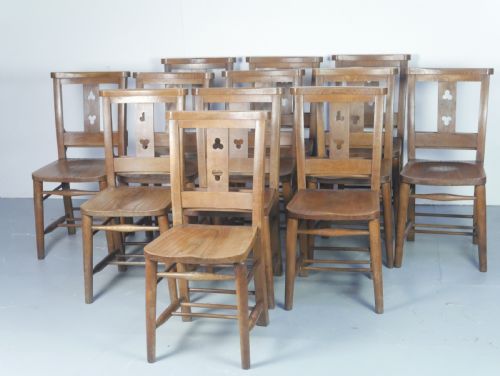
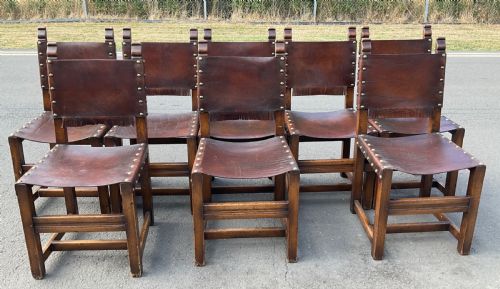
Seating areas often featured woven rush, needlepoint fabric, or upholstered leather secured with brass tacks, while decorative elements like trefoil cut-outs and hand-carving were integrated directly into the timber structure.
Several items double as gossip chairs, designed for intimate seated conversations rather than formal dining.
What varies in quality
The distinction between standard utility seating and finer workshop production lies in the depth of the carving and the presence of documented maker influence. Pieces associated with firms like Liberty & Co or Shapland & Petter demonstrate superior joinery and more ambitious design proportions.
The choice of secondary materials also alters the character of a set, where original leather upholstery or intact rush seating commands greater attention than later replacement fabric. Consistency across larger sets of dining chairs remains a primary indicator of original workshop output.
Liberty & Co·Charles Bevan·Shapland & Petter
The Craft Revival Dining Chairs Glossary
- Arts and Crafts
- A design movement valuing handcraftsmanship, simple forms, and traditional materials over mass production. It heavily influences the construction of these chairs.
- Gothic Revival
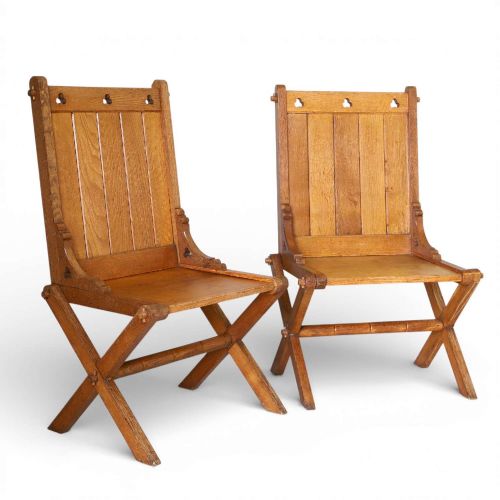
- An architectural and decorative style drawing on medieval forms, featuring pointed arches, trefoils, and heavy timber frames.
- Pitch Pine
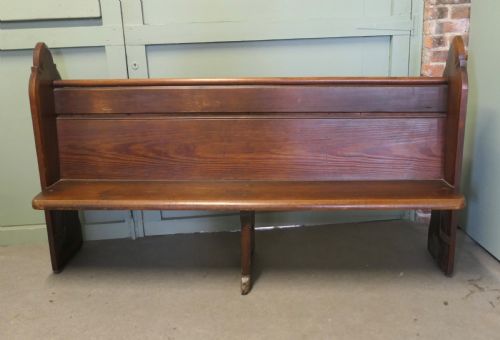
- A durable resinous softwood utilised in nineteenth-century benches and seating for its strong grain pattern and resilience.
- Rush
- A traditional seating material woven from dried marsh plants to create a flexible, supportive seat base on country chairs.
Craft Revival Dining Chairs: Frequently Asked Questions
Are these chairs suitable for daily use?
Solid oak and ash construction makes these chairs robust enough for everyday dining when joints remain tight and stable. Regular checks on traditional rush or leather seats will keep them in practical condition.
Most pieces from the nineteenth and early twentieth centuries were built for heavy domestic service, ensuring they handle modern weight and use without difficulty.
How do I spot an Arts and Crafts chair?
Look for exposed joinery, plain timber surfaces, and structural honesty where the construction methods form part of the decoration. These pieces avoid excessive veneering in favour of solid oak or pitch pine.
Details like trefoil cut-outs, tall vertical backs, and simple leather or rush inserts also point directly towards the Arts and Crafts aesthetic.
Can I mix different chair styles around one table?
Mixing individual side chairs and carvers works well if the timber tones and general periods share a common origin, such as pairing nineteenth-century country chairs with early 1900s oak seating. The shared use of solid wood ties diverse forms together.
Sticking to similar materials like oak or ash helps maintain a cohesive look across the dining room even when exact matching sets are unavailable.
What is the difference between side chairs and highback chairs?
Side chairs are compact, armless seats designed to fit easily around a dining table without taking up excessive floor space. They are typically lighter and easier to move.
Highback chairs feature extended vertical backs, sometimes incorporating carved details or leather upholstery, providing a more imposing presence in the room.