
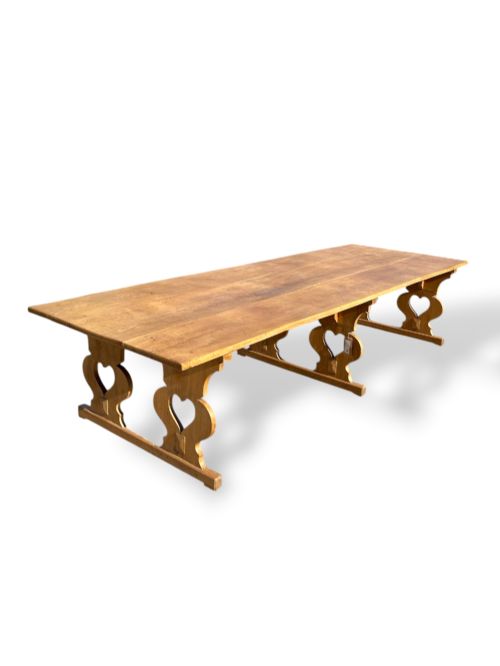
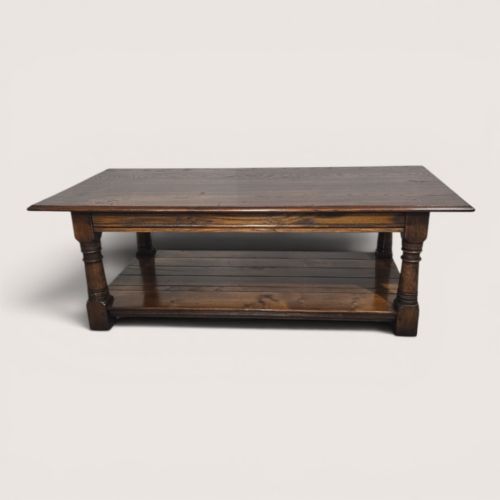


Country Oak Centre Table
A country oak centre table grounds a room with honest timber and utility, spanning eras from Georgian to Victorian and French provincial.
Country Oak Centre Table
A country oak centre table serves as a sturdy focal point in a room, drawing on utilitarian forms intended for daily domestic use. When you search for a country oak centre table, you encounter low tables, coffee tables, and occasional pieces made primarily from solid oak.
The pieces listed on this page span the 18th century, Georgian era, 19th century, and early decades like 1920 and 1930. Styles range from rustic farmhouse and French provincial to Jacobean style and Victorian neo-gothic, reflecting both English and continental origins.
Most items you meet here lean towards low coffee tables and occasional tables on turned legs, plank tops, or refectory designs. Fruitwood, mahogany, and bleached oak also appear alongside the dominant oak material, offering variety in tone and texture.
Materials and Construction
Makers built these country oak centre tables using solid timber planks, often joining oak with secondary woods such as fruitwood, sycamore, and mahogany. Construction relies on straightforward joinery, visible in pegged joints, heavy plank tops, and turned or square legs.
Surface treatments vary from natural waxed oak to bleached finishes, painted surfaces, and parquetry patterns. Brass hardware and leather inserts occasionally supplement the timber framework, particularly on Victorian and later examples.
Listings feature oak as the primary material, supported by fruitwood, walnut, and mahogany across 18th-century, Georgian, and Victorian periods.
Assessing Quality and Character
Quality in a country oak centre table rests on the integrity of the timber, the weight of the planking, and the harmony of the proportions. Tables with rich grain patination and substantial timber thickness stand apart from lighter or more heavily altered pieces.
The character of the surface, whether a well-waxed 18th-century top or a weathered 19th-century bleached oak finish, dictates the visual appeal. Original structural stability and honest, period-appropriate construction define the better examples in this group.
The Country Oak Centre Table Glossary
- Oak
- A durable hardwood prized for its strength and prominent grain pattern, forming the primary material for these tables.
- Parquetry
- Geometric wood inlay work used to create decorative patterns on tabletops, often seen on French provincial examples.
- Refectory table
- A long, narrow table traditionally used for dining, adapted here in country kitchen and farmhouse styles.
- Bleached oak
- Timber treated to lighten its natural tone, a finish found on several 19th-century French and English pieces.
- Turned legs
- Table supports shaped on a lathe, ranging from simple columnar designs to more elaborate Jacobean-style balusters.
Country Oak Centre Table: Frequently Asked Questions
What is a country oak centre table used for?
These tables function primarily as coffee tables, low serving surfaces, or occasional pieces in living spaces and halls. Their sturdy construction suits daily placement in the middle of a room.
Historically, similar formats served multiple domestic purposes from dining to food preparation in country kitchens.
How do I date a country oak table?
Dating relies on examining construction methods, timber patination, and leg styles such as turned supports or refectory framing. Pieces range from 18th-century Georgian origins through Victorian interpretations to early 20th-century examples.
Tool marks and the type of secondary wood used underneath can further help narrow the period of manufacture.
How do I fit one into a modern interior?
A low oak table anchors a seating area, pairing well with upholstered sofas and diverse interior styles from rustic to traditional. The neutral tones of natural or bleached oak adapt easily to contemporary colour schemes.
Allowing sufficient clearance around the table ensures functional flow in both large reception rooms and compact spaces.