


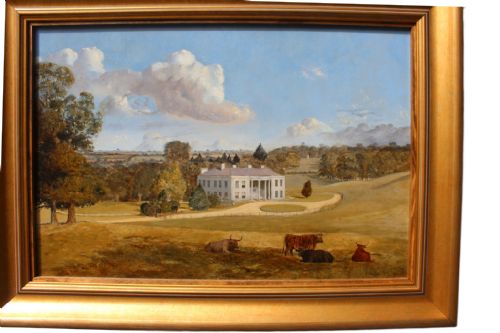


Country Estate Landscape
These country estate landscape works capture historic seats, grand parks, and stately homes in oil paint, canvas, wood, paper, and framed print.
Country Estate Landscape
A country estate landscape depicts historic British and European seats, parks, and architectural landmarks such as Trentham Hall, Arundel Castle, Lowther Castle, Newstead Abbey, and Gwydir Castle. These works record aristocratic homes, royal residences, and landed estates through different centuries.
The pieces on this page appear across various forms, predominantly as oil paintings on canvas and wood panel, alongside engravings, lithographs, and pencil sketches. Creators range from the 18th Century and Regency periods through Victorian, 1860, Edwardian, and 1900.
Subjects often combine architectural portraiture of country houses with surrounding parkland, ornamental lakes, hunting scenes, and staffage figures or cattle. Works may record specific topographical views or serve as general portrayals of rural estates.
Materials and techniques
Artists painted primarily with oil paint upon stretched canvas or wood panels, building rich surfaces with pigments and binders. Works on paper utilise engraving and lithography techniques, alongside pencil sketches.
Frames employ wood and gilded wood, often finished with gold leaf to enclose the canvas or paper support. Glass protects delicate paper pieces such as prints and sketches.
Listings feature works from the 18th Century, Georgian, Regency, Victorian, 1860, Edwardian, and 1900 periods.
Factors that define quality
Quality rests upon the precision of architectural rendering and the atmospheric handling of the surrounding parkland, trees, and water. Finer works display confident brushwork in oil paint or sharp clarity in early engravings.
Provenance and documented association with specific historic houses, titled owners, or recorded artists elevate a piece. The skill shown in depicting figures, cattle, and horses within the landscape distinguishes superior examples from standard topographical views.
Clifton Tomson·T.M Baynes·Samuel Sidley·James Canter·C de Falens·Robert Thomas Buttery·Fred Merriman·Peter Tillemans·Martin Pierre - Denis·Henri Harpignies·Frances Wyndham
The Country Estate Landscape Glossary
- Canvas
- A heavy woven fabric used as a surface for oil paintings. It is stretched over a wooden frame before painting begins.
- Lithograph
- A printmaking process based on the incompatibility of oil and water. An image is drawn on limestone or a metal plate and transferred to paper.
- Engraving
- A printmaking technique where an artist cuts lines directly into a metal plate with a burin. Ink is held in these grooves and pressed onto paper.
- Topographical
- A genre of art focused on the accurate depiction of specific places, buildings, and landscapes. These works often record actual historic seats and parks.
- Staffage
- Human figures or animals included in a painting to enliven a scene or indicate scale. They provide narrative context within an estate landscape.
Country Estate Landscape: Frequently Asked Questions
What is a country estate landscape?
A country estate landscape is an artwork depicting a historic stately home, country house, or landed property alongside its surrounding parkland, gardens, and lakes.
These pieces document specific architectural seats and rural estates from the eighteenth century onwards through paintings, prints, and drawings.
How were these paintings displayed?
Historically, these oil paintings and works on paper hung within the reception rooms, libraries, and galleries of the very country houses they portrayed.
Today, they function as interior wall art framed in wood and gold leaf, suitable for residential display.
How do I identify the period?
Periods are identified through painting styles, clothing of figures, framing techniques, and architectural details of the depicted houses.
References to specific historical reigns, such as Regency or Victorian, alongside artist signatures and inscriptions, provide dating evidence.
Are all pieces oil paintings?
No, while oil paint on canvas or wood panel forms a large part of the selection, other mediums appear.
The inventory also includes pencil sketches, coloured lithographs, and engravings on paper.