




Country Cottage Canvas Art
Country cottage canvas art brings domestic rural idylls into a room through oil paint on stretched cloth.
Country Cottage Canvas Art
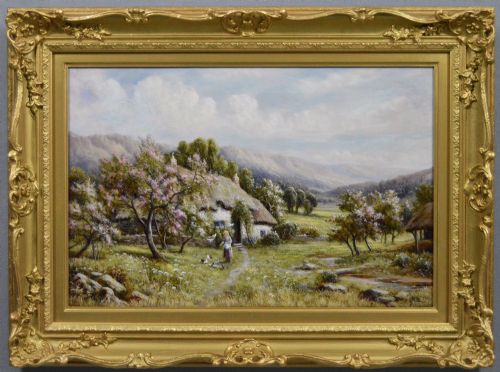
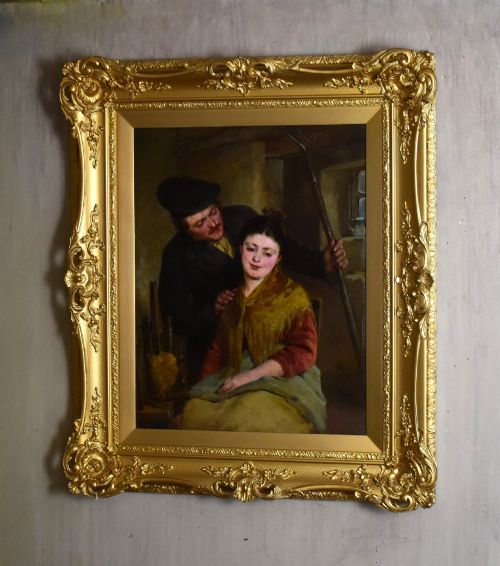
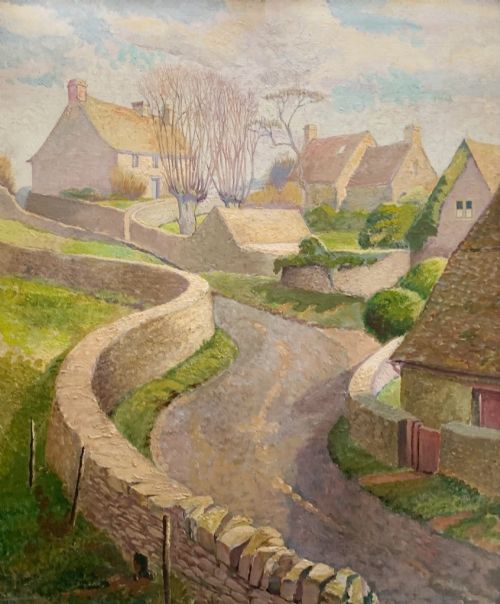
Country cottage canvas art encompasses oil paintings on canvas depicting rural dwellings, farmsteads, and pastoral landscapes. These works span the Victorian period, the nineteenth century, and twentieth-century revivals.
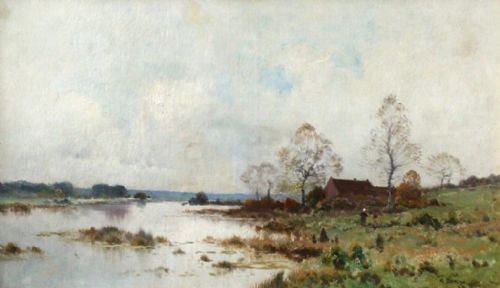
Buyers meet subjects ranging from thatched cottages and garden scenes to riverscapes and farmyards populated by figures and livestock. The selection includes signed works by known British and continental artists alongside unsigned historical studies.
The form stretches from intimate cabinet pieces to large gallery formats housed in period wooden frames.
How they were made
The works rely upon oil paint applied to woven canvas supports, often stretched over wooden frames and secured with gesso preparation layers. Artists worked in pigment to build texture and depth across pastoral scenes.
Many canvases sit within period frames constructed from wood, embellished with gilt wood or gold leaf finishes. The physical construction combines traditional stretcher joinery with layered oil media.
Several cottages share canvas space with an assortment of farmyard animals, including pigs, ponies, guinea pigs, rabbits, and dogs.
What varies in quality
Quality rests in the handling of light, brushwork confidence, and compositional balance rather than mere subject matter. Stronger examples demonstrate assured pigment application that captures atmospheric conditions and natural textures.
The integrity of the canvas support, original stretcher frames, and period gilt surrounds influence the standing of a piece. Works retaining their initial framing and stable paint surfaces hold greater visual coherence.
Robert John Hammond·Howard Helmick·Frederick James Knowles·William Greaves·Ernest Higgins Rigg·John Falconar Slater·Abraham Hulk Junior·Pierre Emmanuel Eugene Damoye·Harry Pennell·Ernest Walbourn·Herbert Royle·James William Stamper·Henry Singleton·George Morland·Robert Gallon·Thomas Thomas·Charles Hunt Jnr·John F Pasmore·Arthur Herbert Rigg·Walter Meegan·James Edwin Meadows·G R Vaughan
The Country Cottage Canvas Art Glossary
- Oil on Canvas
- A painting technique using pigments bound in a drying oil medium applied to a stretched cloth support. This combination allows for rich colour blending and textured brushwork.
- Gesso
- A plaster-like mixture applied to wooden frames or canvas surfaces to prepare them for gilding or painting. It creates a smooth, absorbent base for subsequent layers.
- Gilt Wood
- Carved timber finished with a thin layer of gold leaf or metallic powder. It provides a reflective decorative border common in period framing.
- Genre Painting
- Artwork depicting scenes from everyday life, typically involving ordinary people engaged in domestic or rural activities. These compositions often feature cottages and farmyards.
- Barbizon School
- A mid-nineteenth-century art movement focused on tonal realism and direct observation of nature. Painters associated with this group favoured rural landscapes and pastoral settings.
Country Cottage Canvas Art: Frequently Asked Questions
What periods do these paintings date from?
The works span the eighteenth, nineteenth, and mid-twentieth centuries, with strong representation from the Victorian era and the Edwardian period.
Dates are determined by stylistic evidence, signatures, and framing methods typical of those decades.
Are these works original oil paintings?
Every piece recorded here is an original oil painting executed on canvas or wooden panel supports.
They are handmade artworks rather than modern reproductions or prints.
How should I hang and light an oil painting?
Mount the canvas securely on a wall away from direct sunlight, heating vents, and damp environments to protect the oil medium and wooden stretcher.
Use picture lights with low heat output to illuminate the surface without causing thermal stress to the paint layers.
How do I identify different landscape styles?
Victorian landscapes often feature detailed realism and narrative elements, whereas Impressionist and Barbizon works focus on loose brushwork and atmospheric light.
Examining the handling of foliage and skies reveals the aesthetic priorities of the period.