
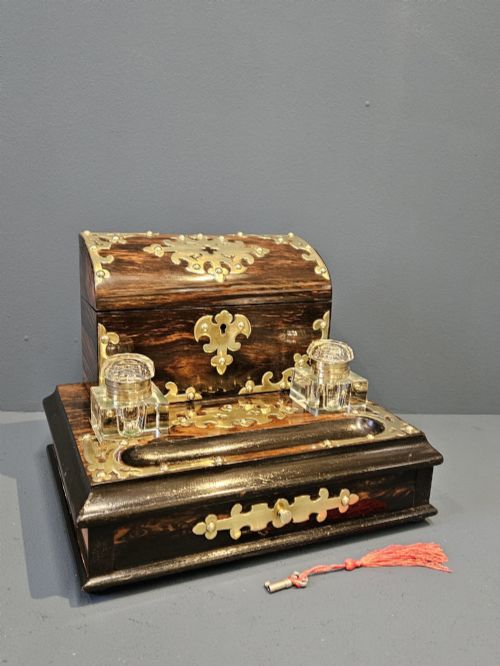


Coromandel Wood Stationery Box
These coromandel wood stationery box pieces combine dense tropical grain with resilient brass mountings, offering a secure and handsome desk storage solution.
Coromandel Wood Stationery Box
A coromandel wood stationery box is a desk accessory designed to hold correspondence, paper, and writing implements securely in a domestic or campaign setting. These pieces appear most frequently from the Victorian period, spanning the nineteenth century alongside occasional Regency examples.
The objects take several distinct forms on this page, including dome-topped caskets, drop-front cabinets, and letter boxes. Many incorporate fitted interiors for inkstands, pens, and smaller keepsakes.
Makers such as Houghton and Gunn, Mechi and Bazin, and C.G. Hope Hastings produced refined examples during the nineteenth century. The materials commonly paired with the timber include brass, mother-of-pearl, abalone, ceramic, and ormolu.
How they were made
Makers constructed these boxes using dense coromandel wood over a sturdy carcass, often applying brass banding to reinforce the edges and corners against heavy travel. Inlays of mother-of-pearl, abalone, and pietra dura decorate the exterior surfaces.
Gothic revival forms utilise domed tops and architectural brass mounts to create a formal appearance. Ormolu mounts and ceramic plaques further embellish the finer nineteenth-century examples.
Listings feature pieces spanning the Regency period through the late Victorian nineteenth century, predominantly constructed from coromandel wood with brass and mother-of-pearl.
What varies in quality
The depth of the grain figure in the coromandel wood and the precision of the brass binding set the standard for each piece. Fine boxes display meticulous inlay work in mother-of-pearl or pietra dura rather than simple surface decoration.
The complexity of the interior fittings, such as integrated inkstands, letter racks, and secret drawers, distinguishes standard utilitarian boxes from elaborate maker-signed pieces.
Houghton and Gunn·Mechi and Bazin·C.G. Hope Hastings
The Coromandel Wood Stationery Box Glossary
- Coromandel
- A dense, heavily figured tropical hardwood prized for its dark brown colour and striking black striping. It was frequently used for luxury nineteenth-century boxes.
- Pietra dura
- An artistic technique of inlaying cut and fitted polished coloured stones to create pictures or geometric designs. It appears on select Victorian desk boxes.
- Ormolu
- Gilt bronze mounted onto furniture and desk accessories for decorative effect. It provides a bright metallic contrast to the dark timber.
- Writing slope
- A portable box with a sloping lid designed to provide a slanted surface for handwriting. Many include compartments for stationery and ink.
- Stationery casket
- A box specifically proportioned to hold envelopes, writing paper, and letters upright. They often feature hinged lids or drop fronts.
Coromandel Wood Stationery Box: Frequently Asked Questions
What is a coromandel wood stationery box used for?
These boxes served to keep letters, envelopes, and writing paper organised on a desk or in a study. They provided a secure, lidded enclosure to protect correspondence from dust and loss.
Many examples included dedicated slots for letters alongside compartments for inkwells, pens, and wax seals, functioning as complete portable writing stations.
How do I date a coromandel stationery box?
Dating relies on stylistic clues and construction methods, with the vast majority originating in the Victorian era during the nineteenth century. Regency examples from the early nineteenth century tend to show simpler, classical lines.
Maker stamps, brass lock signatures, and registration marks offer more precise chronological markers when present on the hardware or interior linings.
How do I care for coromandel wood?
Keep the wood away from direct sunlight and heat sources to prevent the dense timber from splitting or warping over time. A light application of appropriate wax polish maintains the lustre of the grain.
Take care around brass mounts and mother-of-pearl inlays during cleaning, using a soft, dry cloth to avoid moisture accumulation in the joints.
What is the difference between a stationery box and a writing slope?
A stationery box is built to store paper, envelopes, and correspondence upright or flat within a compact cabinet or casket. These often feature drop fronts or vertical dividers.
A writing slope opens to reveal an angled surface designed specifically for resting paper upon while writing a letter, housing inkwells and pens inside the lower body.