




Cornish Coastal Landscape
These cornish coastal landscape works capture the rugged fishing ports, tidal harbours and Atlantic light of the far south-west.
Cornish Coastal Landscape
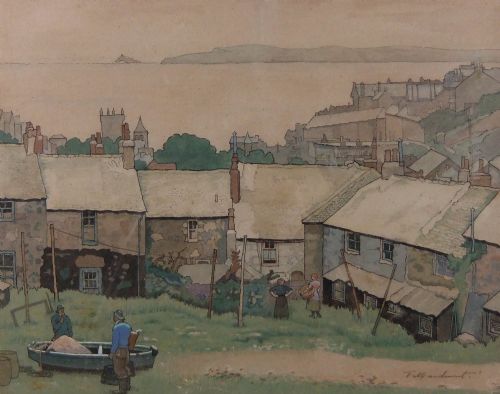
A cornish coastal landscape records the working harbours, granite cliffs and shifting light of fishing communities such as St Ives, Newlyn and Polperro. The examples met on this page span from the Victorian period through mid-century British art movements.
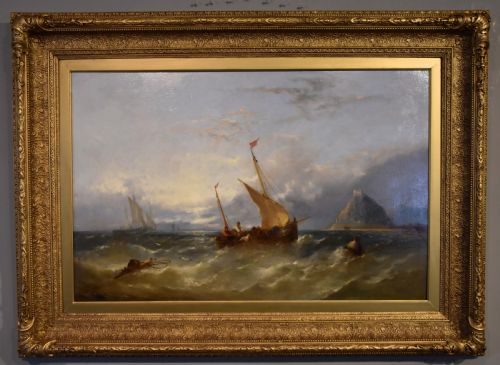
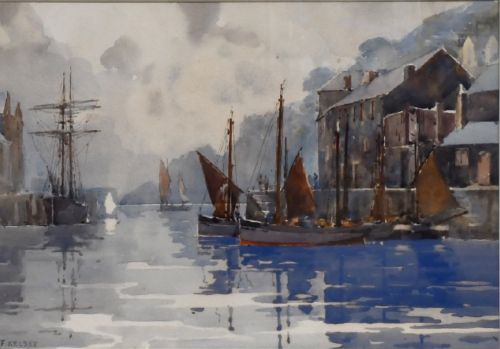
Most pieces take the form of framed paintings, capturing maritime scenes en plein air or within established artists' colonies. Subjects range from fishing boats moored in tidal estuaries to dramatic shipwrecks off rocky strands.
The selection reflects both local topography and stylistic shifts across decades, moving from detailed Victorian maritime traditions toward the looser brushwork of the Newlyn and St Ives schools.
Materials and methods
Artists relied primarily on oil paint applied to canvas or wood panels, alongside watercolour on paper for lighter studies executed directly beside the shore. Gilt wood frames frequently house these works, preserving the edges and complementing the palette.
The technique often involved painting en plein air to capture transient weather conditions, salt spray and changing coastal illumination. Brushwork ranges from tight academic precision to rapid, impressionistic application that emphasises movement and atmosphere.
Listings feature works executed in oil paint, watercolour and pastel on canvas, paper and wood.
Distinguishing quality
Quality rests in the artist's ability to render the specific weight of Atlantic skies and the character of Cornish granite without lapsing into formulaic topographical illustration. Superior works demonstrate confident handling of light reflecting off water and accurate observation of maritime architecture.
The strength of the composition and the integrity of the original framing also separate accomplished studio and plein air pieces from standard decorative views.
Sidney A Court·William Banks Fortescue·Thomas Maidment·William Henry Williamson·Frank Kelsey·George F Pennington·Edward Matthew Elliott·Gyrth Russell·George Turland Goosey·Charles Sim Mottram·William Pitt·Ernest F Hill·Frederick Stuart Richardson·William Lambert Bell·Jack R Mould·Walter Sweet·S J Lamorna Birch·Cuthbert Crossley·William Edward Webb
The Cornish Coastal Landscape Glossary
- En plein air
- Painting outdoors to capture direct observation of natural light and weather. This practice defined much of the work produced by coastal art colonies.
- Newlyn school
- An art colony based in the Cornish fishing village from the late nineteenth century onwards. Artists focused on naturalistic depictions of local life and coastal scenes.
- St Ives school
- A later grouping of artists associated with the Cornish port who embraced various forms of modernism and impressionism. Their output shaped twentieth-century British art.
- Watercolour
- A paint consisting of pigment suspended in a water-based solution, typically applied to paper. It allows for transparent washes well suited to coastal mist and sea spray.
- Maritime
- Pertaining to the sea, shipping and coastal navigation. These subjects dominate nineteenth-century views of harbours and shipwrecks.
Cornish Coastal Landscape: Frequently Asked Questions
What subjects appear most often?
Harbours, fishing trawlers, rocky coves and tidal inlets across Cornwall dominate the compositions. Views frequently feature named locations such as St Ives, Polperro and St Michael's Mount.
Artists also recorded everyday maritime labour, boat building and the dramatic effects of weather along the south-western coastline.
How do I date these works?
Signatures, framing styles and recorded biographical dates for the artists provide the primary chronological clues. Shifts in artistic movement, from Victorian academic realism to twentieth-century impressionism, also help place a piece.
Material choices, such as the type of canvas stretcher or paper watermark, offer further confirmation of the period.
Were these painted on site?
Many coastal works were executed en plein air directly beside the harbour or cliffs to capture authentic weathering and light. Artists often used smaller watercolour blocks or wood panels for these rapid outdoor studies.
Larger canvases were frequently finished or developed further within studio spaces based on initial sketches.
How should I display them?
These works suit traditional or contemporary interiors where natural light can illuminate the brushwork and paper surfaces. Direct sunlight should be avoided to prevent fading, particularly for watercolours on paper.
Keeping paintings away from damp walls ensures the canvas, wood and gilt frames remain stable over time.