


Continental Fall Front Cabinet
A continental fall front cabinet offers a hinged writing flap that conceals fitted drawers, combining display or storage with a compact workspace.
Continental Fall Front Cabinet
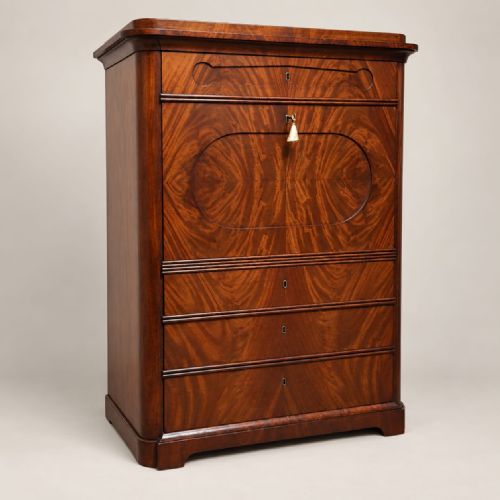
A continental fall front cabinet serves as a dual-purpose piece of furniture that functions primarily as a desk when the writing flap is lowered. These pieces appear across several centuries and regions, encompassing forms such as escritoires, secretaire chests, and bureau bookcases.
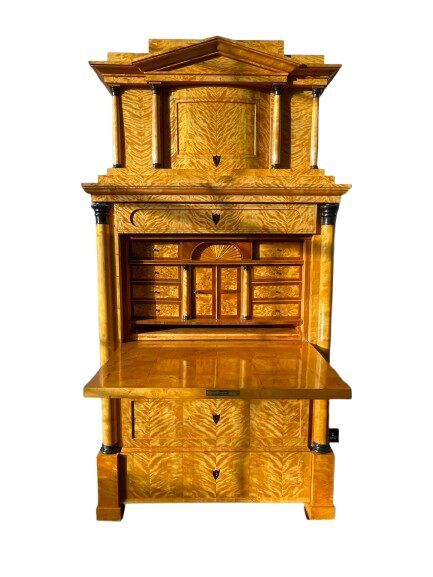
The version most commonly encountered on this page is the Biedermeier secretaire, frequently rendered in mahogany or birch with clean architectural lines. Alongside these, buyers find earlier walnut examples from South German and Dutch baroque traditions, as well as pine country pieces.
Materials and construction
Cabinetmakers utilised dense timbers like mahogany, walnut, and fruitwood, often laid over pine carcases, alongside specialised veneers such as Karelian birch. Surface decoration relied heavily on marquetry inlay and contrasting ebonised wood details to create visual depth.
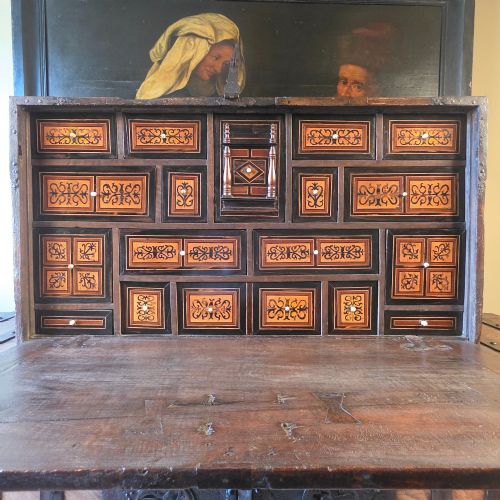
Internal compartments frequently incorporated secret drawers, pigeonholes, and small cupboards accessed by lowering the central abattant flap, requiring precise joinery and brass hardware fittings.
Listings feature eighteenth-century walnut bureau bookcases alongside nineteenth-century mahogany Biedermeier secretaires and pine country pieces.
Assessing craftsmanship and execution
The grade of a continental fall front cabinet depends on the selection of timber veneers and the intricacy of the internal pigeonholes and concealed compartments. Superior examples display seamless grain alignment across the falling front and crisp execution of marquetry or inlay work.
Structural integrity of the hinged writing surface and the smoothness of the internal drawer mechanisms separate standard utility furniture from pieces exhibiting finer cabinetmaking standards.
Joseph II the Holy Roman Emperor
The Continental Fall Front Cabinet Glossary
- Fall front cabinet
- A piece of furniture featuring a hinged writing flap that opens forward to reveal a fitted interior of small drawers and pigeonholes.
- Secretaire a abattant
- A tall cabinet with a vertical front panel that drops down to form a writing surface, hiding internal compartments.
- Escritoire
- A small writing cabinet or desk, often fitted with drawers and a sloping or falling front.
- Biedermeier
- A style of Central European furniture spanning the nineteenth century, characterised by utilitarian comfort and clean lines using native woods.
- Marquetry
- Decorative veneer work inlaid into the wood surface to form geometric patterns or pictorial designs.
- Block front
- A piece of furniture whose front is divided into three vertical panels, with the exterior sections raised and the centre recessed.
Continental Fall Front Cabinet: Frequently Asked Questions
What is a continental fall front cabinet?
A continental fall front cabinet is a tall storage piece featuring a hinged writing panel that drops down to create a desk surface. Behind this flap lie various small drawers and compartments.
These cabinets span styles from seventeenth-century baroque to nineteenth-century Biedermeier, serving both decorative and practical writing functions.
How do I identify a Biedermeier secretaire?
Biedermeier secretaires typically date from the nineteenth century and showcase minimal ornamentation, relying instead on the natural grain of timbers like mahogany, walnut, and Karelian birch.
They emphasise clean architectural proportions and functional interiors rather than heavy carving.
Where were these cabinets made?
These pieces originate from various regions across continental Europe, including Germany, the Netherlands, and Eastern Europe. Different areas developed distinct regional aesthetics, such as Dutch marquetry or South German baroque walnut work.
Pine versions were also produced as country furniture in broader continental areas.
What is inside the falling front?
The interior behind the fall front typically contains an arrangement of small pigeonholes and letter slots surrounding a central small cupboard. Many examples also incorporate secret or hidden drawers accessed by removing internal fittings.
This fitted section converts the upper portion of the cabinet into a compact writing desk.