

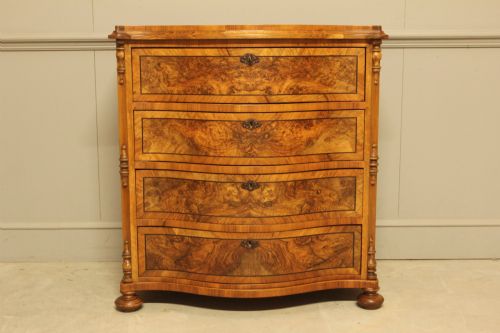

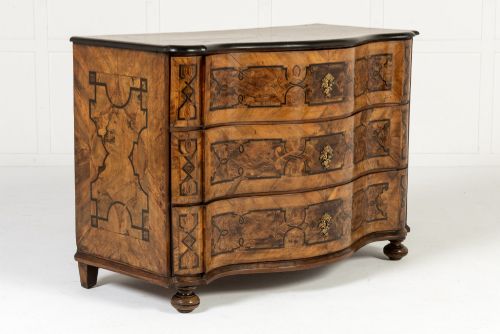
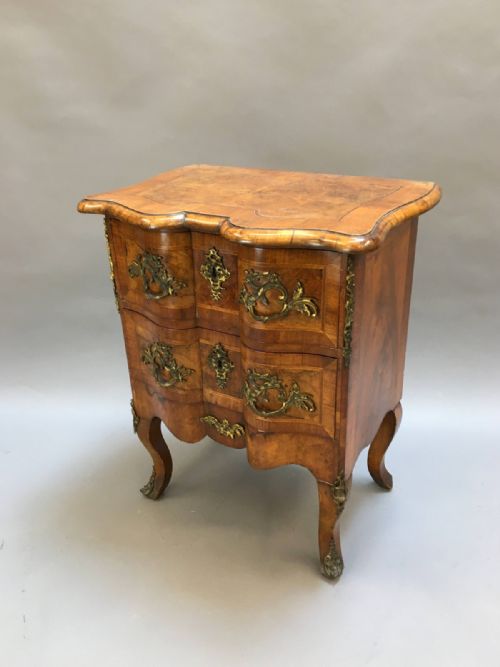
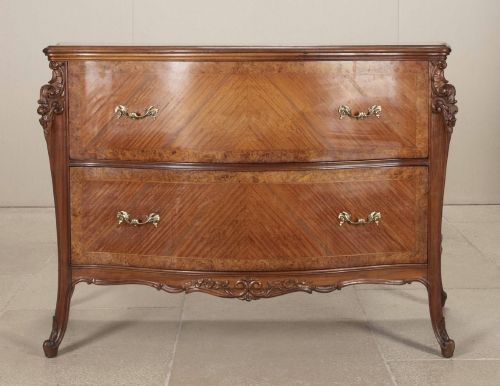


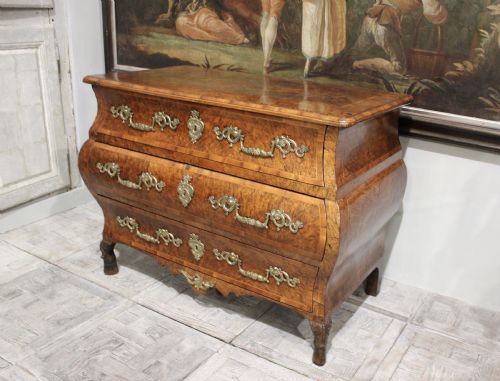
Continental Burr Walnut Commode
A continental burr walnut commode brings deep, swirling wood figure and serpentine presence to a room, offering both generous storage and rich visual weight.
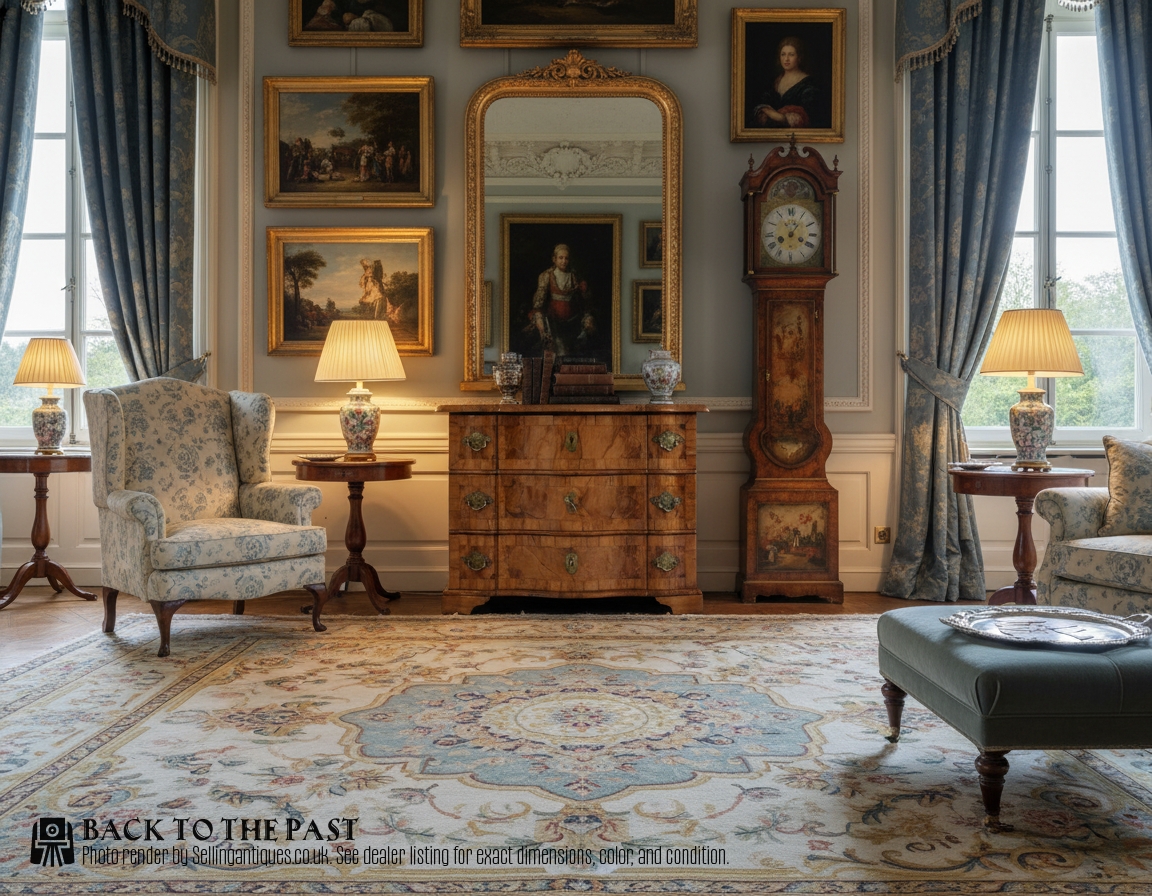
Continental Burr Walnut Commode
A continental burr walnut commode is a low chest of drawers defined by rich veneers and curved timber forms originating from workshops across Europe. When searching this phrase, buyers encounter substantial case furniture primarily built during the eighteenth and nineteenth centuries.
The versions most commonly met on this page include eighteenth-century Dutch, German, and Italian examples alongside nineteenth-century revivals and Biedermeier interpretations. These pieces function as decorative focal points in principal rooms while providing deep drawer capacity.
Makers across Italy, Germany, France, Sweden, and the Netherlands shaped these commodes with serpentine fronts, bombe profiles, and straightforward chest proportions. Each region imparted distinct regional flair to the foundational burr walnut surface.
What varies in quality
Quality rests principally in the selection and bookmatching of the burr walnut veneer across the drawer fronts and top surface. Superior examples display symmetrical grain patterns that flow seamlessly around keyholes and corners.
The sophistication of the carcase construction and the execution of serpentine or bombe curves dictate the structural ambition of the piece. Finer commodes integrate subtle secondary woods and precise inlay work that elevate the overall presence.
Continental Burr Walnut Commode Retail Price Guide 2026
Typical asking prices for continental burr walnut commode among the pieces listed under this phrase on Sellingantiques today, from the lower quarter to the upper quarter. They describe what is for sale here now, not the wider market.
Listings span from the early eighteenth century through the nineteenth century, incorporating oak, pine, and fruitwood carcases beneath burr walnut veneers.
The Continental Burr Walnut Commode Glossary
- Burr walnut
- A veneer sliced from the knotty growth of a walnut tree, prized for its swirling, intricate grain patterns. It creates highly decorative surfaces on eighteenth and nineteenth-century case furniture.
- Serpentine
- A front or top edge shaped with a central convex curve flanked by two concave curves. This fluid line softens the mass of large wooden chests.
- Bombe
- A swollen or bulging profile where the sides and front of a commode curve outward dramatically. This complex shape demands advanced cabinetmaking skill.
- Biedermeier
- A Central European style from the mid-nineteenth century prioritising clean lines, minimal ornamentation, and pale figured woods. It strips away baroque excess in favour of domestic warmth.
- Ormolu
- Gilded bronze mounts and decorative hardware applied to furniture. It adds metallic contrast against dark timber veneers.
Continental Burr Walnut Commode: Frequently Asked Questions
How do I clean a burr walnut commode?
Dust the surface regularly with a soft, dry cloth to prevent particulate accumulation in the veneer crevices. Apply a quality microcrystalline wax sparingly once or twice a year to nourish the timber.
Avoid placing these chests near direct heat sources or strong sunlight, which can dry out the old timbers and cause the delicate veneers to lift.
Where should I place a commode in my home?
These low chests sit comfortably in reception rooms, large hallways, or bedrooms where their decorative fronts can be fully appreciated. Their substantial surface area also provides a natural staging ground for lamps or decorative objects.
Ensure the room maintains stable humidity levels to protect the historic wood and prevent warping in the primary carcase.
How do I tell an 18th-century commode from a 19th-century revival?
Eighteenth-century pieces typically show hand-cut joinery, native secondary woods appropriate to their specific European region, and natural wear patterns within the drawer linings. Their proportions and carving styles reflect the baroque or rococo movements of their origin.
Nineteenth-century revival pieces often utilise more standardised construction methods while faithfully copying earlier serpentine and bombe forms.
What is the difference between a chest of drawers and a commode?
While both provide tiered drawer storage, the term commode historically denotes a more ornamental, low French-derived cabinet designed for formal rooms. They frequently feature elaborate serpentine or bombe shaping rather than strict rectangular proportions.
Many continental makers adopted this continental form to showcase their finest burr walnut veneers and decorative hardware.