
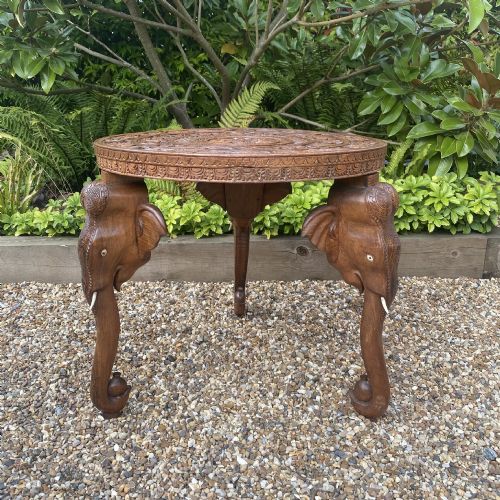
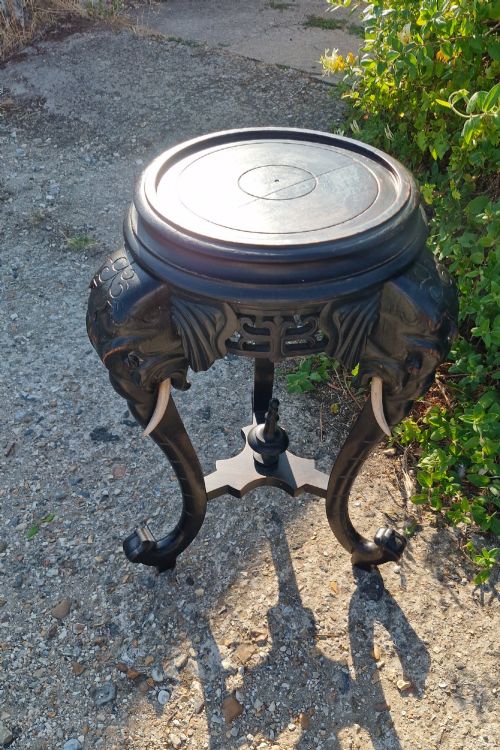
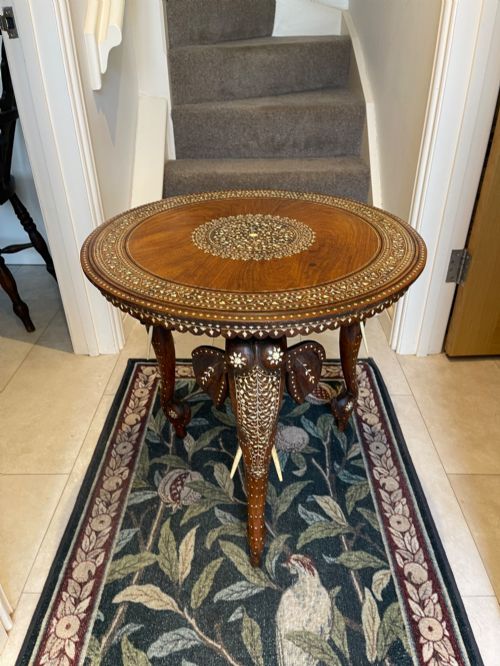
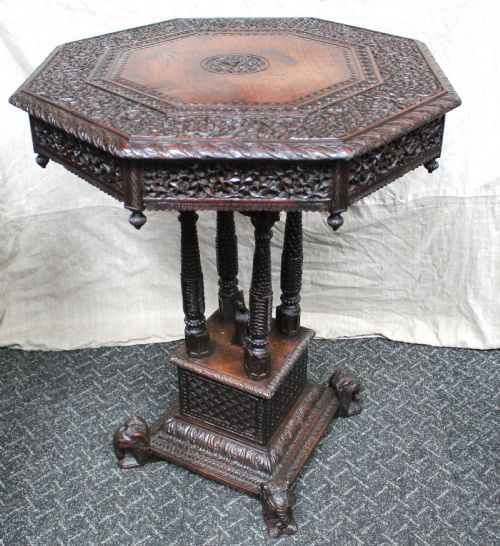


Colonial Carved Elephant Table
These colonial carved elephant table examples bring distinct nineteenth-century Anglo-Indian and Burmese craftsmanship into a room.
Colonial Carved Elephant Table
When you search for a colonial carved elephant table, you are looking at occasional furniture, side tables, and centre pieces fashioned with animal supports or motifs.
The versions most likely to meet you on this page date from the late nineteenth century through to the early decades of the twentieth century, originating from regions such as Bombay and Hoshiarpur.
These forms range from small circular occasional pieces to octagonal trays and solid rosewood or teak stands, often incorporating structural elephant heads and legs.
How they were made
Carpenters utilised dense tropical timbers including teak, rosewood, and ebonised hardwood to construct stable frames capable of supporting intricate surface carving.
Detailing was achieved through deep hand-carving and delicate bone inlay, occasionally complemented by painted wooden tusks.
Some Victorian examples feature painted wooden tusks alongside standard carved trunks.
What varies in quality
The distinction between standard examples and finer pieces lies in the crispness and depth of the carved motifs across the timber and the precision of any bone inlay.
Weight and structural integrity also separate workshop outputs, with solid rosewood and teak variants offering superior longevity compared to softer painted woods.
The Colonial Carved Elephant Table Glossary
- Anglo-Indian
- A style of decorative arts produced during the British period in India, combining European furniture forms with local carving traditions. These pieces often feature dense foliate patterns and animal motifs.
- Hoshiarpur
- A Punjabi city renowned for intricate woodwork and inlay techniques. Items from this centre typically display complex geometric patterns in bone.
- Rosewood
- A heavy, durable timber prized for its rich grain and dark colour. It provides a solid foundation for deep relief carving.
- Bone Inlay
- A technique where small pieces of bone are set into recesses within the wooden surface to create contrasting patterns. It appears frequently on tables from specific northern workshops.
- Occasional Table
- A small, movable table designed for specific, intermittent use in a reception room or parlour. These forms dominate the available selection.
Colonial Carved Elephant Table: Frequently Asked Questions
What is an elephant table?
An elephant table is a low or occasional table supported by carved elephant figures, heads, or legs. They were produced during the nineteenth and early twentieth centuries in regions influenced by British colonial rule.
These pieces served functional roles as side tables, coffee tables, or centre pieces while displaying distinct regional carving techniques.
Where were these tables made?
The listings show origins spanning India, Burma, and Ceylon, with specific pieces attributed to centres such as Bombay and Hoshiarpur. Workshops in these areas adapted traditional motifs for export and local colonial markets.
Cabinetmakers utilised locally available dense timbers like teak and rosewood to construct the frames.
How old are these tables?
The pieces seen here predominantly date from the Victorian era up to the 1920s, encompassing the nineteenth and early twentieth centuries. Specific dates span from the 1870s through to the interwar period.
Stylistic markers and construction methods help align individual tables within this broad timeframe.
How do I live with one?
These tables function well as side tables or plant stands in traditional or eclectic interiors. Their dark timbers and carved details provide a strong visual anchor in a room.
Placement should avoid direct sunlight and extreme temperature shifts to protect the dense hardwoods and any inlaid bone elements.