

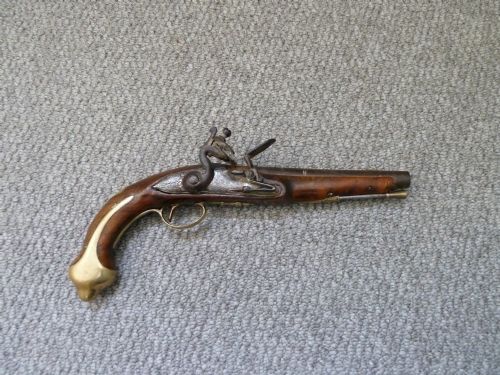


Collectible Flintlock
Collectible flintlock arms combine mechanical ingenuity and historical theatre, offering tangible links to eighteenth and nineteenth century conflicts.
Collectible Flintlock
Collectible flintlock pieces encompass functional firearms, military sidearms, and related militaria spanning the eighteenth and nineteenth centuries. Buyers encounter pocket pistols, heavy military muskets, and blunderbusses originating from English, French, Belgian, Ottoman, and Irish workshops.
Pocket pistols and overcoat variations designed for civilian self-defence appear alongside regulation military equipment from the Georgian and Napoleonic eras. These domestic forms frequently display decorative elements like silver wire inlay or turn-off cannon barrels, contrasting with utilitarian service pieces.
Materials and Construction
Makers constructed these mechanisms predominantly using forged steel, iron, and brass fitted to stocks of figured walnut or other dense wood. Metal components often received engraved or cast decoration, while high-status pieces incorporated silver mounts and gold inlay.
The ignition system relied on a flint held in the cock striking a steel frizzen to generate sparks into a priming pan. Barrel production involved shaping iron or brass into smoothbore or cannon profiles, sometimes bearing official London proof marks.
Collectible Flintlock Retail Price Guide 2026
Typical asking prices for collectible flintlock among the pieces listed under this phrase on Sellingantiques today, from the lower quarter to the upper quarter. They describe what is for sale here now, not the wider market.
Some pocket pistols hid their identity inside a coat pocket, ready to discourage highwaymen with a sudden flash of brass.
Evaluating Quality and Origin
Distinctions in quality rest upon the crispness of the lock mechanism, the integrity of the wooden stock, and the prominence of the maker's signature. Examples bearing legible signatures from established London or provincial makers command greater interest than unsigned utilitarian arms.
The survival of original surface finishes, unpolished brass or steel components, and intact decorative wire or silver inlays elevate specific pieces. Evidence of conversion from flintlock to percussion systems alters the historical status of a piece.
Henry Nock·James Barber·Thomas Henshaw·Timothy Hughes·John Rimes·Meyer And Mortimer·Barber Of Newark·Dutton
The Collectible Flintlock Glossary
- Flintlock
- An ignition mechanism utilising a piece of flint held in a cock to strike a steel frizzen and produce sparks. This system dominated firearms design from the early seventeenth century until the mid-nineteenth century.
- Cannon barrel
- A barrel shaped with a flared muzzle resembling a naval cannon, common on eighteenth-century pocket pistols. This design allowed the barrel to be unscrewed for loading.
- Frizzen
- The vertical steel plate struck by the flint to create sparks and uncover the priming pan. Grooved versions appear on specific regional lock mechanisms.
- Bore
- The interior diameter of the firearm barrel, determining the size of projectile used. Measurements are typically expressed in standard bore sizes.
- Proof marks
- Official stamps struck onto the barrel to signify successful pressure testing. London proof marks indicate inspection by the local gunmakers' company.
Collectible Flintlock: Frequently Asked Questions
How do I identify a flintlock period?
Dating relies on stylistic markers, proof marks, and mechanical evolution. Eighteenth-century arms typically exhibit distinct cock profiles and stock contours compared to later nineteenth-century examples.
Maker signatures and London proof marks help narrow production dates to specific decades. Comparing form against documented military patterns provides further chronological context.
Are these pieces functional?
While the mechanical lockwork on many surviving examples remains intact, evaluating functionality requires professional inspection. Most collectors treat these items as historical artefacts rather than shooting pieces.
Display and preservation take priority over operation to protect fragile wood and steel components. Consulting a specialist is essential before attempting any mechanical action.
Why do some pistols have silver mounts?
Silver wire inlay, mounts, and plaques denoted high status and bespoke craftsmanship. Makers applied these decorative elements to appeal to affluent civilian clients.
Irish and English pocket pistols frequently display intricate silver wire work on the walnut stocks. Such ornamentation elevates the aesthetic value beyond standard military issue.