


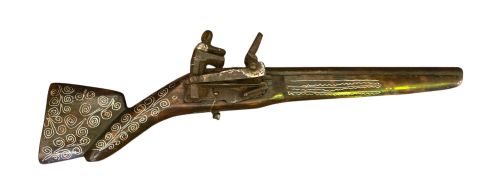


Collectable Flintlock Handgun
A collectable flintlock handgun is a historic muzzle-loading firearm valued for its mechanical ingenuity and period craftsmanship.
Collectable Flintlock Handgun
A collectable flintlock handgun comprises historic muzzle-loading firearms spanning the eighteenth and nineteenth centuries, including military regulation arms and civilian pocket weapons. Buyers exploring this category will encounter English, continental European, and Ottoman examples featuring distinct mechanical and decorative qualities.
The selection ranges from robust sea service and cavalry pieces to refined pocket pistols and officer sidearms. Most items originate from the eighteenth century, the Georgian period, and the Napoleonic era, reflecting the dominant manufacturing styles of those decades.
How they were made
Gunsmiths utilised forged steel and iron for barrels and lock mechanisms, pairing these metal components with stocks fashioned from walnut or other dense hardwoods. Structural integrity relied on precise smithing and hand-fitting of internal springs and triggers.
Decoration often involved intricate silver wire inlay, cast brass mounts, and gilt decoration applied to barrels and lockplates. Makers signed their work on the lockplate or barrel, employing techniques such as engraving and silver parquetry to distinguish higher-status pieces.
Collectable Flintlock Handgun Retail Price Guide 2026
Typical asking prices for collectable flintlock handgun among the pieces listed under this phrase on Sellingantiques today, from the lower quarter to the upper quarter. They describe what is for sale here now, not the wider market.
Pocket pistols were small enough to slip into a gentleman's muff or overcoat pocket for a quiet evening stroll.
What varies in quality
Quality rests on the crispness of the lock mechanism, the integration of metal and wood, and the refinement of any decorative embellishments. Superior pieces exhibit harmonious proportions, clean maker signatures, and original mounts without replacement parts.
The skill of the maker and the intended use of the firearm heavily influence its execution. Military regulation arms prioritise robust utility, whereas civilian pocket pistols and officer pieces display finer engraving, precious metal inlays, and carefully figured walnut stocks.
Henry Nock·James Barber·Timothy Hughes·John Rimes·Meyer and Mortimer·Dutton
The Collectable Flintlock Handgun Glossary
- Flintlock
- A firearm ignition mechanism that uses a flint struck against a steel frizzen to generate sparks for gunpowder ignition.
- Cannon barrel
- A barrel shaped with a flared muzzle resembling a small cannon, commonly found on eighteenth-century pocket pistols.
- Bore
- The interior diameter of the firearm barrel, which determines the size of the projectile it fires.
- Frizzen
- The vertical steel plate struck by the flint during the ignition sequence to produce sparks.
- Turn-off
- A barrel design that unscrews from the breech to allow front-loading, frequently utilised on pocket pistols.
Collectable Flintlock Handgun: Frequently Asked Questions
How do I care for a flintlock pistol?
Keep the metal lightly oiled and store the firearm in a stable, dry environment to protect the wooden stock and steel mechanism.
Avoid exposing the piece to moisture or rapid temperature changes, which can damage the aged timber and iron components.
Were these pistols used in combat?
Many examples served military and naval roles, while others functioned as civilian personal defence weapons for travel.
Military patterns saw active service during the Napoleonic era, whereas pocket pistols were carried by individuals for protection.
How can I tell the period?
Stylistic indicators, proof marks, and the design of the lock mechanism help determine the decade of production.
Georgian and Napoleonic pieces often feature distinct barrel shapes, mount styles, and maker signatures characteristic of their era.
What is a snaphaunce?
A snaphaunce is an early type of flintlock mechanism featuring a manually operated pan cover independent of the frizzen.
This system represents an earlier stage in the evolution of firearm ignition before the integrated flintlock became standard.