
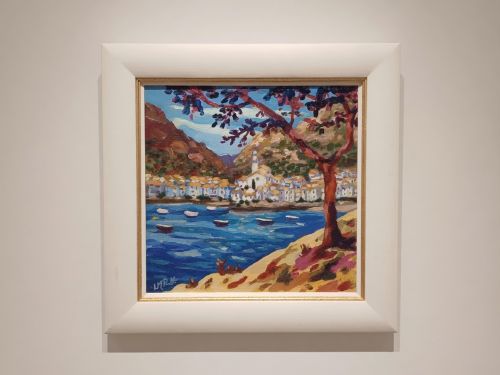
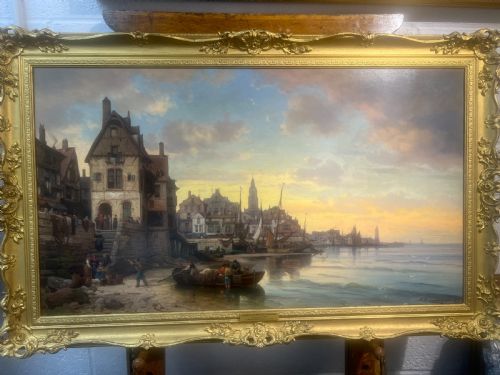


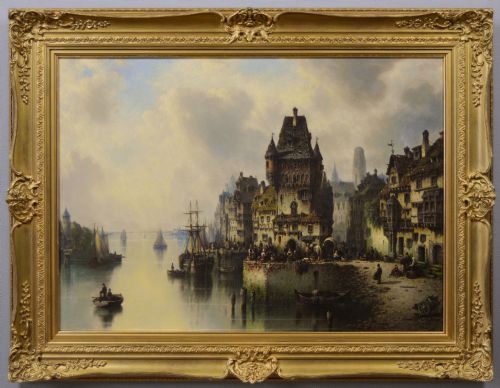


Coastal Town Harbour Scene
A coastal town harbour scene captures maritime life on canvas or paper, offering buyers a window into bustling ports and quiet inlets alike.
Coastal Town Harbour Scene
A coastal town harbour scene brings together land and sea, depicting ports, quaysides and maritime architecture across various eras. These works range from Victorian watercolours of moored yachts to later twentieth-century interpretations of British and continental harbours.
Buyers encountering this search phrase will find paintings executed in oil and watercolour, framed in wood and gold leaf. The examples available span the nineteenth century, the nineteen-twenties, nineteen-thirties, and periods later than nineteen-sixty.
The assortment includes specific topographical views such as Whitby and the Firth of Forth alongside continental townscapes. These pieces represent distinct artistic movements including nineteenth-century realism, Scottish school, and contemporary impressionism.
Materials and methods
Artists create these coastal works primarily using oil paint or watercolour applied to canvas, paper, or wooden supports. Oil paint allows for rich, textured layering, whereas watercolour provides a lighter, more translucent quality well suited to maritime light.
Many of these paintings are completed with gold leaf highlights applied to the framing or details within the work. The physical mediums are framed in wood, preserving the integrity of both canvas and paper pieces.
Several artists packed their watercolours to sketch bustling quaysides where ships and Abbeys shared the same salty horizon.
Assessing quality and execution
Quality in these maritime works rests on the artist's handling of light, atmosphere, and architectural precision within the harbour setting. Finer examples demonstrate a confident command of perspective, capturing the bustle of ships and townscapes with distinct brushwork.
The integration of the supporting materials, such as the choice of canvas versus paper and the condition of the wooden framing, also influences the overall standard. Works that retain their original colour intensity and compositional balance command greater appreciation.
Lucy Pratt·Charles Euphraisie Kuasseg·James Thomas Watts·Ludwig Hermann·Fred Lawson·Donald Wood·Augustus William Enness
The Coastal Town Harbour Scene Glossary
- Watercolour
- A painting method in which the paints are made of pigments suspended in a water-based solution. Applied to paper, it creates translucent washes of colour.
- Oil on Canvas
- A medium utilising pigments bound in a drying oil, applied to a stretched cloth surface. This combination allows for depth of tone and reworkable textures.
- Gold Leaf
- Gold beaten into extremely thin sheets used for gilding frames and decorative elements. It adds a reflective quality to the presentation of the artwork.
- Townscape
- An artistic representation of the physical aspects of a city or urban area. In maritime contexts, it focuses on harbour buildings and quaysides.
Coastal Town Harbour Scene: Frequently Asked Questions
What periods do these paintings cover?
The works span from the nineteenth century through the nineteen-twenties and thirties up to periods later than nineteen-sixty.
This broad timeline encompasses Victorian maritime art as well as twentieth-century British and continental movements.
Where do the depicted harbours come from?
Representations include specific British locations like Whitby and the Firth of Forth alongside continental European townscapes.
Artists record both domestic maritime hubs and foreign ports observed during their travels.
What materials support these artworks?
The pieces utilise canvas, paper, and wood as their primary physical supports for oil and watercolour media.
Gold leaf frequently appears in the decorative presentation of these framed scenes.
How do styles differ across the works?
Styles range from nineteenth-century realism and Victorian maritime traditions to contemporary impressionism and twentieth-century British schools.
Each movement brings a distinct interpretation to the depiction of coastal architecture and harbour activity.