
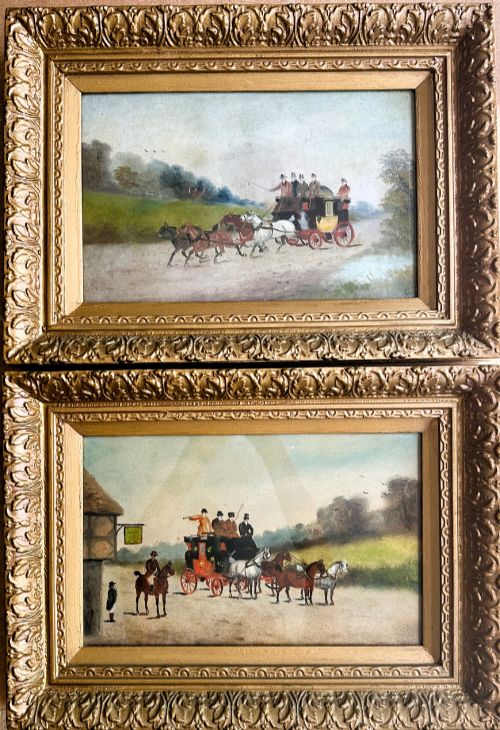


Coaching Scene Oil Painting
A coaching scene oil painting captures the motion and colour of traditional British travel before the arrival of the railway.
Coaching Scene Oil Painting
When you examine a coaching scene oil painting, you are looking at works that celebrate horses, stagecoaches, and rural posting inns. The selection here leans heavily towards nineteenth-century examples and the Edwardian era, showing teams of horses pulling royal mail carriages or negotiating winter snowstorms.
Most pieces on this page stem from the Victorian period through to the early decades of the twentieth century. Traditional British sporting art forms the core of these offerings, depicting roadside drama, coaching inns, and hounds alongside the main carriage.
You will encounter single works as well as matched pairs, often framed in giltwood or gilt wood. The subjects range from bustling summer arrivals at coaching inns to hazardous winter journeys through snow drifts.
What varies in quality
Quality rests upon the artist's ability to render the anatomy of horses and the complex perspective of four-wheeled carriages at speed. Finer examples display meticulous brushwork in the harness details, human figures, and architectural backgrounds of roadside inns.
The handling of atmosphere and light also separates standard works from master pieces, particularly in challenging subjects like snowstorms where depth and shadow must remain convincing. Furthermore, the preservation of the original canvas and the condition of the accompanying giltwood frame influence the overall standing of the piece.
Stagecoaches frequently found themselves battling unexpected snowstorms, giving artists an excuse to paint dramatic drifts and shivering horses.
Philip Rideout·George Wright·Philip Henry Rideout·Samuel Henry Alken·John Charles Maggs·John Richard Worsdale·James Pollard·Philip H Rideout·Herbert St John Jones
The Coaching Scene Oil Painting Glossary
- Giltwood
- Wood carved and covered with a thin layer of gold leaf or gold paint. This material forms the ornate frames frequently found surrounding nineteenth-century paintings.
- Canvas
- A heavy woven fabric used as a surface for oil painting. It is stretched tightly across a wooden frame before the artist begins.
- Board
- A rigid flat panel used as a painting support instead of woven fabric. These grounds appear in various period works.
- Sporting art
- A genre of painting dedicated to horses, hounds, hunting, and coaching scenes. This tradition defines many British works from the Georgian and Victorian eras.
Coaching Scene Oil Painting: Frequently Asked Questions
What periods do these paintings come from?
The available selection spans the nineteenth century, the Victorian and Edwardian eras, up to the nineteen-twenties. Many works date specifically from the eighteen-eighties and nineteen-tens.
Earlier pieces touch upon the late Georgian and Regency styles, while later examples reflect traditional British sporting art persisting into the twentieth century.
What materials were used for these paintings?
Painters utilised oil paint on woven canvas or rigid board supports. These traditional mediums allowed artists to build rich textures and deep colour fields.
Many of these artworks retain their original giltwood or gilt wood frames, which complement the traditional subject matter.
Who are the notable artists behind these works?
The inventory includes signed pieces and attributed works by established equestrian and sporting painters. Names such as John Charles Maggs and Philip Rideout appear frequently across the collection.
Other recorded painters include George Wright, Samuel Henry Alken, James Pollard, and Herbert St John Jones.
How should I display a coaching painting?
These works suit traditional drawing rooms, studies, or hallways where their rich colour and narrative detail can be appreciated up close. Keep them away from direct sunlight to protect the oil pigments and the delicate gilt of the frames.
Pairing matching works together, as artists often intended, creates a balanced display on a suitably sized wall.