
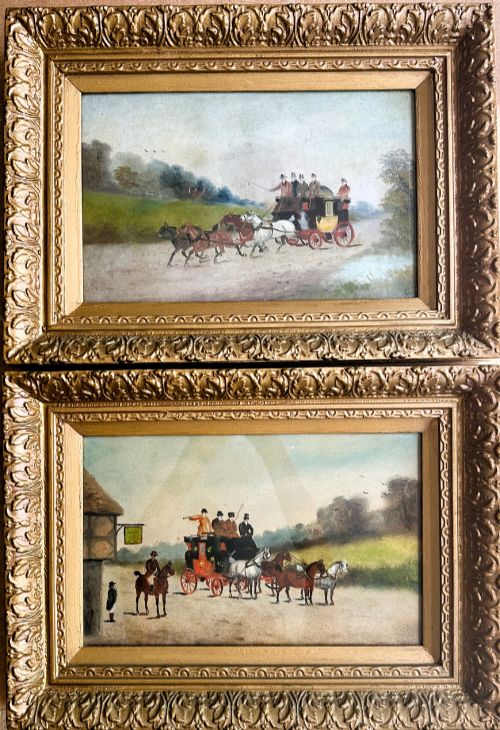


Antique Coaching Scene Painting
An antique coaching scene painting captures the movement and horses of the road, offering a glimpse into nineteenth-century travel.
Antique Coaching Scene Painting
An antique coaching scene painting depicts stagecoaches, mail carriages, and horses on the road, often set against winter snow or outside coaching inns. These works emerge primarily from the nineteenth century and the early twentieth century, spanning Victorian and Edwardian periods.
Buyers encounter oil paintings on canvas alongside watercolours and reverse glass paintings. Traditional British sporting themes dominate the selection, capturing the atmosphere of historical travel and roadside stops.
How they were made
Artists worked primarily with oil paint on canvas, applying pigments to build up horses, figures, and carriages. Giltwood and gilt wood frames frequently house these canvases, providing a formal border.
Alternative techniques include watercolour on paper and reverse painting on glass, where artists applied details directly to the reverse side of the glass panel.
Listings feature oil on canvas, watercolour, and reverse glass paintings from the 19th century, Edwardian period, and 1920.
What varies in quality
The precision in rendering horses in motion and the handling of atmospheric conditions, such as snowstorms or winter light, distinguish the work. Skilled composition balances the intricate details of the stagecoach with the surrounding landscape.
The condition of the canvas and the original framing contribute to the standing of the piece. Works retaining their period giltwood frames maintain greater visual integrity.
Philip Rideout·George Wright·Samuel Henry Alken·John Charles Maggs·John Richard Worsdale·Frank Dadd·John Atkinson·James Pollard
The Antique Coaching Scene Painting Glossary
- Oil on canvas
- Pigment mixed with drying oil applied to stretched fabric. This medium allows for rich colour depth and detailed brushwork.
- Reverse glass painting
- An artwork created by applying paint to the back of a glass panel so the image is viewed through the front. This technique produces a glossy finish.
- Giltwood
- Wood carved and covered with a thin layer of gold leaf or gilt. It is commonly found on traditional frames from the nineteenth century.
- Watercolour painting
- A method where paints are made of pigments suspended in a water-based solution. Artists use this on paper for lighter, translucent effects.
Antique Coaching Scene Painting: Frequently Asked Questions
What periods do these paintings come from?
The available works date primarily from the nineteenth century through the Edwardian era and up to 1920. Victorian and Georgian influences appear frequently across the selection.
Artists active during these decades produced detailed records of stagecoaches, mail carriages, and equestrian subjects.
What materials were used?
Painters relied on oil paint on canvas as the primary medium, supported by watercolour on paper and reverse glass painting techniques. Frames are often made of giltwood.
Paper and glass elements appear in specific decorative formats, while canvas serves the larger oil compositions.
Who painted these scenes?
Notable painters recorded in these works include John Charles Maggs, Philip Rideout, George Wright, and James Pollard. Their works focus on traditional British sporting subjects.
These artists specialised in capturing horses, carriages, and roadside inns during winter and fair weather.
How do snow scenes differ?
Winter and snowstorm compositions depict mail coaches caught in drifts or navigating difficult weather conditions. These scenes emphasise the struggles of travel on nineteenth-century roads.
The palette shifts to whites and greys to convey snow, contrasting with the dark tones of the horses and carriages.