




Club Chair and Sofa
These club chair and sofa groupings bring robust leather comfort and distinct period character to a room, offering deep seats built for everyday lounging.
Club Chair and Sofa
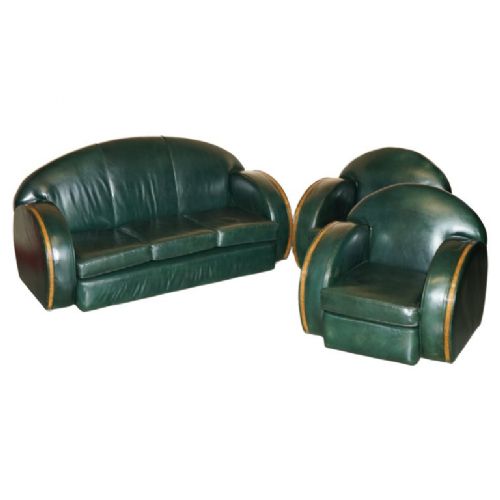
When you search for club chair and sofa combinations, you encounter substantial lounge suites and seating sets designed for relaxation. These groupings pair single armchairs with matching sofas, creating a cohesive seating arrangement for a room.
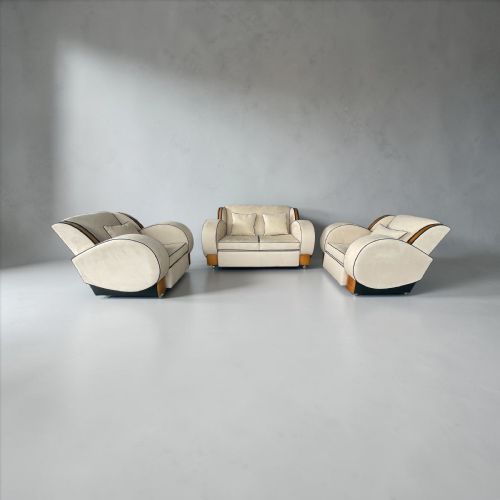
The selections available here span several distinct periods, reaching from Victorian and Edwardian iterations through to prominent Art Deco designs. You will frequently encounter three-piece suites and larger seating combinations originating from the nineteenth and early twentieth centuries.
Forms vary from buttonback seating and barrel backs to substantial cloud suites and lion hand carved chesterfield suites. Miniature apprentice pieces also appear, demonstrating the same form on a smaller scale.
How they were made
Construction relies heavily on sturdy timber and walnut frames, providing the underlying structure for heavy upholstery. Wood and walnut veneer form the foundations of these substantial frames.
Upholstery makes extensive use of leather, velvet, and fabric to cover the deep cushioning. Brass details and hand-carved wooden elements, such as lion carvings, often adorn the frames and finishes.
Club Chair and Sofa Retail Price Guide 2026
Typical asking prices for club chair and sofa among the pieces listed under this phrase on Sellingantiques today, from the lower quarter to the upper quarter. They describe what is for sale here now, not the wider market.
Apprentice makers practiced their advanced upholstery skills by crafting tiny miniature suites identical to full-sized furniture.
What varies in quality
The distinction between standard examples and finer pieces often rests on the treatment of the leather and the execution of the woodwork. Rich patination on brown or green leather indicates how well the material has aged.
Subtleties in hand-carved details and the preservation of original frames separate utilitarian seating from superior artisan work. The integration of distinct styles like Art Deco geometry or Victorian barrel backs defines the visual weight of each suite.
Howard and Sons
The Club Chair and Sofa Glossary
- Art Deco
- A design style from the early twentieth century characterised by sleek geometric lines and streamlined forms. It appears frequently in walnut suites from the nineteen-thirties.
- Chesterfield
- A traditional sofa style traditionally featuring deep buttoning and rolled arms of equal height. These suites often incorporate hand-carved wooden elements.
- Buttonback
- An upholstery technique where buttons are pulled deep into the padding to create a quilted diamond pattern. This method provides structured support across the backrest.
- Walnut veneer
- A thin layer of walnut applied over a base timber foundation to create a decorative surface. It is commonly found on frames from the Art Deco period.
- Barrel back
- A seating design where the backrest curves continuously around into the arms in a circular shape. This enclosing form appeared in Victorian iterations.
Club Chair and Sofa: Frequently Asked Questions
What is a club chair and sofa set?
A club chair and sofa set combines single armchairs with a matching sofa to create a unified seating arrangement. These groupings provide generous proportions designed for comfortable lounging.
Such suites often serve as the central seating focal point in a living space, matching upholstery and frame styles across every piece.
How do I identify Art Deco suites?
Art Deco suites display streamlined forms, smooth surfaces, and often utilise walnut or walnut veneer alongside leather. Their geometry marks a distinct departure from earlier nineteenth-century ornamentation.
Look for cloud suites and tank suite configurations that showcase the characteristic styling of the nineteen-twenties and thirties.
What materials were used?
These seating arrangements utilise robust timber and walnut frames to support heavy upholstery. Coverings consist primarily of leather, velvet, and various fabrics.
Metal elements like brass and hand-carved wood details frequently finish the construction of Victorian and Edwardian examples.
How do I care for leather suites?
Leather upholstery requires regular conditioning to maintain its suppleness and prevent the material from drying out over time. Keeping the leather clean preserves the natural patination developed across decades.
Positioning the furniture away from direct sunlight and heat sources protects both the leather surface and the underlying wooden frame.