
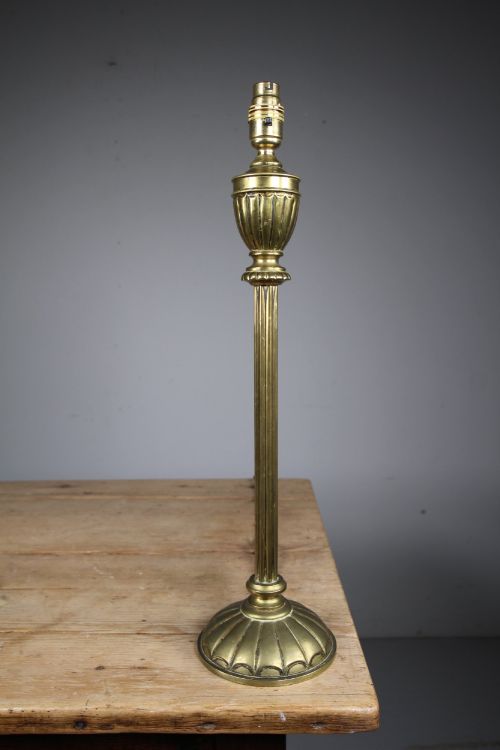
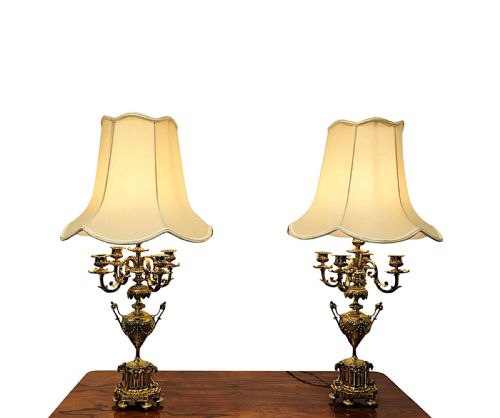
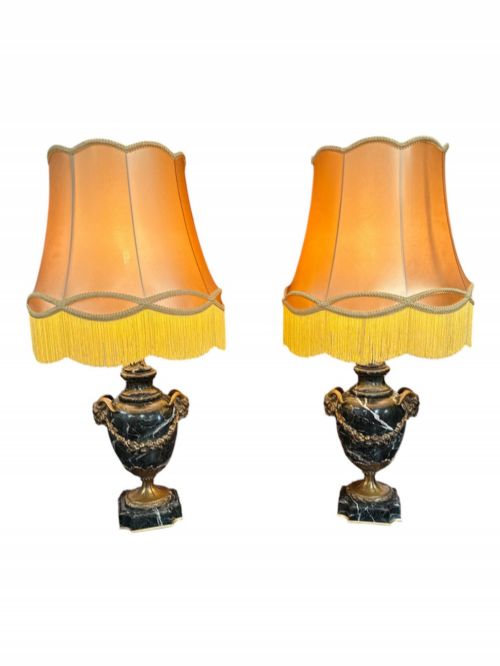


Classical Urn Side Lamps
Classical urn side lamps bring sculptural dignity and soft light to a room, drawn from nineteenth-century and early twentieth-century decorative forms.
Classical Urn Side Lamps
Classical urn side lamps take their shape from ancient vessels, rendered as table lamps through nineteenth-century and early twentieth-century adaptations. These pieces transform traditional urn forms, cassolettes, and vases into functional lighting supported by periods from Victorian to Edwardian production.
Most examples found here originate from French and Italian workshops, often emerging as matched pairs configured from earlier candelabra, bronze vases, or architectural ornaments. Their silhouettes draw directly on Neoclassical, Classical Revival, and Louis XVI design vocabularies.
The materials span carved alabaster, white marble, and Siena marble alongside cast metals including brass, ormolu, gilt bronze, and patinated bronze. Fabric shades complete these table lamps, balancing solid stone and metal bodies with diffused illumination.
How they were made
Makers shaped heavy stones like alabaster, white marble, and Siena marble on lathes, turning solid blocks into hollow urn profiles and lidded cassolettes. Metal components relied on sand casting for bronze, spelter, and brass, followed by chasing and fire gilding to create ormolu mounts.
Many of these side lamps began as decorative garnitures, oil lamps, or candelabra before conversion to electricity during the nineteenth or twentieth centuries. Skilled metalworkers fitted internal wiring channels and secured threaded brass stems through the original stone or bronze vessels.
Townley vases make unexpected cameo appearances disguised as stately Victorian table lights.
What varies in quality
The refinement of the casting and carving separates standard production from exceptional work, visible in the crispness of acanthus leaf mounts, berried laurel bands, and classical handles. High-grade ormolu displays deep gold tones and precise hand-chasing, whereas lesser pieces rely on simpler plated metal finishes.
The choice of raw material dictates the visual weight of the piece, with translucent carved alabaster and richly veined Siena marble commanding greater presence than plain cast spelter or basic brass. Matched pairs with intact original patination and well-integrated conversion work demonstrate superior coherence.
The Classical Urn Side Lamps Glossary
- Ormolu
- Gilded bronze produced by applying a mercury and gold amalgam to cast bronze and firing it to drive off the mercury. This technique creates a durable, warm golden finish seen on French neoclassical mounts.
- Cassolette
- A decorative vase or urn featuring a reversible lid that can function as a incense burner or a solid vessel. In lighting conversions, these lidded forms provide striking bodies for side lamps.
- Alabaster
- A fine-grained, translucent stone used extensively in Italian urn lamps to diffuse light softly through its natural veining. It requires careful handling due to its relative softness compared to marble.
- Spelter
- A zinc alloy commonly used as a less expensive substitute for bronze in nineteenth-century decorative objects. It accepts patination and gilding but feels lighter and more brittle than cast bronze.
- Neoclassical
- A style spanning the eighteenth and nineteenth centuries that revived classical Greek and Roman motifs such as urns, fluting, and swags. This aesthetic informs the architectural lines of these side lamps.
Classical Urn Side Lamps: Frequently Asked Questions
Are these lamps converted from older objects?
Many nineteenth-century examples began life as decorative urns, candelabra, or cassolettes before being adapted for electricity. This practice preserves historical bronze and marble bodies while integrating modern functional wiring.
Makers often drilled through existing stone or metal vessels, adding weighted bases and lamp fittings to create stable table lighting.
How do I identify French and Italian styles?
French pieces often incorporate refined ormolu mounts, Siena marble, and Sèvres-style porcelain following Louis XVI or French Chateau aesthetics. Italian examples frequently showcase carved alabaster and white marble derived from classical revival traditions.
Examining the cast mounts and stone types helps distinguish the regional workshops of the nineteenth and early twentieth centuries.
What is the difference between marble and alabaster?
Marble is a crystalline metamorphic rock valued for its solid structure and bold veining, while alabaster is a softer, translucent gypsum stone. Alabaster lamps allow light to pass partially through the body when illuminated.
Both materials were turned on lathes to form classical urn profiles during the Victorian and Edwardian periods.
How do I style an urn lamp?
These sculptural lamps suit side tables, mantelpieces, or pedestals where their classical silhouettes and fabric shades can act as focal points. Their symmetrical forms and metallic finishes complement both traditional and eclectic interiors.
Pairs work particularly well on matching sideboards or flanking a central mirror to create balanced illumination.