



Classical Revival Sideboard
A classical revival sideboard brings formal architectural dignity to a dining room through rich timbers and disciplined classical ornament.
Classical Revival Sideboard
A classical revival sideboard draws on historical idioms like Sheraton Revival, Neo-classical, Regency, and Renaissance Revival, manifesting primarily as side cabinets, cabinets on stands, console tables, and credenzas.
The pieces on this page span the 19th century, including specific dates such as 1800, 1880, 1900, and the Victorian era, showing how cabinetmakers reinterpreted ancient and classical motifs for later Victorian interiors.
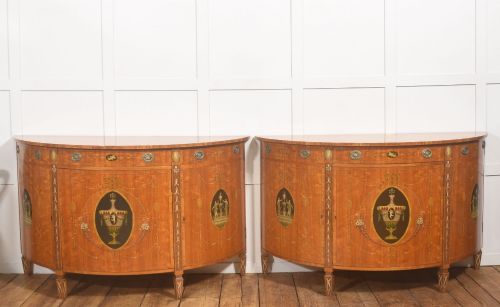
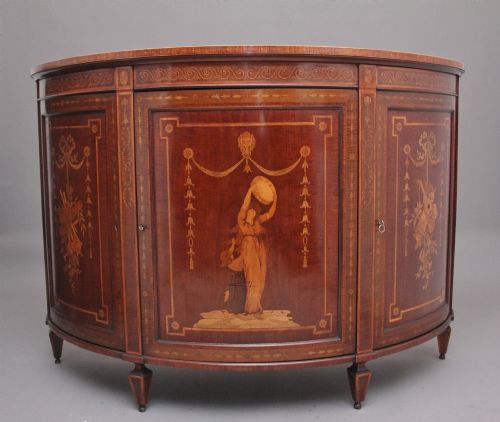
Buyers will most frequently encounter satinwood and mahogany side cabinets, often enhanced with marquetry, painted panels, or delicate inlay work executed in boxwood and brass.
Materials and construction
Cabinetmakers constructed these pieces using dense and decorative hardwoods such as mahogany, walnut, satinwood, and coromandel, often framing them with ebonised wood and fine boxwood stringing.
Surface ornament relied heavily on intricate marquetry, hand-painted panels, and carved details, supported by brass mounts and fittings that punctuate the dark and light grains of the timbers.
Classical Revival Sideboard Retail Price Guide 2026
Typical asking prices for classical revival sideboard among the pieces listed under this phrase on Sellingantiques today, from the lower quarter to the upper quarter. They describe what is for sale here now, not the wider market.
Distinctions in quality
The distinction between standard execution and exceptional quality lies in the crispness of the carving, the precision of the marquetry and inlay, and the refinement of the painted decoration.
Superior pieces demonstrate a harmonious integration of timber selection, such as figured satinwood paired with contrasting boxwood and ebony details, alongside distinguished workshop provenance.
Edwards and Roberts·Lamb of Manchester
The Classical Revival Sideboard Glossary
- Satinwood
- A hard, yellow timber prized for its lustrous sheen and smooth grain, frequently utilised as a primary veneer in Sheraton Revival furniture.
- Marquetry
- The art of applying decorative veneer pieces to a structure to form intricate pictorial designs, often incorporating various exotic woods.
- Credenza
- A dining room side cabinet designed for serving food and storing tableware, which emerged as a popular Victorian form.
- Demi-lune
- A half-moon shape characteristic of console tables and side cabinets designed to sit flush against a wall.
- Sheraton Revival
- A late 19th-century design style drawing inspiration from the light, neoclassical furniture forms of the late 18th century.
Classical Revival Sideboard: Frequently Asked Questions
What defines a classical revival sideboard?
A classical revival sideboard is a substantial storage piece or console that incorporates historical classical motifs, symmetrical designs, and refined surface ornament.
These pieces reflect 19th-century interpretations of earlier neoclassical and Regency styles, using fine timbers like mahogany and satinwood to anchor a formal interior.
How do I care for satinwood and mahogany?
Satinwood and mahogany furniture requires stable room temperatures and protection from direct sunlight to prevent the timber and painted panels from fading.
Regular dusting with a dry, soft cloth and occasional gentle waxing will preserve the natural lustre of the wood and the integrity of the marquetry.
Where were these cabinets placed originally?
These cabinets were designed for principal reception rooms, drawing rooms, and formal dining rooms where hosts entertained guests and displayed fine tableware.
Console tables and side cabinets typically stood against primary walls beneath large mirrors or paintings, serving both decorative and practical functions.
How do I identify the Victorian aesthetic influence?
The Victorian Aesthetic Movement introduced a lighter, more artistic approach to cabinetmaking, often featuring painted floral motifs and ebonised details.
These elements combined with traditional neoclassical symmetry to create side cabinets that felt both classical and modern for late 19th-century homes.