

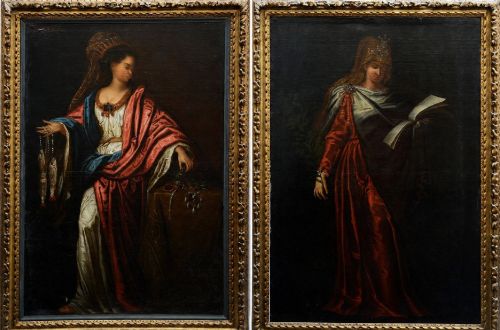


Classical Religious Canvas Painting
These classical religious canvas painting examples bring centuries of devotional art into your interior, spanning Renaissance compositions and Baroque interpretations.
Classical Religious Canvas Painting
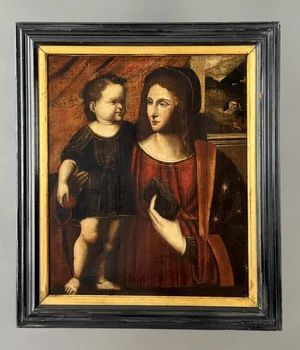
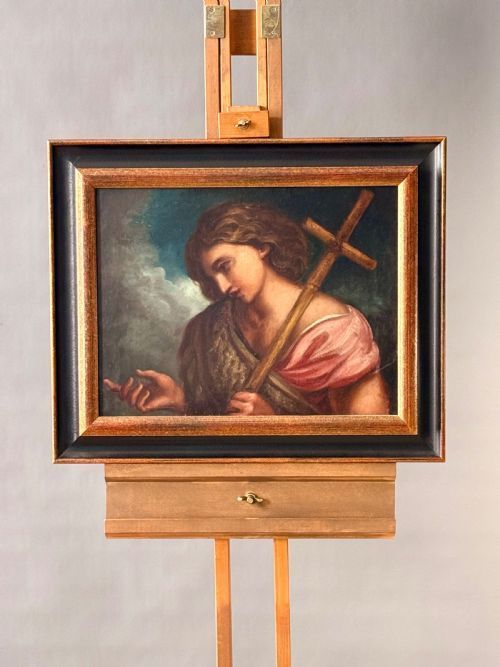
A classical religious canvas painting presents sacred figures and biblical narratives, drawing from Italian, French, and Venetian schools across several centuries. You encounter works depicting the Madonna and Child, Mary Magdalene, and key scriptural events executed in oil on canvas.
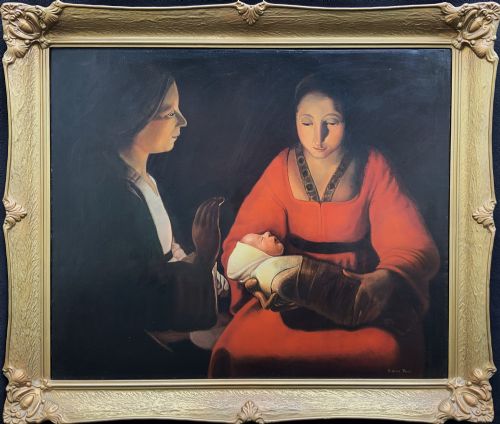
Many pieces on this page are later interpretations or works from the circle of major masters such as Raphael, Correggio, and Guido Reni. These canvases range from 16th-century Italian creations through 18th-century compositions to Edwardian and mid-20th-century adaptations.
The subjects include traditional devotional themes like the Holy Family, the Adoration of the Shepherds, and the conversion of saints. Collectors find both intimate panel-sized works and large-scale portraits framed in period giltwood.
Materials and technique
Artists painted these works primarily using oil paint applied to stretched canvas surfaces, building depth through layered glazes and pigments. This technique allowed for the rich chiaroscuro and luminous skin tones characteristic of Baroque and Renaissance styles.
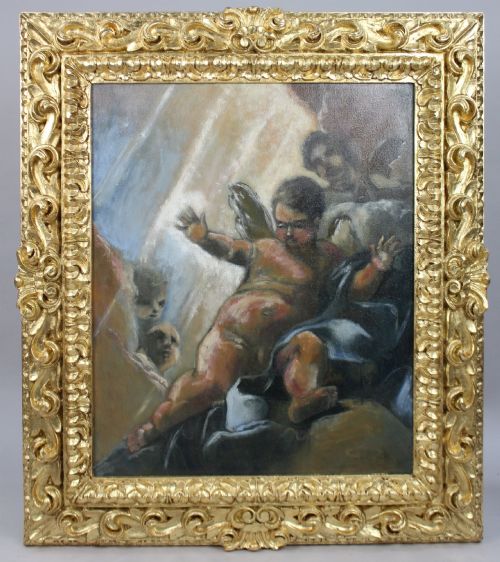
Many surviving canvases are housed in their original or period-appropriate wood and giltwood frames, sometimes enhanced with gold leaf. The framing often utilises carved ornamentation that reflects the aesthetic of the painting's period, from heavy Baroque moulding to Renaissance revival styles.
Several canvases depict saints deep in contemplation while accompanied by remarkably placid angels.
Quality and execution
The integrity of the canvas and the preservation of the original pigment layer determine the visual impact of the work. Finer examples retain their original depth of colour and subtlety of shadow without heavy modern overpainting obscuring the underlying hand.
Bernardino Luini·Antonio Allegri Correggio·Guido Reni·Pompeo Batoni·Bartolomé Murillo
The Classical Religious Canvas Painting Glossary
- Oil on Canvas
- Pigments mixed with a drying oil, typically linseed, applied to a woven fabric support. This combination provides flexibility and allows for rich colour blending.
- Giltwood
- Wood carved and coated with gold leaf or metallic powder. It is commonly found on the ornate frames encasing these traditional paintings.
- Circle of
- A designation indicating that an artist worked in the close milieu or studio of a master, adopting their specific style and methods.
- Baroque
- An artistic style originating around 1600 characterised by dramatic movement, deep shadow, and intense emotional tension. It appears frequently in 17th-century religious subjects.
- Renaissance Revival
- A 19th-century aesthetic movement that imitated the forms, balance, and subjects of 15th- and 16th-century Italian art.
Classical Religious Canvas Painting: Frequently Asked Questions
What does after a master mean?
This attribution indicates that the painting is a later copy or adaptation of a known composition by a celebrated artist, created by a follower or student.
Such works allowed patrons to own versions of famous religious masterpieces that resided in distant churches or private collections.
How do I date an antique canvas?
Dating relies on examining the preparation of the canvas, the composition style, the framing methods, and the ageing of the oil paint.
Experts also study stretcher construction and any historical inscriptions or labels preserved on the reverse of the work.
Where should I hang a religious painting?
These works suit traditional reception rooms, studies, or hallways where adequate wall space allows the framed canvas to become a focal point.
Ensure the location avoids direct sunlight and excessive humidity to protect the oil paint and giltwood frame over time.
Are all these paintings from Italy?
While many originate from Italian schools or follow Italian masters, the inventory includes French and Venetian regional works as well.
Different European schools developed distinct approaches to colour palette and narrative drama within their religious art.