





Circular Entryway Table
A circular entryway table sets a distinguished tone the moment guests step inside.
Circular Entryway Table
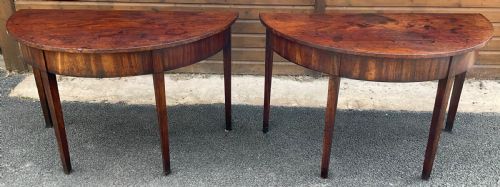
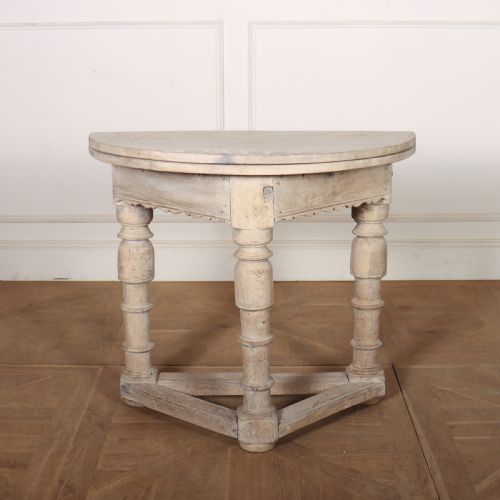
A circular entryway table appears in forms such as console tables, centre tables, and demi-lune shapes designed for hallways and reception rooms. These pieces originate from periods spanning the Georgian era, the Regency period, and Victorian times, constructed in timber and veneer.
The versions most commonly met on this page include mahogany demi-lune console tables from the Georgian and Victorian eras, alongside rosewood centre tables and satinwood hallway pieces. Swedish and Dutch regional examples also appear among the selection.
How they were made
Cabinet makers utilised dense hardwoods such as mahogany and rosewood, often applying fine veneers and crossbanding in satinwood and boxwood to create decorative geometric borders. Pine and lime wash occasionally serve as secondary structural elements.
Joinery techniques relied on precision fitting for D-end and demi-lune configurations, allowing separate console sections to join together or stand independently against a wall.
Circular Entryway Table Retail Price Guide 2026
Typical asking prices for circular entryway table among the pieces listed under this phrase on Sellingantiques today, from the lower quarter to the upper quarter. They describe what is for sale here now, not the wider market.
Several tables arrive in halves, proving that even eighteenth-century furniture appreciated a good D-junction.
What varies in quality
Quality rests upon the choice of timber figures and the precision of decorative crossbanding, where superior examples exhibit rich grain patterns and meticulous inlay work. Lesser pieces rely on plain timber surfaces without contrasting borders.
Proportion and structural integrity distinguish finer workshops from simpler production, particularly in the delicate shaping of legs and the flush alignment of multiple table sections.
The Circular Entryway Table Glossary
- Demi-lune
- A half-moon shape designed to stand flat against a wall, commonly found in period console tables. This form allows the piece to occupy minimal hallway space while retaining a substantial top surface.
- Crossbanding
- A strip of veneer applied perpendicularly to the surrounding grain along the edge of a table top. This decorative technique frames the primary timber and highlights the craftsmanship.
- Centre table
- A freestanding piece finished on all sides, intended to occupy the middle of a room rather than sit against a wall. Regency examples often feature circular tops supported by central pedestals.
- D-end table
- A dining or console table whose terminal ends are semi-circular, resembling the letter D. Pairs of these tables can be joined to form larger configurations.
Circular Entryway Table: Frequently Asked Questions
Where does a circular entryway table fit best?
These tables suit hallways, landings, and entrance foyers where floor space is at a premium yet a formal surface is desired for keys or decorative objects.
Demi-lune shapes sit flush against walls, whereas freestanding centre options anchor larger reception spaces.
How do I care for antique wood surfaces?
Maintain timber finishes by avoiding direct sunlight and excessive moisture, using dry or slightly damp cloths for routine dusting.
Apply natural beeswax periodically to nourish mahogany and rosewood without sealing the grain.
Can I use a console table as a desk?
Most period console tables feature shallow depths and fixed heights designed for display rather than knee clearance. Using one for writing depends entirely on the specific leg clearance beneath the apron.
What defines the Georgian style?
Georgian design spans the eighteenth and early nineteenth centuries, characterised by classical proportions, refined mahogany construction, and subtle decorative inlay. Pieces from this era prioritise symmetry and understated elegance.