


Circular Cocktail Table
A circular cocktail table anchors a room with low, centred hospitality, bringing walnut, brass, and lacquer together for drinks and display.
Circular Cocktail Table
A circular cocktail table is a low surface designed for drinks, service, and daily use within a reception room. You will encounter various incarnations spanning the Victorian era through the Edwardian period, 1920s, 1930s, and 1940s.
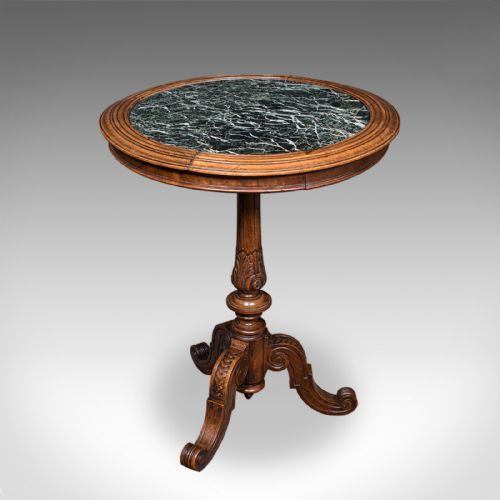
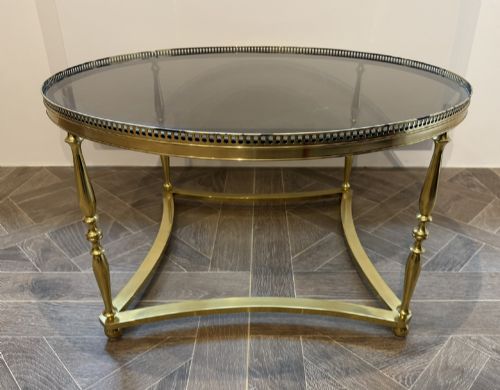
The selections on this page range from high Victorian antique decanter tables to Edwardian Chinoiserie lacquer pieces, Art Deco burr walnut designs, and Mid-Century Modern or French-influenced styles. Many pieces double as coffee tables or side tables.
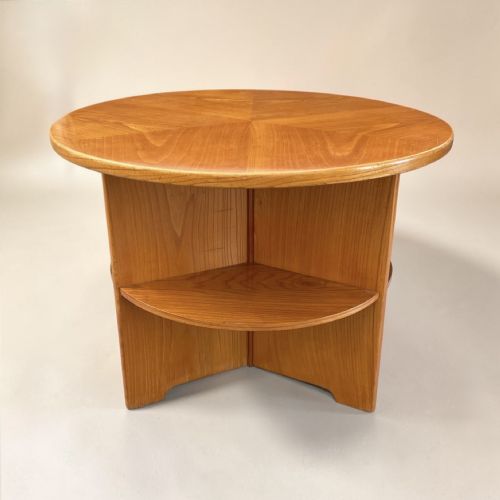
Art Deco and 1920s iterations dominate the offerings, frequently featuring figured walnut veneers, pop-up mechanisms for drinks bars, or pie crust edges. These tables bridge functional serving needs with decorative presence across diverse historical styles.
What varies in quality
The distinction between ordinary and exceptional tables lies in the choice of timber veneer and the precision of the joinery. Figured burr walnut and carefully matched grain patterns elevate the visual impact of Art Deco items significantly.
Quality also manifests in the execution of decorative elements, such as hand-applied lacquer, brass casting, and carved walnut details. Structural integrity of mechanical pop-up bars and stability of pedestal bases separate superior examples from standard production.
Current selections span the Victorian period, Edwardian era, 1910, 1920, 1930, and 1940, utilising walnut, burr walnut, brass, marble, lacquer, gilt, teak, and mahogany.
The Circular Cocktail Table Glossary
- Burr walnut
- A wood harvested from the wart-like growths on walnut trees, yielding intricate, swirling grain patterns. Cabinet makers prized this timber for high-status Art Deco and 1930s veneer work.
- Pie crust edge
- A raised, decoratively carved rim shaped in small, undulating curves resembling pastry work. This detail frequently frames antique circular tables.
- Chinoiserie
- European artistic style reflecting Chinese motifs, executed in lacquer and gilt. Edwardian makers applied this technique to small circular coffee tables.
- Decanter table
- A low or portable furnishing built to secure wine bottles and glassware. High Victorian iterations combined walnut and marble for this purpose.
Circular Cocktail Table: Frequently Asked Questions
What is a circular cocktail table used for?
These tables provide a low, central surface for holding drinks, decanters, and glassware in a drawing room or sitting room. Many historical variants double as coffee tables or feature specialised compartments for entertaining.
Pop-up cocktail bars and decanter tables specifically accommodate the service of wine and spirits. Their compact circular footprint allows them to fit comfortably amidst surrounding seating arrangements.
How do I identify an Art Deco circular table?
Art Deco pieces typically date from the 1920s and 1930s, displaying clean geometric lines alongside rich figured walnut or satin birch veneers. They often omit heavy carving in favour of smooth, polished surfaces.
Makers of this era embraced functional innovation, sometimes incorporating clever pop-up mechanisms for drinks storage. The grain of the burr walnut veneer is usually arranged symmetrically across the circular top.
What periods do these tables come from?
The listings span the Victorian era, Edwardian period, and the 1920s, 1930s, and 1940s. Each era brings distinct materials and aesthetic influences, ranging from high Victorian marble-topped decanter tables to Mid-Century Modern forms.
Edwardian examples often showcase Chinoiserie lacquer work, whilst 1920s and 1930s pieces lean heavily into Art Deco walnut veneers and French revival styling.