


Chrome Desk Timepiece
A chrome desk timepiece brings the sharp geometry and dependable engineering of the early twentieth century straight to your workspace.
Chrome Desk Timepiece
When you search for a chrome desk timepiece, you find compact instruments designed to sit upon writing surfaces, tables and mantels. These objects serve to measure hours while adding distinct modernist or Art Deco character to an interior.
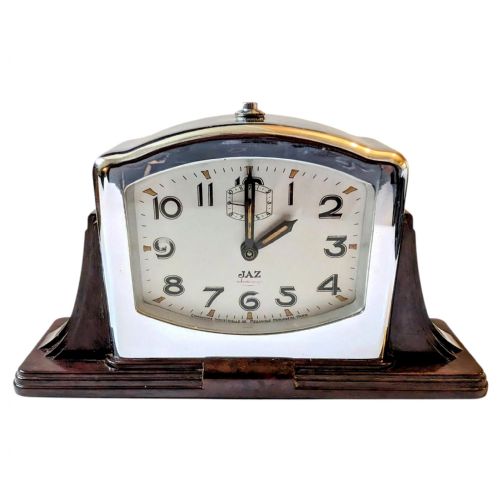
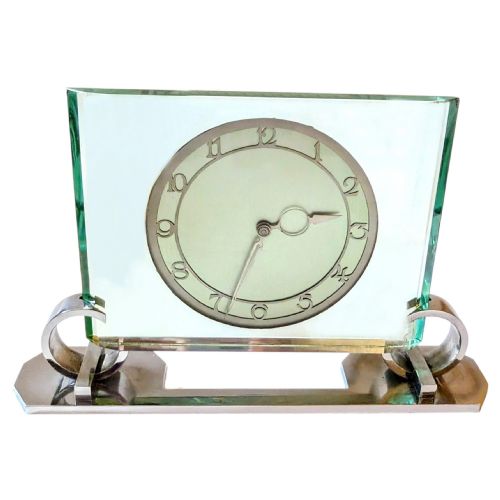
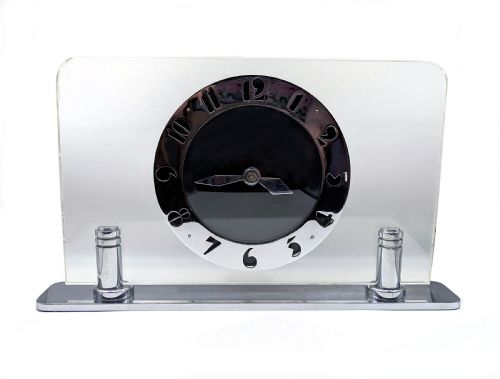
The pieces you meet most often on this page date from the 1930 period, taking the form of desk clocks, mantel clocks and travel alarms. Makers combined polished metal frames with dials housed in glass, bakelite, marble and wood.
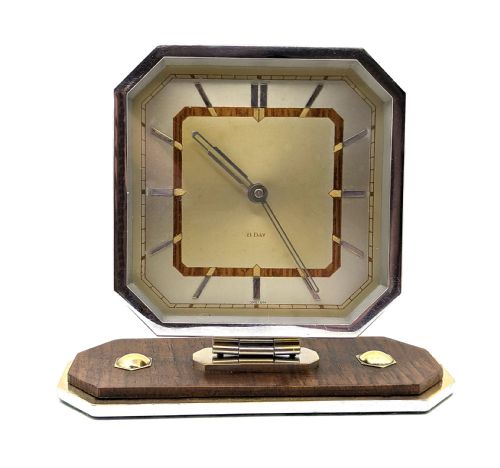
Origins span English, French and Swiss workshops, ranging from modest bedside alarms to imposing skyscraper designs. Many items incorporate eight-day movements or specialised mechanisms such as mystery dials and atmospheric power sources.
Materials and construction
Cabinets frequently incorporate contrasting elements of bakelite, walnut, onyx and marble to anchor the metal structure. Movements rely on mechanical wind-up systems, including eight-day calibres and specialised Swiss mechanisms.
Styling follows strict geometric lines, stepping up in skyscraper formations or sweeping into curved nautical silhouettes. Metal components undergo precise plating and polishing to withstand daily desktop handling.
One promotional advertising piece unites a desk clock directly with the world of early motoring garages.
Factors of quality
Quality rests in the precision of the movement and the integrity of the plating across the metal body. Pieces with fully serviced eight-day movements demonstrate superior mechanical retention compared to basic daily wind versions.
The choice of housing materials sets tiers within the selection, separating simple metal cases from complex combinations of heavy marble, onyx and tinted glass. Finer examples retain crisp geometric casting without pitting to the chrome surface.
Smiths Clockmakers·Mappin & Webb·Harrods of London·Blangy Clockmakers·Asprey
The Chrome Desk Timepiece Glossary
- Eight-day movement
- A mechanical clock movement that requires winding only once every eight days. This design offers greater convenience than standard daily-wind alternatives.
- Bakelite
- An early synthetic thermosetting plastic frequently moulded into geometric bezels and cases. It provides rich dark tones that contrast sharply with bright metal.
- Opaline glass
- A pale, translucent glass type used for clock dials and surrounds during the 1930 period. It diffuses light softly across the face.
- Mystery clock
- A timepiece where the hands appear to float without any visible connection to the internal movement. The dial is typically set in transparent glass plates.
- Garniture
- A set comprising a central clock flanked by matching decorative objects such as sculptures or vases. They form a coordinated display on a mantel.
Chrome Desk Timepiece: Frequently Asked Questions
Are these clocks suitable for daily use?
These items function reliably as timekeepers provided they receive regular mechanical service from a qualified horologist.
Placement should avoid direct sunlight and damp environments to protect the metal plating and internal gears.
How do I identify a 1930 piece?
Look for stepped skyscraper silhouettes, chrome plating, and numerals rendered in distinct modernist or sans-serif typefaces.
Materials like moulded bakelite and coloured mirror glass also point directly to the interwar period.
What is a mystery clock?
A mystery timepiece uses concealed glass or crystal discs to transmit motion from the base to the hands invisibly.
This clever illusion creates the impression that the hands float entirely unsupported across the dial face.