

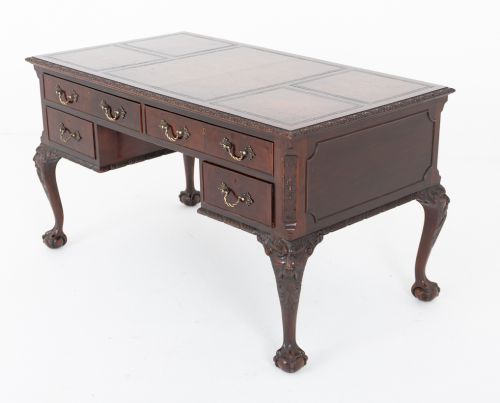
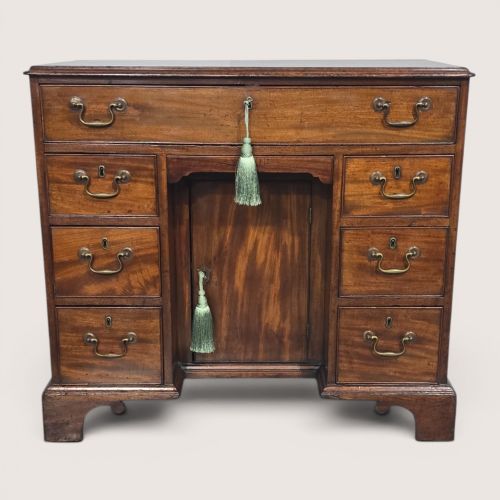
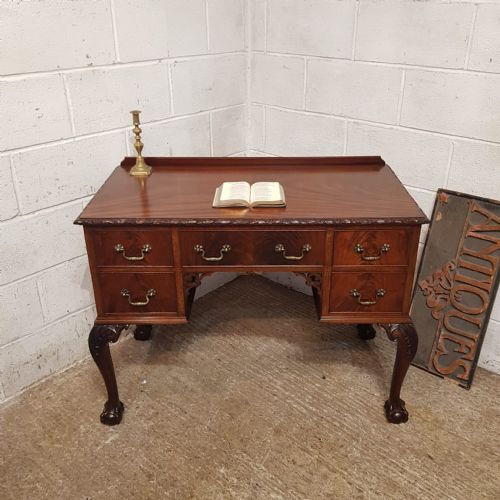
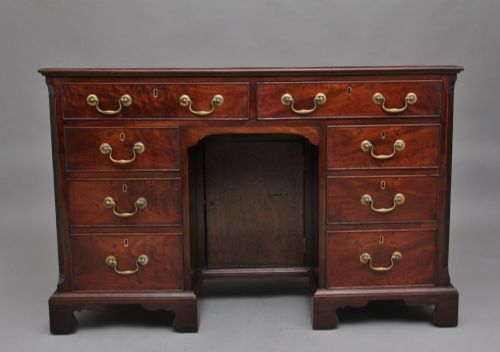

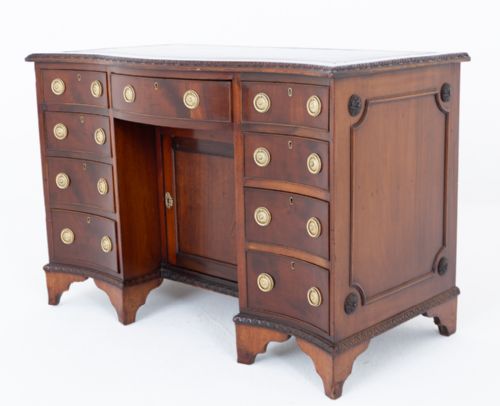


Chippendale Style Kneehole Desk
A chippendale style kneehole desk brings classic proportions and fitted drawers to a study, built to command attention in mahogany or walnut.
Chippendale Style Kneehole Desk
When you search for a chippendale style kneehole desk, you encounter writing furniture rooted in eighteenth-century cabinet making traditions. These pieces combine a recessed central kneehole cupboard with banks of smaller drawers, creating a symmetrical facade that serves as a working desk or dressing chest.
The versions most common on this page span the Georgian era through to the revival periods of the late nineteenth and early twentieth centuries. You will find examples ranging from authentic eighteenth-century pieces to Edwardian interpretations bearing Gothic or serpentine influences.
How They Were Made
Cabinet makers built these desks primarily using solid mahogany, walnut, and burr walnut, often applying flame mahogany veneers to drawer fronts to create figured grain patterns. Secondary timbers like oak appear in drawer construction, while brass handles and escutcheons furnish the hardware.
Construction techniques involve traditional joinery for the pedestals and writing surfaces. Some pieces incorporate carved detailing typical of the style, whilst others rely on clean serpentine shaping and panelled construction.
Chippendale Style Kneehole Desk Retail Price Guide 2026
Typical asking prices for chippendale style kneehole desk among the pieces listed under this phrase on Sellingantiques today, from the lower quarter to the upper quarter. They describe what is for sale here now, not the wider market.
Materials across the inventory include solid mahogany, walnut, burr walnut, flame mahogany veneer, and oak.
What Varies in Quality
The standard of a kneehole desk depends heavily on the selection of timber and the precision of the veneer work. Superior examples display carefully matched grain across the drawer fronts and crisp execution of any carved mouldings.
Internal construction also separates finer desks from standard production. Well-made pieces feature solid oak drawer linings and robust framing that maintains structural stability through decades of use.
Druce And Co Baker Street
The Chippendale Style Kneehole Desk Glossary
- Kneehole desk
- A compact writing desk featuring a central recessed space flanked by two pedestals of drawers. This configuration provides a tidy workspace with substantial storage.
- Serpentine front
- A furniture front curving outward at the ends and inward at the centre. This shape requires advanced cabinet making skill to execute cleanly.
- Lowboy
- A small table with drawers resembling the lower section of a tallboy. These serve as compact writing desks or dressing tables.
- Flame mahogany veneer
- Thin slices of mahogany cut from timber where the branch meets the trunk, producing a distinctive flickering flame pattern. Cabinet makers applied these veneers to display decorative grain.
- Partners desk
- A large freestanding desk designed for two people to work opposite one another. These feature drawers and cupboards on both sides.
Chippendale Style Kneehole Desk: Frequently Asked Questions
How do I use a kneehole desk?
These desks suit a study or library as a compact writing station. The central kneehole provides comfortable legroom while the surrounding drawers organise correspondence and stationery.
Position the desk freestanding in a room or against a wall depending on whether the back is finished. Ensure your chair fits comfortably within the central recess before arranging your workspace.
Are these desks genuine eighteenth century?
The selection includes both authentic eighteenth-century pieces and later revival items from the Victorian and Edwardian eras. Examining the secondary timbers and construction methods helps determine the age.
Revival pieces often utilise machine-sawn elements and twentieth-century hardware alongside traditional styling. Comparing the interior drawer construction against known period examples clarifies the manufacturing date.
What is the difference between walnut and mahogany?
Mahogany offers a dense, reddish-brown timber that resists warping and takes a sharp carved edge. Walnut provides a rich, darker brown tone with intricate grain figures like burr variations.
Both woods were favored during different stylistic phases of furniture making. Walnut predominates in earlier periods before mahogany became the dominant cabinet timber.
How do I care for antique veneer?
Protect veneered surfaces by avoiding direct sunlight and maintaining steady room humidity. Dry dusting with a soft cloth prevents surface scratches without moisture damage.
Apply occasional professional wax polish to nourish the timber and maintain the sheen. Avoid chemical sprays that can lift or degrade historic finishes.