
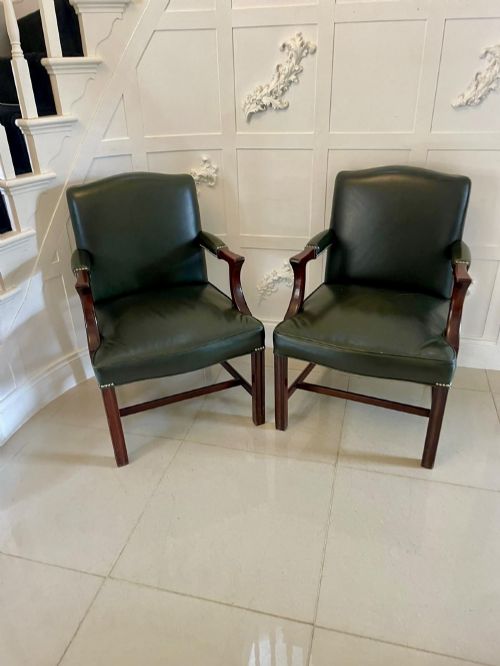
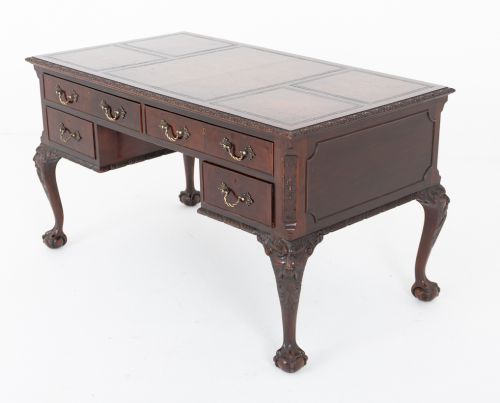
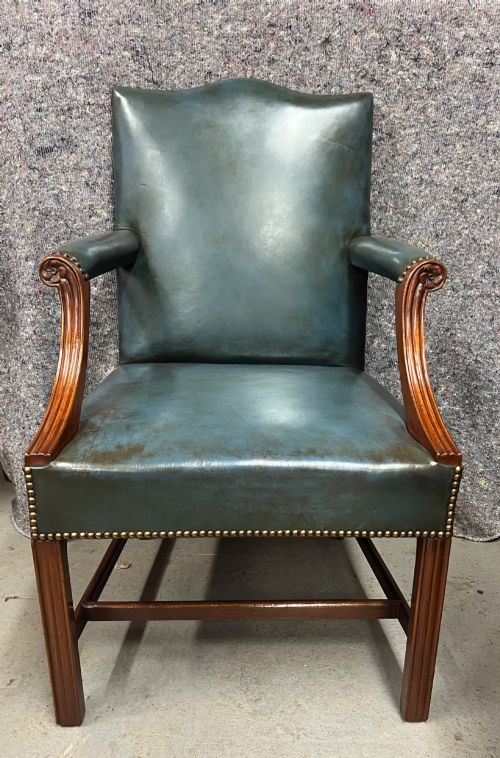

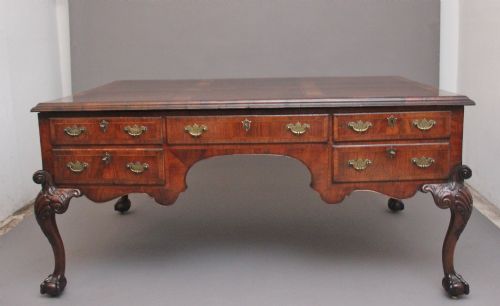




Chippendale Style Executive Desk
A chippendale style executive desk brings serious presence to a room, offering grand proportions and traditional carved detail.
Chippendale Style Executive Desk
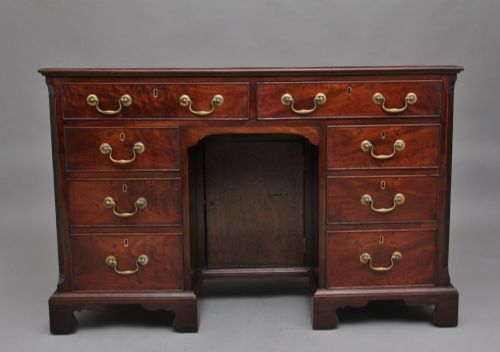
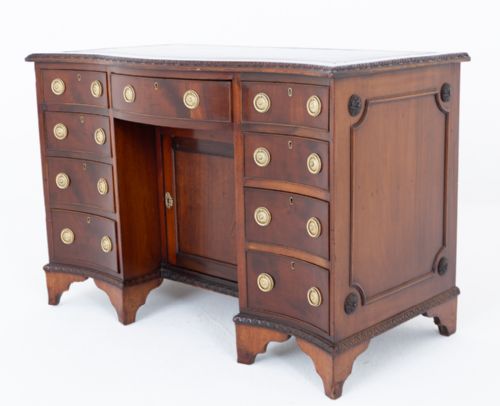
A chippendale style executive desk takes many physical forms on this page, including pedestal desks, partners desks, writing tables and kneehole desks. Most pieces appearing here date from the nineteenth century or early twentieth century revival periods, alongside select eighteenth century examples.
Pedestal desks and double-sided partners desks dominate the selection, often accompanied by matching desk chairs. These substantial pieces provide ample workspace and substantial storage drawers for daily use.
Materials and construction
Cabinetmakers built these desks primarily using solid mahogany, flame mahogany veneer, walnut and burr walnut. Brass hardware and inset leather writing surfaces complete the construction of the desktop.
Makers applied intricate carving techniques to shape cabriole legs, serpentine fronts and detailed edge mouldings. Veneers were carefully selected to create figured grain patterns across large writing surfaces.
Some desks hide secret drawers behind carved mouldings, keeping private letters safe from curious eyes.
Judging quality and craftsmanship
Quality rests upon the depth and crispness of the timber carving, particularly around the drawer fronts, friezes and legs. Hand-carved details separate superior revival pieces and period originals from simpler commercial production.
The choice of timber grain also dictates distinction, where figured mahogany and burr walnut display superior visual movement. Secondary woods and the precision of drawer dovetailing reveal the standard of workshop execution.
Gillows·Druce and Co·Shapland and Petter
The Chippendale Style Executive Desk Glossary
- Partners desk
- A large pedestal desk designed to be used from both sides simultaneously by two people. These pieces feature drawers and cupboards facing in opposite directions.
- Kneehole desk
- A compact desk featuring a central recess for the legs, flanked by vertical banks of drawers. They often present flat or serpentine fronts.
- Serpentine front
- A furniture front curving outward in the centre and inward at the sides. This contour requires advanced woodworking skill to shape accurately.
- Pedestal desk
- A heavy freestanding desk supported by two supporting pedestals containing drawers. The top surface typically incorporates an inset leather panel.
Chippendale Style Executive Desk: Frequently Asked Questions
How do I spot a true partners desk?
Look for drawer fronts or cupboard doors on both the front and the back of the piece. These desks allow two people to sit opposite each other with independent legroom and storage.
Check the internal framing to ensure the construction is finished to the same standard on both sides. Many single-sided desks are incorrectly labelled as partners desks.
What is the difference between revival and period?
Period pieces originate from the eighteenth century when Thomas Chippendale and his contemporaries actively worked. Revival pieces date from the nineteenth and early twentieth centuries when cabinetmakers recreated those earlier aesthetics.
Both categories utilise traditional mahogany and walnut, but timber seasoning and construction marks help separate the eras.
How do I care for the leather top?
Maintain the inset leather writing surface by dusting it regularly with a dry cloth. Apply a specialist leather balm periodically to prevent the hide from drying out.
Avoid placing hot cups or moisture directly onto the leather to protect the surface finish and gold tooling.
Where should I place a large pedestal desk?
Position a large pedestal desk in the centre of a room if it is a double-sided partners desk, allowing access from all angles. Single-sided pedestal desks sit comfortably against a wall or anchored in front of a window.
Ensure you measure the floor space carefully, as these substantial pieces require room for chairs to pull out fully.