



Chinoiserie Folding Floor Screen
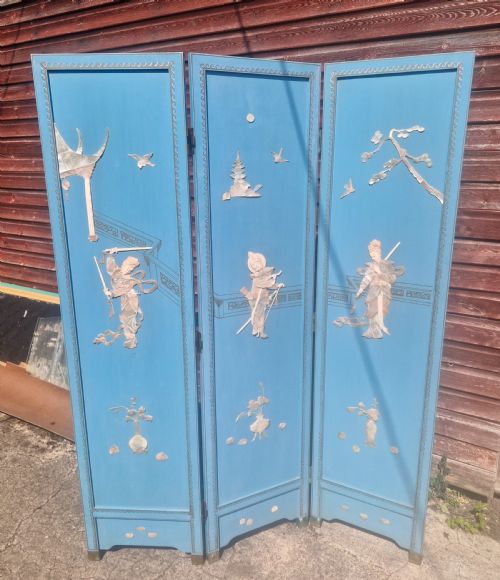
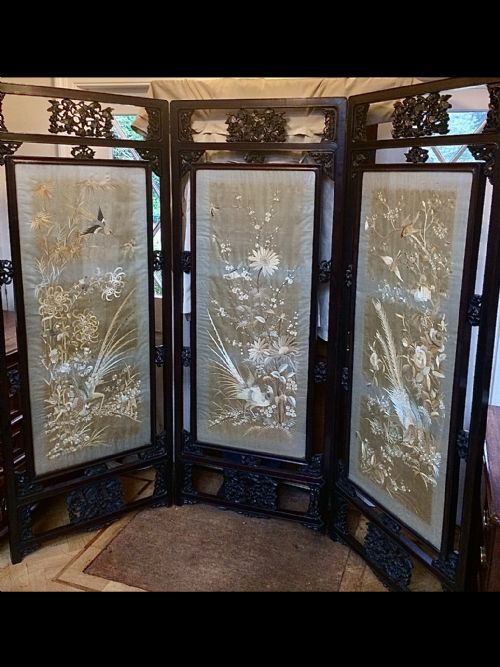
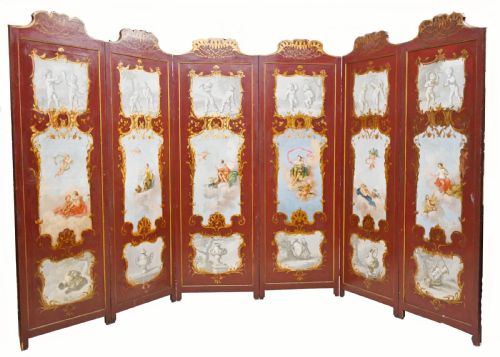
These chinoiserie folding floor screen examples bring layered lacquer, gold leaf, and carved panels into a room to divide space with decorative theatre.
Chinoiserie Folding Floor Screen
A chinoiserie folding floor screen operates as a portable room divider built from multiple hinged panels that fold together when not in use. These pieces range from four to eight folds, creating substantial architectural presence within an interior space.
The objects displayed here span centuries of production, incorporating styles such as Chinese Qing Dynasty, Chinese Traditional, and Rococo. Buyers encounter items from the eighteenth, nineteenth, and twentieth centuries, including pieces dated to 1860, 1890, 1900, 1920, 1930, and 1950.
Forms include folding screens, room dividers, and dressing screens designed for both decorative impact and practical division. Surfaces feature painted finishes, lacquered panels, and elaborate figurative or dragon motifs.
Materials and construction methods
Makers built the structural framework using wood and hardwood to support the weight of multiple folding panels. Brass hinges typically join the sections together, allowing flexible movement across four, six, or eight panels.
Surfaces receive layers of lacquer adorned with polychrome pigment, gold leaf, and silk panels. Artisans also applied hardstone, soapstone, and mother-of-pearl inlay to create textured pictorial scenes and decorative motifs.
Dragon carved motifs watch quietly over the room, bringing centuries of mythical protection straight to your floorboards.
Evaluating craftsmanship and detail
Quality reveals itself in the depth of the lacquer work and the precision of the carved details, particularly where dragon carvings or inlaid soapstone meet the wood substrate. Higher grade panels show meticulous hand application of gold leaf and polychrome pigment across every fold.
The integrity of the structural joinery and the durability of the hinges dictate how well a multi-panel screen stands upright over time. Finer examples maintain crisp definition in their incised coromandel work and secure placement of mother-of-pearl elements.
The Chinoiserie Folding Floor Screen Glossary
- Coromandel lacquer
- A Chinese incised lacquer technique where the artisan carves through multiple layers of dark lacquer to reveal a contrasting ground beneath, often filling the recesses with colour.
- Chinoiserie
- A European artistic style reflecting Chinese motifs and decorative techniques, widely adopted in furniture and screen production.
- Polychrome pigment
- Paint applied in multiple colours to decorate wooden surfaces and figurative scenes on decorative screens.
- Hardstone
- Dense minerals such as soapstone or jade used to create raised relief elements and inlaid decorative panels.
- Qing Dynasty
- The final imperial dynasty of China, spanning from sixteen forty-four to nineteen twelve, whose artistic output heavily influences these traditional forms.
Chinoiserie Folding Floor Screen: Frequently Asked Questions
How do I place a large screen in a room?
Position the screen against a blank wall or angle the outer panels to create a freestanding partition that zones a larger space. Ensure the folds remain slightly bent to provide stability on flat flooring.
Allow enough clearance around the panels so the hinges can move freely without stressing the wood or lacquer finish during adjustment.
What is the difference between coromandel and standard lacquered screens?
Coromandel screens feature an incised carving technique where artisans cut deep into layers of dark lacquer to expose underlying hues. Standard lacquered screens rely on painted or applied surface decoration rather than carved recesses.
Both methods utilise wooden panel cores, but coromandel work yields a tactile, recessed surface texture that contrasts with smoother painted lacquer finishes.
How many panels do these screens usually have?
The pieces listed here typically feature four, six, or eight folds linked together by brass hinges. Larger eight-panel examples create expansive decorative backdrops, while four-panel versions suit more compact spaces.
Consider the wall space and room dimensions before selecting panel counts, as wider screens demand adequate clearance to stand securely.
How should I care for lacquer and inlaid surfaces?
Dust the wood, lacquer, and inlaid elements gently using a soft, dry cloth to prevent scratching the delicate gold leaf and polychrome pigments. Avoid placing the screen near direct heat sources or strong sunlight that might dry out the lacquer.
Keep humidity levels stable within the room to protect both the wooden core and any applied soapstone or mother-of-pearl inlay from shifting.