
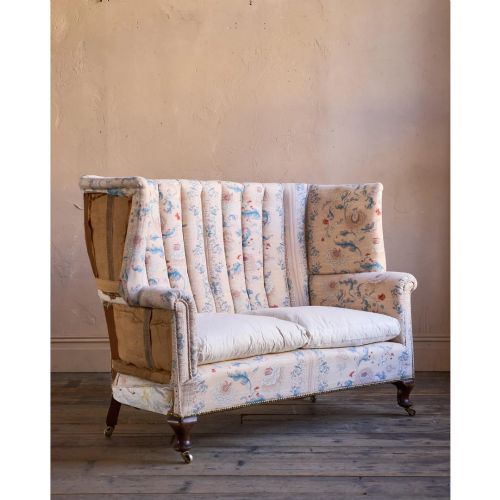


Channel Tufted Wingback
These channel tufted wingback seating pieces bring deep vertical channeling and enveloping upholstered wings into a room for comfort and presence.
Channel Tufted Wingback
When searching for a channel tufted wingback, buyers encounter substantial seating designed to protect against draughts while offering structured vertical cushioning. The examples seen on this page span the 19th Century, Georgian, Victorian, Edwardian, and Art Deco periods, encompassing armchairs, sofas, and complete suites.
The dominant forms present are barrel back armchairs and sofas, alongside specific variations such as fluted and ribbed upholstered chairs. These pieces originate from distinct design traditions including English Country House and George III styles.
Most items on this page lean heavily toward nineteenth-century origins and subsequent early twentieth-century interpretations, particularly the 1920s barrel back chair. Buyers will frequently meet timber frames upholstered in various textiles rather than raw woodwork alone.
Materials and construction methods
The construction relies heavily on sturdy structural timbers, with specific listings identifying mahogany, walnut, and general wood and timber frames. These solid foundations support the substantial weight of large upholstered seating units.
Upholstery defines the surface texture of these pieces, utilising velvet, linen, hessian, fabric, and brown leather. Brass detailing occasionally appears as part of the hardware or structural reinforcement on these armchairs and sofas.
Listings on this page span the 19th Century, Georgian, Victorian, Edwardian, and Art Deco periods, utilising mahogany, walnut, brass, leather, and velvet.
Distinctions in quality and execution
Quality separates along the precision of the vertical channeling and the integrity of the underlying timber frame. Superior examples demonstrate rigorous execution in the alignment of ribs or flutes across curved barrel backs.
The choice and durability of the covering material, whether supple brown leather or dense velvet, dictate the tactile longevity of the piece. Substantial scale and proportions, as seen in large suites and sofas, separate commanding focal pieces from standard seating.
The Channel Tufted Wingback Glossary
- Channel tufted
- Upholstery characterised by vertical stitched channels or flutes that hold padding in parallel rows. This technique provides both structural support and a distinct linear visual rhythm.
- Wingback
- An armchair or sofa featuring projecting side panels designed originally to shield the occupant from drafts. These wings extend from the upper back to the arms.
- Barrel back
- A seating form where the back and arms form a single continuous semi-circular curve. This encloses the sitter for enhanced comfort and warmth.
- Hessian
- A coarse woven fabric typically utilised as internal upholstery scrim and foundation stuffing support. It provides hidden structural integrity beneath outer textiles like velvet or leather.
Channel Tufted Wingback: Frequently Asked Questions
What is a channel tufted wingback?
A channel tufted wingback is an upholstered seating piece featuring vertical stitched flutes or ribs along the backrest, combined with protective side wings. These items include armchairs and sofas designed to offer enveloping comfort.
Peculiar to specific traditional and twentieth-century styles, these pieces merge architectural framing with deep, structured padding.
How were these chairs used historically?
Historically, winged and barrel-shaped chairs were placed near fireplaces or in drafty hallways to trap heat and block cold air currents. The high back and enclosed sides created a microclimate for the occupant.
Over time, they transitioned into principal living room seating and central elements of large upholstered suites.
How do I identify a Victorian piece?
Victorian examples often display heavy proportions, robust wooden frames, and materials such as walnut or deep brown leather. Listings from this era frequently emphasise massive scale and comprehensive upholstery.
Comparing the frame timbers and overall bulk against lighter Edwardian or Georgian silhouettes helps clarify the period.
What materials are typical for these frames?
The structural framework relies on traditional hardwoods such as mahogany and walnut, alongside general timber framing. These sturdy woods support heavy internal webbing and springs.
Visible woodwork is often minimal due to the extensive fabric, velvet, linen, or leather upholstery covering the body.