

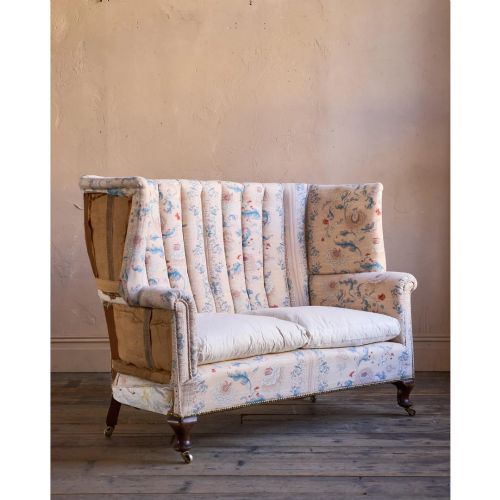


Fluted Back Wing Chair
A fluted back wing chair offers deep comfort and traditional form, making it a striking centrepiece for a period sitting room.
Fluted Back Wing Chair
A fluted back wing chair is a substantial seat designed for warmth and comfort, featuring characteristic upholstered wings and vertical fluting along the backrest. These seating pieces appear in forms such as armchairs and sofas, providing a commanding presence within a room.
The versions most likely to be met on this page span the 19th Century, Georgian, 1920, and 1930 periods. They reflect historical styles including Victorian, George III, Edwardian, and Queen Anne Style.
Makers and craftsmen of the past produced these forms to shield sitters from draughts while adding architectural refinement to domestic interiors. They remain sought after for their blend of substantial padding and upright support.
How they were made
Makers built the structural frames of these armchairs and sofas from sturdy woods such as mahogany and walnut, which provided a durable foundation for heavy upholstery. Brass elements occasionally appeared in the construction or hardware details.
The upholstery work relied on traditional textiles recorded in the evidence, including linen, hessian, and damask fabric. Skilled upholsterers shaped the distinctive ribbed and barrel back forms using dense stuffing beneath these outer covers.
Fluted Back Wing Chair Retail Price Guide 2026
Typical asking prices for fluted back wing chair among the pieces listed under this phrase on Sellingantiques today, from the lower quarter to the upper quarter. They describe what is for sale here now, not the wider market.
Early makers designed the wings to trap hearth warmth, accidentally inventing the cosiest seat in the house.
What varies in quality
Quality in these seating pieces rests upon the precision of the woodwork and the integrity of the frame construction. Pieces fashioned from solid mahogany or walnut exhibit superior structural permanence compared to lesser timber examples.
The refinement of the upholstery work also dictates the standard of the piece, particularly the exactness of the vertical fluting and the quality of textiles like damask or linen used to finish the surface.
The Fluted Back Wing Chair Glossary
- Wingback
- An armchair style featuring protective side panels, known as wings, designed to deflect draughts from the sitter's head and retain fireplace warmth.
- Fluted
- A decorative technique involving parallel vertical grooves carved into wood or formed through precise upholstery work across the backrest.
- Barrel back
- A seating design where the back and arms form a single, continuous semicircular curve that wraps around the sitter.
- Damask
- A reversible figured fabric, historically woven from silk, wool, or linen, utilised for formal upholstery on period furniture.
- Hessian
- A coarse woven fabric, typically made from jute fibres, traditionally employed as a sturdy foundation layer beneath top upholstery.
Fluted Back Wing Chair: Frequently Asked Questions
What is a fluted back wing chair?
A fluted back wing chair is an upholstered seat featuring protective side wings and vertical ribbed detailing along the backrest. These pieces combine draught-excluding wings with structured vertical padding.
They serve as both comfortable reading seats and decorative anchors in traditional reception rooms.
How do I identify a Georgian model?
Georgian examples display the proportions, timber choices, and restraint characteristic of 18th-century cabinet making. They frequently utilise mahogany frames and traditional upholstery foundations.
Examining the construction methods beneath the fabric reveals the historical period of the woodwork.
Where were these chairs used?
Historically, these armchairs were placed near fireplaces in grand drawing rooms and libraries to protect sitters from cold draughts. The high wings captured radiant heat from the hearth.
Today, they function well in studies, living rooms, and bedrooms as statement seating.
What materials are typical?
The frames generally consist of hardwoods such as mahogany and walnut, while upholstery employs traditional textiles like linen, hessian, and damask fabric. Brass details also appear on certain examples.
These materials ensure both structural longevity and a suitably formal appearance.