
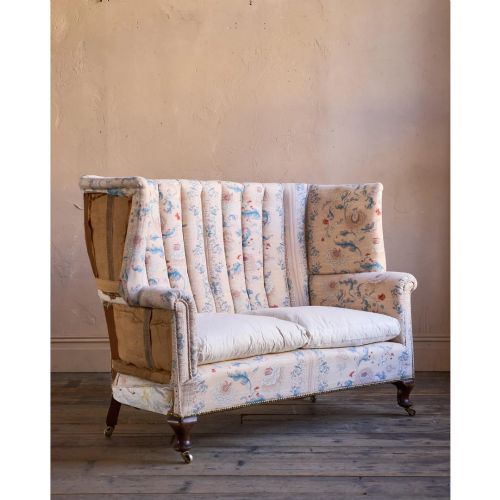


Channel Tufted Wingback Chair
A channel tufted wingback chair brings deep vertical fluting and high protective sides together to offer substantial comfort and period character.
Channel Tufted Wingback Chair
A channel tufted wingback chair provides deep upholstered fluting along the interior backrest, creating a distinct ribbed texture. These pieces appear across various historical periods including the 19th Century, Georgian era, and the 1920s.
The form frequently overlaps with barrel back armchairs and fluted wingback sofas, constructed using wood frameworks like mahogany and walnut. Buyers on this page will regularly encounter Victorian, Edwardian, and Art Deco interpretations of the classic wingback design.
Originating largely within English country house and traditional styling, these seating forms combine high protective wings with vertical channeled upholstery. The selection spans standard armchairs up to large Victorian brown leather suites.
How they were made
Makers built the structural frames using timber such as mahogany, walnut, and general wood, establishing a sturdy foundation for the upholstered body. Brass details occasionally supplement the heavy wooden frameworks.
The upholstery technique relies on dense internal padding secured beneath surface coverings of velvet, linen, fabric, hessian, and brown leather. Vertical channels or ribs are stitched directly into the backrest to maintain the signature fluted shape.
Listings span the 19th Century, Georgian, 1860, 1900, 1910, and 1920 periods, utilising mahogany, walnut, brass, velvet, leather, and linen.
What varies in quality
Quality rests upon the structural integrity of the underlying timber frame, distinguishing solid mahogany or walnut foundations from simpler wood construction. The precision of the vertical fluting and the tightness of the channel stitching dictate the refinement of the piece.
Material choice marks another division, separating standard fabric or linen upholstery from high-grade brown leather or velvet coverings. Pieces originating from the Georgian period or early Victorian eras display cabinetmaking standards distinct from later mass production.
The Channel Tufted Wingback Chair Glossary
- Channel tufting
- Upholstery technique where vertical stitched columns create a ribbed backrest. This method provides structured padding and a formal appearance.
- Wingback
- An armchair style featuring protective side panels attached to the arms and framing the head. Originally designed to shield the sitter from drafts.
- Barrel back
- A seating form featuring a semicircular upholstered backrest that curves continuously into the arms. It encloses the user for added comfort.
- Fluted
- Architectural term describing parallel vertical grooves. Applied here to the vertical channels running down the upholstery.
- Hessian
- A coarse woven fabric typically utilised as internal foundation material in traditional upholstery work. It supports the padding before the final covering is applied.
Channel Tufted Wingback Chair: Frequently Asked Questions
What is a channel tufted wingback chair?
A channel tufted wingback chair is an upholstered seating piece featuring high protective wings and vertical fluted channels stitched into the backrest. The design combines the draught-excluding wings of traditional seats with ribbed internal padding.
Such chairs appear in various historical periods including Victorian and Edwardian eras, utilising materials like velvet, linen, and leather over timber frames.
How do I identify a Georgian model?
Identifying a Georgian model involves examining the timber framework, joinery methods, and proportions typical of the 18th century. These pieces often feature mahogany elements and classic lines predating later Victorian excesses.
Comparing the upholstery style and wood grain against known period examples helps confirm the age and origin of the chair.
Are these chairs comfortable for daily use?
These chairs offer substantial physical support due to their enclosed barrel backs and high padded wings. The internal padding and deep vertical channels provide a firm yet supportive sit.
Living with them involves placing them in studies or living rooms where their high backs can serve both a functional and decorative purpose.
What materials were used historically?
Historical examples utilise timber frameworks made from mahogany, walnut, and general wood. Upholstery materials recorded include velvet, linen, fabric, hessian, and brown leather, occasionally accented with brass.
The combination of these materials reflects the prevailing style of the specific period, ranging from George III to Art Deco.