
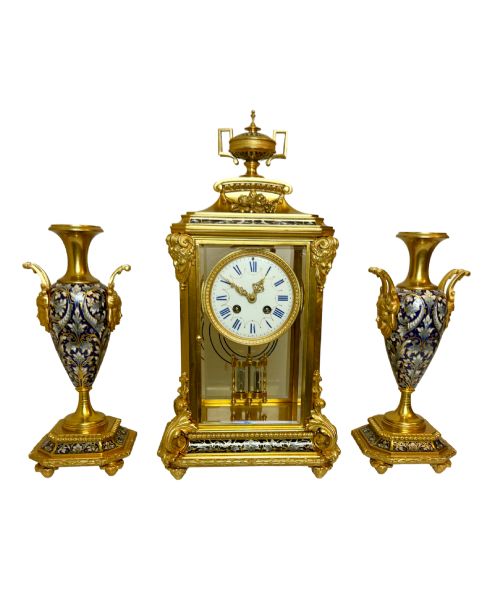


Champleve Brass Clock
A champleve brass clock brings heavy cast metal and colourful fused glass panels together into a striking timepiece from the nineteenth and early twentieth centuries.
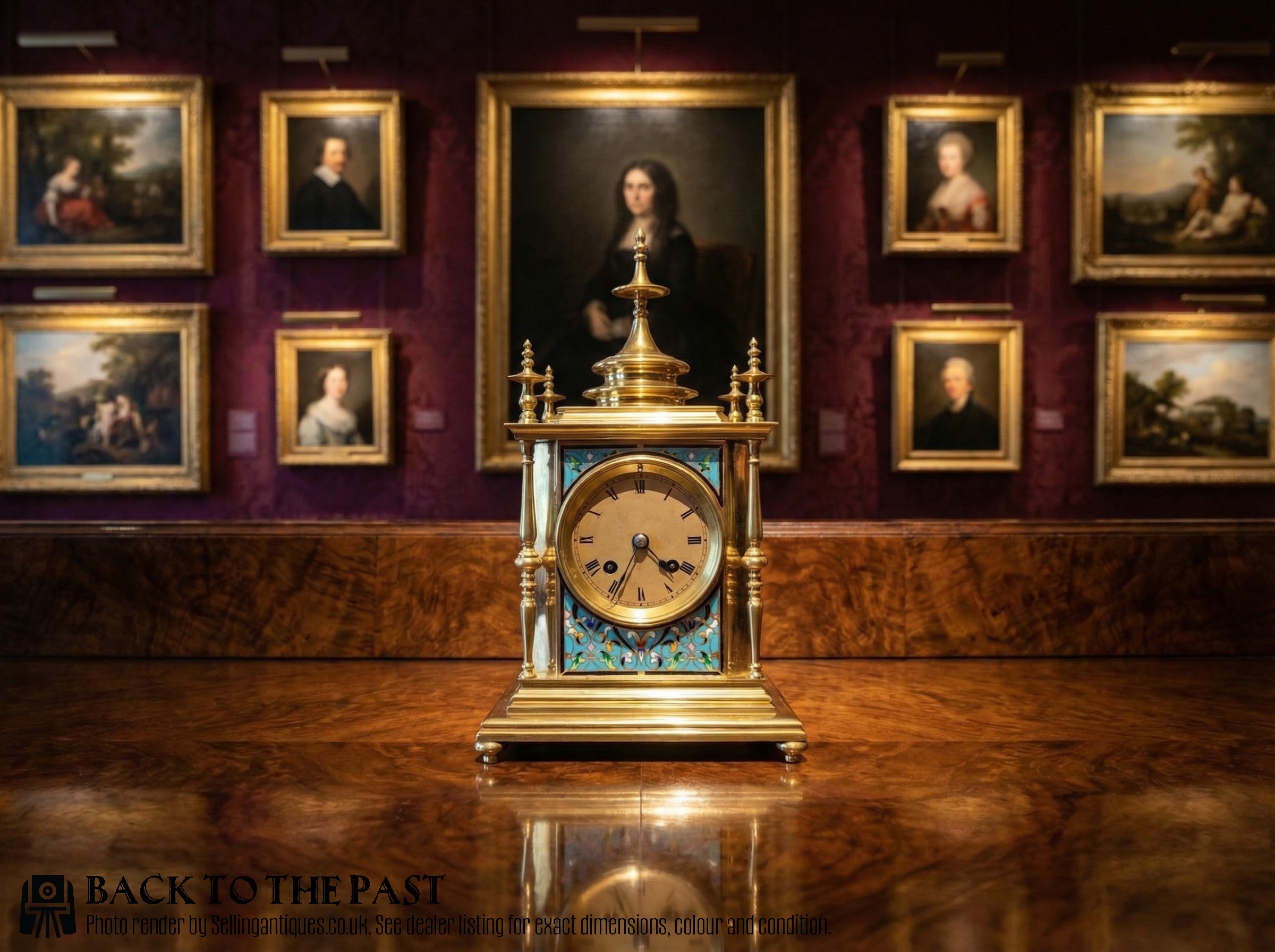
Champleve Brass Clock
A champleve brass clock is a domestic timekeeping device primarily encountered in French mantel, carriage and four glass regulator formats from the Victorian and Edwardian eras. These pieces range from substantial clock garniture sets with matching side urns down to miniature bedside or desk timepieces.
The objects combine structural brass or gilt bronze frames with recessed compartments filled with coloured enamel. Makers deployed these decorative techniques across diverse stylistic revivals, including French Rococo, Second Empire, and Belle Epoque designs.
How they were made
Workshops constructed these clocks using cast brass, gilt bronze, or ormolu as the structural body. Artisans channelled or hollowed out compartments directly into the metal surface to create troughs for the decorative decoration.
Vitreous enamel paste was packed into these recessed metal cells and fired at high temperatures to fuse the glass to the substrate. The cooled surface was then ground down and polished flush with the surrounding brass.
Listings feature brass, gilt bronze, ormolu, and glass, spanning Victorian, Edwardian, and Napoleon III periods.
What varies in quality
Quality rests in the crispness of the cast brass mounts and the depth of the enamel work. Finer examples display meticulous hand-chasing on the metal alongside smooth, evenly fired enamel panels free of surface pitting.
The complexity of the movement also dictates the tier of the piece, with repeating mechanisms and multi-glass regulator cases representing more ambitious manufacturing than simpler timepieces.
Barwise London·Leroy Paris·Samuel Marti·Vincenti
The Champleve Brass Clock Glossary
- Champleve Enamel
- A technique where troughs or cells are sunk into a metal surface and filled with vitreous enamel before firing. This method contrasts coloured glass directly against polished brass or bronze outlines.
- Clock Garniture
- A matching set consisting of a central clock flanked by decorative side ornaments such as urns or vases. These decorative suites were designed to display together on a mantelpiece.
- Crystal Regulator
- A mantel clock featuring bevelled glass panels on all four sides to expose the mechanical movement within. They frequently incorporate delicate enamel dial rings and mercury pendulums.
- Ormolu
- Finely ground high-carat gold mercury-gilded to a bronze or brass object. The process produces a rich, durable metallic lustre typical of luxury nineteenth-century French pieces.
- Carriage Clock
- A small, portable spring-driven timepiece fitted with a carrying handle and glass side panels. Many Victorian examples feature champleve enamel bands framing the dial.
Champleve Brass Clock: Frequently Asked Questions
How do I wind a champleve brass clock?
Use the appropriate winding key on the arbours located on the dial face or back movement plate. Turn gently until resistance is felt, avoiding over-winding.
Ensure you do not force the spring past its natural stop to protect the historical movement components.
What is a four glass clock?
A four glass clock is a mantel timepiece enclosed by thick bevelled glass panels held within a brass frame. This design allows light to pass through and reveals the inner mechanical movement.
They often feature enamel dial centres and decorative champleve framing around the bezels.
How do I date a champleve brass clock?
Examine the style of the cast brass case, the shape of the enamel dial, and any maker stamps on the back movement plate. Most surviving examples date from the Victorian, Napoleon III, and Edwardian periods.
French makers frequently stamped their medals and serial numbers directly onto the brass movement backplates.
Where should I place a clock garniture?
A clock garniture set looks best arranged as a triplet on a large mantelpiece, sideboard, or console table. The central clock stands between the matching side ornaments to create a balanced display.
Keep them away from direct sunlight and damp environments to protect the delicate enamel and gilt brass surfaces.