
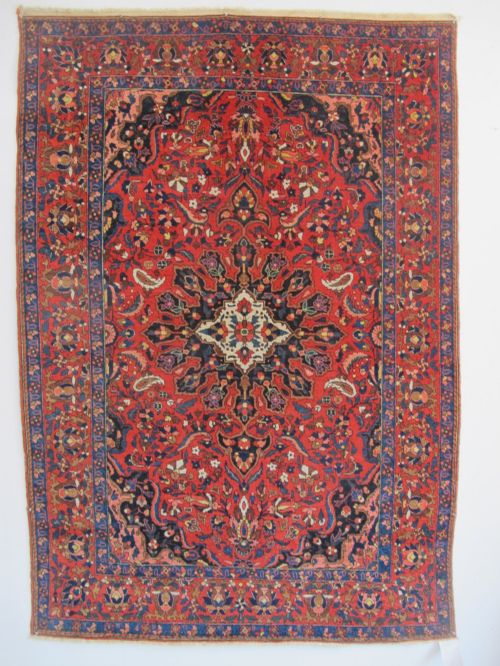
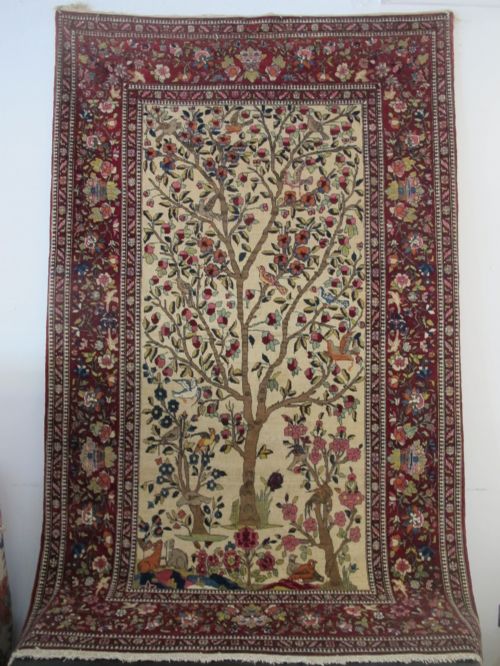


Central Persia Carpet
A central persia carpet brings sophisticated urban weaving and fine wool or silk into a room with remarkable depth of colour.
Central Persia Carpet
When searching for a central persia carpet, buyers encounter sophisticated city room-size floor coverings and smaller tribal village rugs originating from historic urban workshops. These pieces date from the late nineteenth century through to the mid-twentieth century, capturing periods of exceptional weaving skill.
The most common examples on this page hail from renowned weaving centres like Isfahan, Kashan, and Qum. They display intricate floral medallions, intricate vase designs, and precise all-over patterns rooted in traditional Persian aesthetics.
How They Were Made
Weavers utilised natural materials, predominantly knotting fine wool and occasionally lustrous silk onto sturdy cotton foundations. This combination allowed workshops to achieve high knot densities and remarkably crisp, detailed pictorial or geometric designs.
Dyers employed traditional plant and insect dyes to colour the yarns, producing rich shades of indigo, madder red, and ivory that mellow gracefully over decades of light exposure.
The listings span from 1880 to 1940, incorporating wool, cotton, and silk across Persian, tribal, and Ziegler styles.
What Varies in Quality
Quality rests upon the fineness of the knotting and the precision of the drawing across the field. Superior examples demonstrate expert control over proportion in the borders and medallion, whereas simpler work shows minor irregularities in the symmetry.
The grade of the wool also determines the handle and durability of the pile. Softer, high-grade wool yields a supple texture that drapes well and retains its definition under foot.
The Central Persia Carpet Glossary
- Medallion
- A central ornamental motif dominating the field of the carpet. It anchors the composition and is often mirrored in the corner spandrels.
- Knot density
- The number of knots per unit of area, usually measured horizontally and vertically. Higher counts permit greater graphic detail in floral patterns.
- Warp
- The longitudinal threads stretched tightly on the loom before weaving begins. The fringe is typically a continuation of these structural cotton or wool cords.
- Weft
- The horizontal threads passed across the warp after each row of knots. They bind the structure together and dictate the rigidity of the rug.
Central Persia Carpet: Frequently Asked Questions
Where were these carpets woven?
These textiles originated in historic workshops, towns, and nomadic regions across Iran. Major centres included Isfahan, Kashan, and Qum, alongside surrounding tribal territories.
Production spanned urban ateliers creating precise floral masterpieces and village weavers producing robust geometric carpets.
How do I care for my carpet?
Protect the pile by placing the rug in low-traffic areas or areas away from direct, harsh sunlight to preserve the natural dye colours. Regular gentle vacuuming without a rotating brush roll prevents dust accumulation in the wool.
Professional cleaning should be undertaken periodically by specialists familiar with antique Persian textiles.
How do I date a carpet?
Dating relies on stylistic shifts, dye types, and structural characteristics recorded in the weaving. Pieces from the late nineteenth century often display deeper vegetal palettes and looser village structures.
Early twentieth-century works frequently feature finer urban knotting and highly refined floral layouts characteristic of settled workshops.
What is the difference between city and tribal pieces?
City carpets like those from Isfahan or Kashan utilise professional cartoon designs drawn by master artists. They exhibit curves, precise floral sprays, and exceptionally high knot counts.
Tribal and village rugs rely on memory patterns handed down through generations. They showcase bolder geometry, latch hooks, and slightly more casual symmetry.