





Carved Wooden Wellington Chest
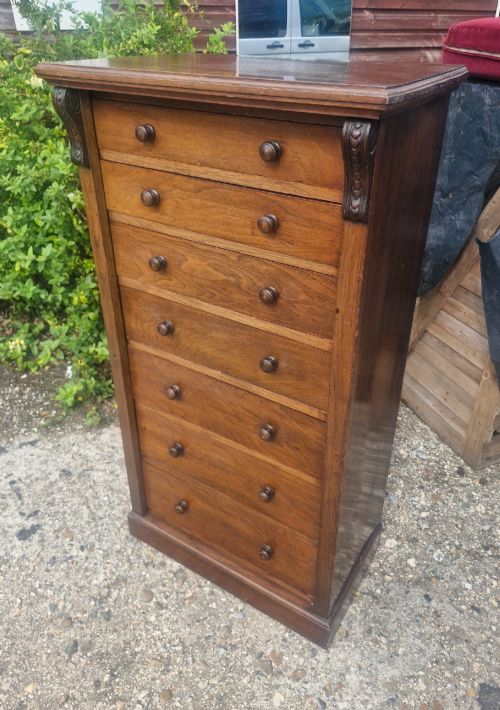
A carved wooden wellington chest is a tall, slender set of drawers secured by a locking side stile, prized for its clever security and compact footprint.

Carved Wooden Wellington Chest
The versions you are most likely to meet on this page span the Victorian period, along with occasional Regency, Anglo-Indian, and North African examples. These pieces vary from plain mahogany workhorses to heavily carved exotic timbers reflecting diverse regional aesthetics.
How they were made
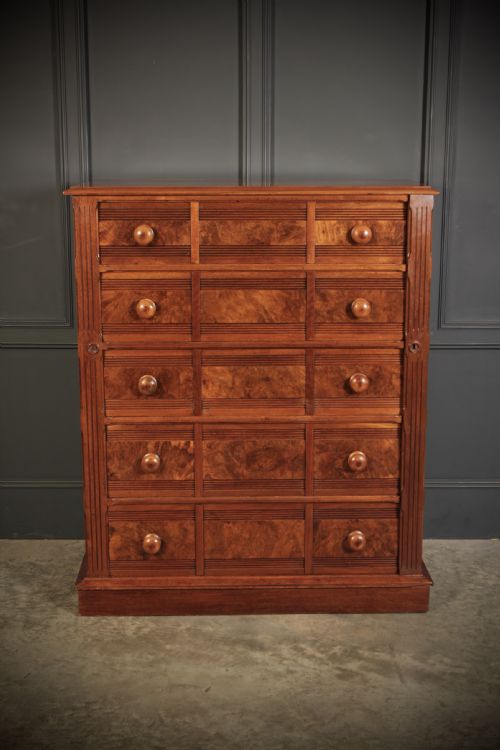
Cabinetmakers constructed these chests using dense hardwoods like mahogany, walnut, and rosewood, often veneered with highly figured burr walnut to catch the light. The distinctive locking mechanism relies on a swinging side stile that fastens over the drawer edges and locks with a key.
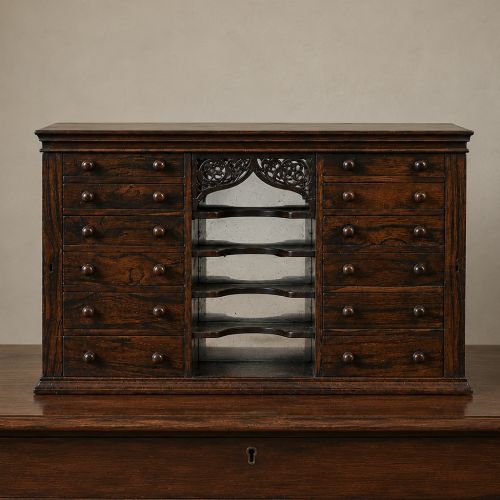
Carving was applied by hand to drawer fronts or structural pilasters, particularly on Anglo-Indian and North African interpretations using diverse hardwoods. Timber selection prioritised stability and grain pattern, ensuring the tall, narrow carcass remained true over decades of daily use.
Carved Wooden Wellington Chest Retail Price Guide 2026
Typical asking prices for carved wooden wellington chest among the pieces listed under this phrase on Sellingantiques today, from the lower quarter to the upper quarter. They describe what is for sale here now, not the wider market.
What varies in quality
The distinction between ordinary and exceptional pieces lies in the choice of timber veneer and the crispness of any hand-carved ornamentation. Finer examples display symmetrical burr walnut figures and tightly fitted locking stiles that operate smoothly without catching.
Proportion and structural integrity dictate the upper tier of the market, where taller chests maintain rigid verticality without leaning or binding in the drawer runners. Secondary timbers inside the drawers and the presence of original locks further separate standard workshop output from master cabinetwork.
The Carved Wooden Wellington Chest Glossary
- Wellington chest
- A tall, narrow chest of drawers characterised by a hinged locking bar on one side that secures all drawers simultaneously. The design dates back to the early nineteenth century.
- Pilaster
- A vertical architectural member projecting from the cabinet face, which on these chests swings outward to release the drawers. It often bears simple fluting or dense hand carving.
- Burr walnut
- A prized timber veneer taken from the knotted growths of walnut trees, displaying intricate, swirling grain patterns. It requires expert application to prevent lifting over large vertical surfaces.
- Stile
- The vertical framing member of the cabinet carcass that receives the locking bar. Its alignment is critical for the smooth operation of the security mechanism.
Carved Wooden Wellington Chest: Frequently Asked Questions
What is a wellington chest?
A wellington chest is a tall, narrow set of drawers that uses a hinged vertical locking stile on one side to secure the entire stack at once.
Originally designed for gentlemen's wardrobes or studies, this clever mechanism kept private journals, linens, or collections safe behind a single locked bar.
How do you open the drawers?
You first unlock and swing open the hinged side pilaster or stile that covers the right-hand edges of the drawer fronts.
Once this locking bar is swung clear, each drawer can be pulled out individually from top to bottom.
Where should I put one?
These chests suit narrow spaces, alcoves, or hallways where a standard wide set of drawers would block passage.
Their vertical proportions provide generous storage in a remarkably small footprint, fitting easily beside a bed or desk.
How do I spot a Victorian one?
Victorian examples typically feature rich mahogany or walnut timbers, traditional hand-cut dovetails, and substantial locking stiles down the front edge.
Later regional variations from the nineteenth and early twentieth centuries may incorporate deep relief carving influenced by Anglo-Indian or North African styles.