


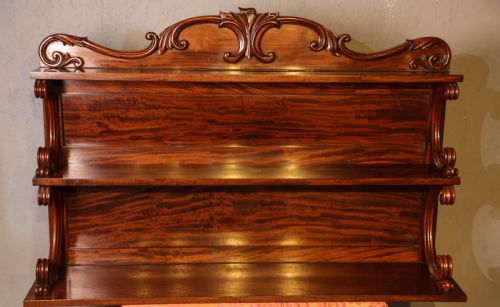


Carved Wood Display Brackets
These carved wood display brackets lift ornaments and timepieces off the floor, bringing period timber and gilding straight onto the wall.
Carved Wood Display Brackets
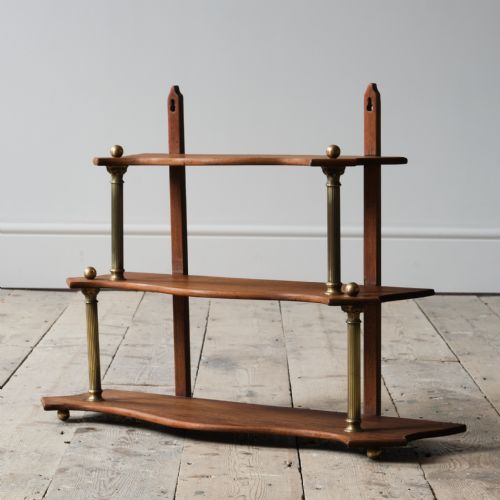
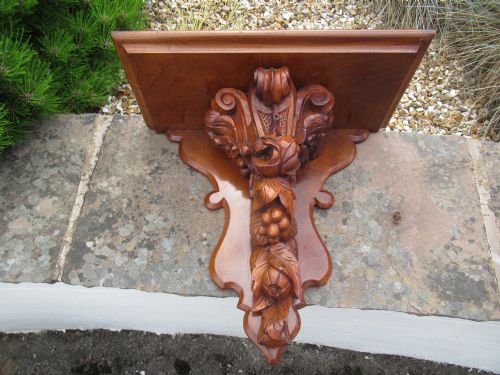
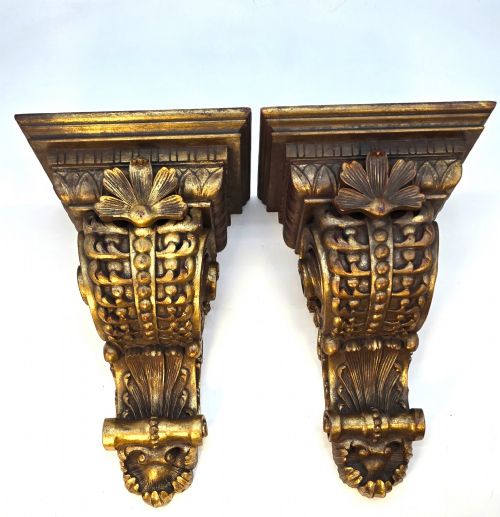
Carved wood display brackets comprise wall-hanging shelves, architectural corbels, and sconces designed to support decorative objects. You will frequently encounter Victorian walnut, mahogany, and giltwood examples shaped for corners or flat wall surfaces.
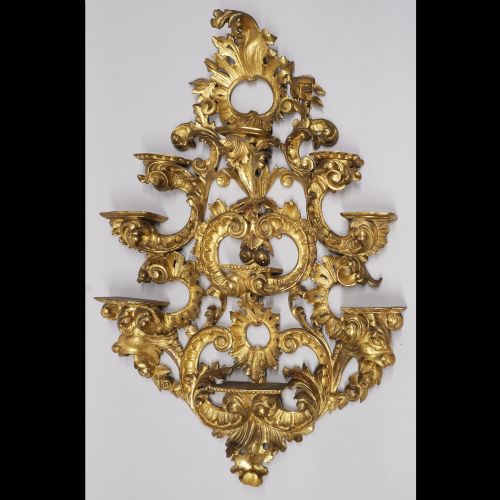
The selection ranges from simple nineteenth-century mahogany plate racks and clock brackets to elaborate Italian Rococo and Baroque-style giltwood pairs featuring cherubs. Smaller hanging shelves sit alongside substantial decorative display pieces created to hold porcelain or small sculptures.
Origins stretch from British workshops to Italian carving centres and the Black Forest, spanning the nineteenth century through to the early twentieth century. Walnut, oak, rosewood, and limewood dominate the domestic forms, while brighter gold leaf finishes define the continental decorative items.
How they were made
Craftsmen shaped these brackets primarily from solid hardwoods such as mahogany, walnut, oak, and limewood using traditional hand-carving chisels. Figures, foliage, and structural supports emerged directly from the timber before mounting plates or hanging loops were attached.
Many pieces received applied gilding, utilising gold leaf laid over prepared grounds on softwood or gessoed timber bases. Inlaid decoration also appears, notably in Sorrento olive wood examples where contrasting veneers create geometric or pictorial patterns across the shelf surfaces.
The listings here span the nineteenth century and early twentieth century, featuring materials from gold leaf and mahogany to olive wood and brass.
What varies in quality
The depth and crispness of the carving dictate much of the visual merit, separating fluid, hand-chiselled foliage from mechanical or shallow relief work. Reliefs involving figures, such as cherubs or eagles, rely heavily on the carver's anatomical understanding and attention to detail.
Surface preservation also shapes the standing of a piece, from the mellow patina built up on polished Victorian mahogany to the intact brilliance of original gold leaf. Integrity of construction, particularly where supporting ledges join the backplate, determines whether a bracket remains sturdy under weight.
The Carved Wood Display Brackets Glossary
- Giltwood
- Wood that has been coated with gold leaf or gold paint for a decorative metallic finish. This technique was widely utilised during the nineteenth century on Italian and Baroque-style wall brackets.
- Corbel
- A structural or decorative bracket projecting from a wall to support a weight above it. In furniture and antiques, the term often describes carved wooden supports used for display shelves.
- Sconce
- A wall-mounted bracket traditionally holding a candle, though the term also describes small wall shelves designed for display. American and European makers applied this to eagle-carved shelf units.
- Limewood
- A pale, fine-grained hardwood favoured by carvers because it cuts cleanly in any direction without splitting. It appears on detailed nineteenth-century decorative brackets where deep undercutting is required.
- Sorrento ware
- Woodwork decorated with micro-mosaic inlay, originating from the town of Sorrento in Italy. These pieces frequently employ olive wood and contrasting timbers to form geometric or scenic shelf panels.
Carved Wood Display Brackets: Frequently Asked Questions
How were wall brackets originally used?
These brackets served as elevated platforms for prized ornaments, clocks, and small sculptures, keeping valuable items safe from dust and accidental knocks on lower surfaces.
In Victorian and earlier interiors, they also acted as architectural focal points, filling empty wall spaces with decorative timber and gilt ornamentation.
How do I hang a heavy wooden bracket safely?
Most antique brackets feature original metal hanging loops or screw holes set into the backplate for wall mounting. You should anchor them directly into wall studs or use appropriate heavy-duty wall fixings matched to the weight of the timber.
Because many pieces project outward, the leverage places strain on the upper fixing point, making secure wall attachment essential.
How can I tell Victorian pieces from later ones?
Victorian pieces generally exhibit hand-cut joinery, older fixings such as slotted screws, and dense native timbers like walnut and mahogany. Stylistic cues also help, as heavy Victorian Italianate and Black Forest designs differ from the lighter early twentieth-century interpretations.
Examining the backboards and timber shrinkage provides further clues to the age of the construction.
Can these shelves support heavy display items?
Capacity depends entirely on the size of the bracket, the strength of the timber, and how securely the shelf joins the backplate. Small corner shelves and delicate giltwood brackets suit light porcelain or clocks, while larger oak or mahogany wall shelves handle heavier loads.