

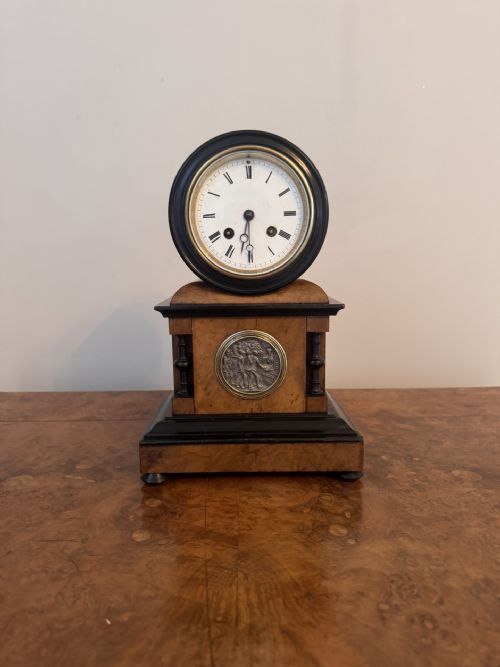
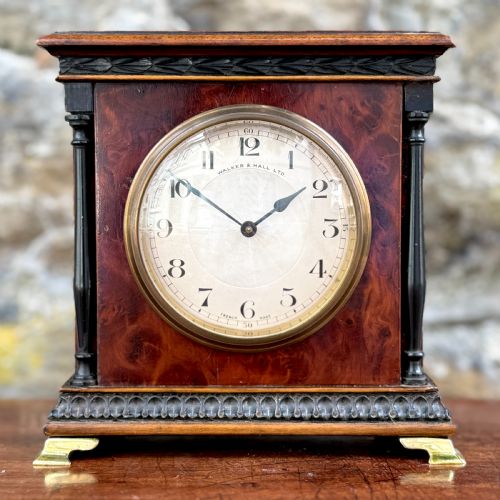
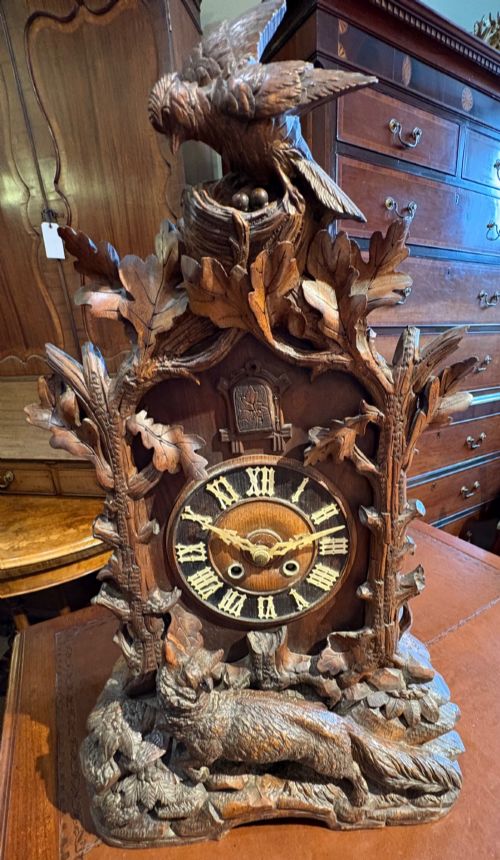


Carved Walnut Mantel Clock
These carved walnut mantel clock examples bring rich timber and precise movement into a room, offering both practical timekeeping and period craft.
Carved Walnut Mantel Clock
A carved walnut mantel clock is a domestic timekeeper designed to sit on a shelf, mantelpiece or bracket, housed in wooden cases shaped by nineteenth-century and early twentieth-century makers. The examples appearing here span periods from the mid-nineteenth century through the Victorian era and into the Edwardian years.
Most pieces you encounter combine walnut or burr walnut timber with carved wooden ornamentation, brass details and enamel dials. Forms range from traditional bracket clock shapes to Black Forest designs influenced by French Rococo or Gothic styles.
Origin points vary across Britain, Germany, Switzerland and France, reflecting international workshop traditions of the 1850s to the 1910s. Alongside standard mantel clocks, related bracket and wall clock forms occasionally appear in walnut timber.
How they were made
Cases rely on solid walnut, burr walnut and ebonised wood, shaped through cabinetmaking and hand-carving techniques. Timber surfaces are often figured to highlight the natural grain, complemented by applied brass mounts and ormolu.
Interior movements are paired with visible exterior dials in white enamel or metal, protected behind glass panels. Makers incorporated striking mechanisms, fusee movements and musical capabilities into the carved wooden housings.
Listings feature walnut, burr walnut, ebonised wood and brass across Victorian, Edwardian and mid-nineteenth-century periods.
What varies in quality
Quality separates simple production items from exceptional workshop output through the depth of the wood carving and the choice of timber figure. Burr walnut and richly figured grain sit at the upper end of the range, showing superior cabinetwork.
The complexity of the movement also divides the pieces, with triple fusee mechanisms and striking or musical trains representing higher standards of horological engineering than basic time-only models.
Walker and Hall·Connell of London·Lenzkirch
The Carved Walnut Mantel Clock Glossary
- Bracket clock
- A portable household clock originally designed to sit on a wall bracket. Many later examples stood directly on mantelpieces while retaining the traditional bracket name.
- Burr walnut
- Wood taken from a walnut tree growth featuring swirling, irregular grain patterns. Cabinetmakers prize this material for decorative clock cases.
- Fusee
- A conical pulley inside a clock movement that equalises the declining power of the mainspring as it unwinds. This mechanism improves timekeeping accuracy.
- Ormolu
- Gilded bronze or brass applied as decorative mounts on clock cases. The technique creates metallic highlights against dark walnut timber.
- Enamel dial
- A metal clock face covered with a fused glass surface for the numerals. These white dials provide a clear, durable background for the hands.
Carved Walnut Mantel Clock: Frequently Asked Questions
How do I wind a mantel clock?
Most mechanical clocks use a key inserted into winding holes on the dial face to tension the internal springs. Care must be taken not to overwind the movement.
Different mechanisms require weekly or fourteen-day winding intervals depending on the train configuration.
Where should I place a walnut clock?
These clocks sit securely on stable mantelpieces, flat shelf surfaces or dedicated wall brackets away from direct heat sources. A level surface ensures the pendulum swings evenly.
Keeping the clock away from damp or fluctuating temperatures preserves the walnut timber case and enamel dial.
How do I identify a Victorian walnut clock?
Victorian pieces often feature deep walnut carving, dark timber tones and specific decorative motifs reflecting nineteenth-century revival styles. Dating relies on case design, movement types and maker signatures.
Examine the rear door and interior movement for maker stamps or serial numbers that link the clock to specific decades.
What is a Black Forest clock?
Black Forest clocks originate from the mountainous region of Germany and Switzerland, known for elaborate hand-carved wood cases. They often incorporate rustic motifs, foliage and cuckoo mechanisms.
These pieces contrast with formal British bracket clocks through their pictorial carving and distinct regional styling.