

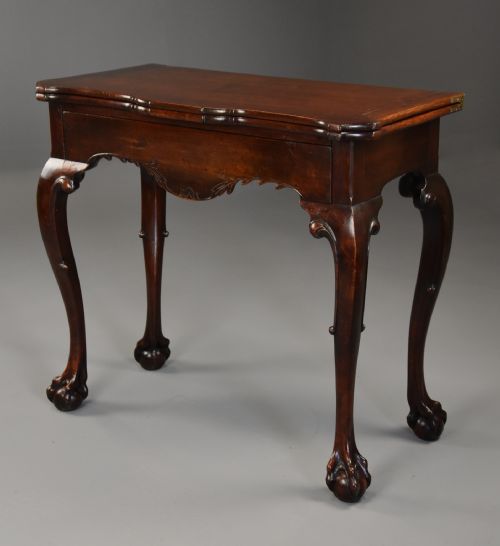


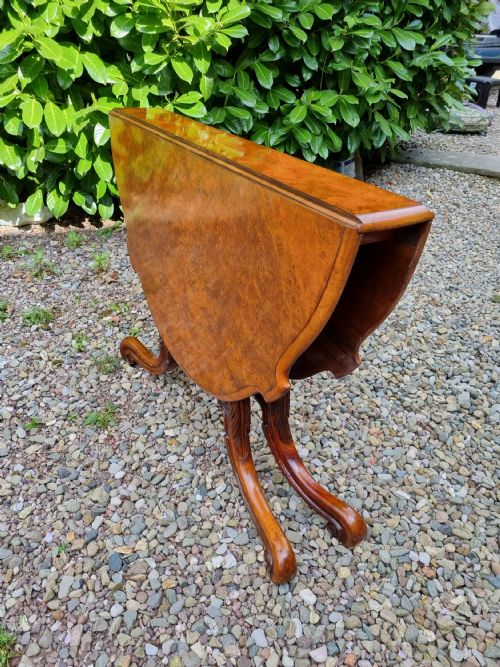


Carved Walnut Flap Table
A carved walnut flap table is a versatile surface for a room, offering folding leaves that extend the top when needed and drop away to save space.
Carved Walnut Flap Table
A carved walnut flap table is a practical antique surface designed with folding leaves that can be raised or lowered to suit the space. When you search for a carved walnut flap table, you encounter various forms including drop leaf tables, Sutherland tables, gateleg tables, and occasional tables spanning from the seventeenth century through to the twentieth century.
The pieces on this page draw from several distinct periods such as the Victorian era, the eighteenth century, and the seventeenth century, alongside revivals like Queen Anne style. Makers constructed these tables using rich timbers including burr walnut and black walnut, often incorporating functional elements like card tables, tea tables, and games tables.
Buyers are most likely to meet Victorian burr walnut drop leaf or Sutherland tables on this page, alongside earlier gateleg and tea table forms. These pieces demonstrate how walnut furniture adapted over centuries to serve dining, gaming, and occasional use in domestic interiors.
Materials and construction methods
Craftsmen utilised walnut and burr walnut timber for these flap tables, sometimes pairing the rich wood grain with secondary timbers, brass hardware, ceramic elements, leather, and iron. The choice of burr walnut provided distinctive figured patterns across the tabletops and flaps.
Joinery techniques varied according to the period, with seventeenth and eighteenth century examples utilising sturdy gateleg frames to support the falling leaves, while later Victorian versions often employed drop leaf and Sutherland mechanisms.
Listings feature walnut, burr walnut, mahogany, brass, ceramic, leather, and iron across pieces dating from the seventeenth century to 1920.
Assessing quality and craftsmanship
Quality in a carved walnut flap table rests upon the selection of the timber and the depth of the figuring in the burr walnut veneer. Superior examples display careful grain matching across the leaves and the main top.
The integrity of the folding mechanism and the crispness of the carving distinguish finer pieces from simpler utilitarian items. The patination of the wood and the condition of the hinges also dictate the standing of a table within the range.
The Carved Walnut Flap Table Glossary
- Burr walnut
- A type of walnut veneer taken from the growth knots of the tree, prized for its swirling, highly decorative grain patterns.
- Gateleg table
- A table with hinged legs that swing out from the centre frame to support folding leaves on either side.
- Sutherland table
- A narrow drop leaf table featuring particularly slender legs and leaves that fold down almost vertically.
- Card table
- A folding or pivoting table designed specifically for playing games, often lined with materials like leather or baize.
- Drop leaf table
- A table with a fixed centre section and hinged flaps that raise to enlarge the surface area.
Carved Walnut Flap Table: Frequently Asked Questions
What is a Sutherland table?
A Sutherland table is a specific form of drop leaf table characterised by its extremely narrow central frame and deep leaves that fold down almost vertically.
Victorian makers produced these tables frequently in burr walnut, creating a compact piece that could easily be tucked away against a wall when not in use.
How do gateleg tables work?
Gateleg tables utilise hinged legs that pivot outward from the base frame to provide physical support for the drop flaps when raised.
This construction allowed seventeenth and eighteenth century makers to build sturdy tables that could expand significantly for dining or tea.
How do I date a walnut table?
Dating a walnut table involves examining the construction techniques, hardware, timber selection, and overall style characteristics visible in the piece.
Earlier examples from the seventeenth and eighteenth centuries show distinct joinery methods compared to Victorian or twentieth century revivals.
How should I care for burr walnut?
Burr walnut requires protection from direct sunlight and extreme changes in temperature to prevent the delicate veneer from drying out or cracking.
Regular dusting with a soft cloth and occasional gentle waxing help maintain the natural lustre and patina of the polished wood surface.