
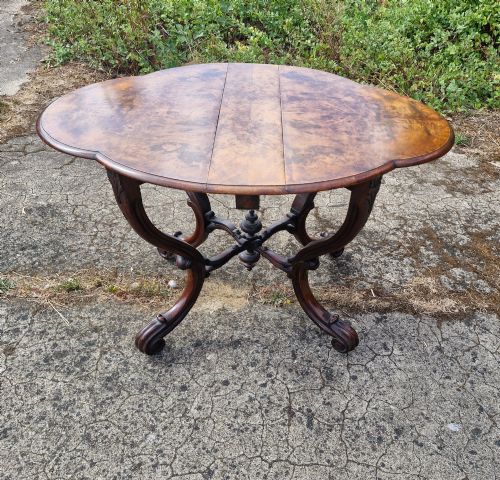
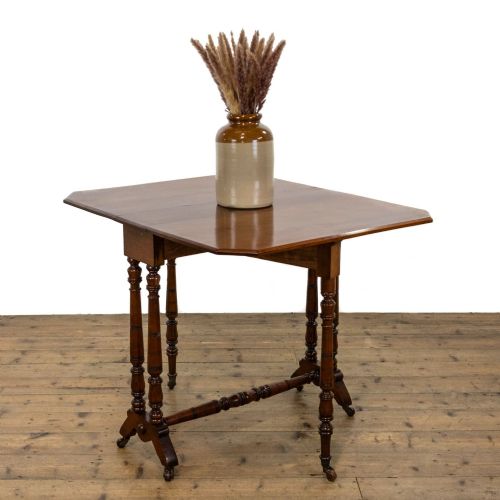
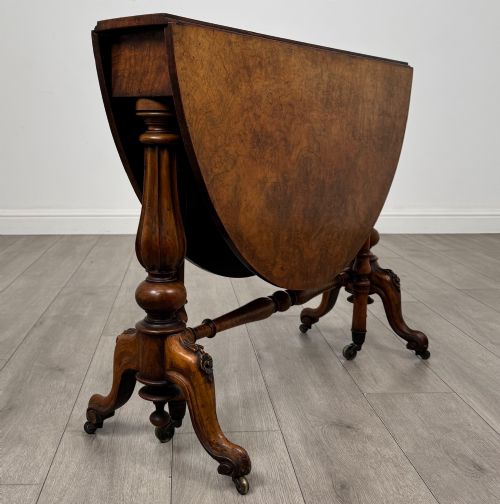

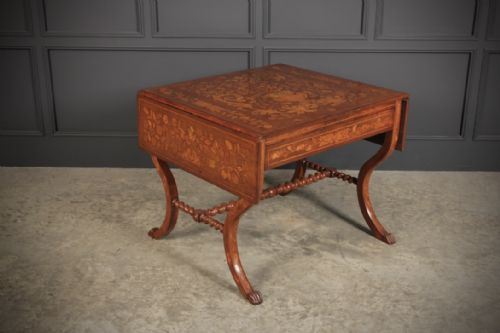
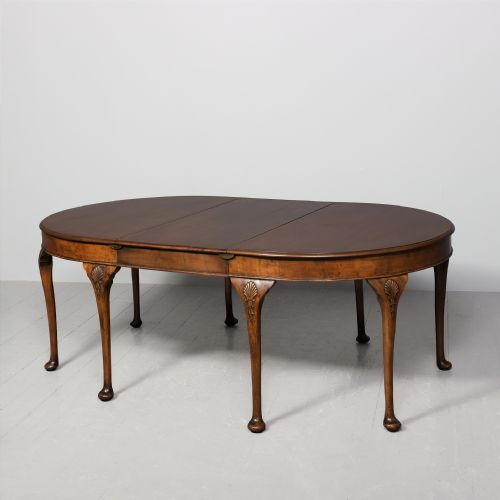


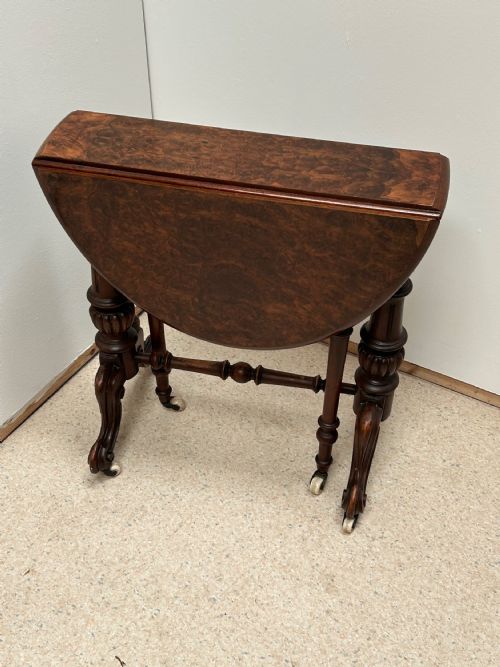

Carved Walnut Drop Leaf Table
A carved walnut drop leaf table brings warm timber and folding utility to a room, offering surface space that tucks neatly away when not in use.
Carved Walnut Drop Leaf Table
A carved walnut drop leaf table spans centuries of cabinet making, appearing most frequently in Victorian iterations alongside earlier examples from the eighteenth century. These pieces encompass various forms including compact Sutherland tables, gate leg designs, sofa tables, and occasional tables with folding flaps.
The versions you encounter most often on this page belong to the Victorian era, particularly smaller scale burr walnut Sutherland tables designed with hinged drop leaves. Alongside these, buyers find occasional tables, drop flap dining pieces, and occasional tables featuring marquetry or fruitwood inlay.
Makers drew upon historical revivals such as the Queen Anne style, George II style, and Dutch marquetry traditions to decorate the timber surfaces. Whether configured as a slim sofa table or a low coffee table, the core utility relies on the drop leaf mechanism supported by pivoting legs or scissor actions.
How they were made
Cabinet makers utilised solid walnut and decorative burr walnut veneers applied over secondary woods like mahogany to create rich, figured surfaces. The distinctive grain patterns of burr timber provided the primary visual interest on table tops and drop leaves.
Intricate decoration involved fruitwood inlay, wood marquetry, and carved details that reflected styles ranging from early eighteenth century traditions to nineteenth century revivals. Brass fittings, ceramic castors, and metal mechanisms frequently assisted the drop leaf and swivel top functions.
The selection spans seventeenth, eighteenth, nineteenth, and twentieth century pieces including Victorian and George II styles.
What varies in quality
The distinction between standard examples and the finest pieces rests upon the selection of the burr walnut veneer and the crispness of any carved ornamentation. Richly figured timber with balanced grain patterns elevates the visual weight of smaller occasional and Sutherland tables.
Construction integrity in the drop leaf hinges, gate leg pivots, and scissor actions determines how smoothly the table transitions between extended and folded states. Superior examples maintain alignment and stability in the folding flaps without looseness in the joints.
The Carved Walnut Drop Leaf Table Glossary
- Drop leaf table
- A table with a fixed centre section and hinged flaps that fold down to save space or lift up to enlarge the surface area. These clever folding mechanisms appear across various nineteenth and eighteenth century forms.
- Sutherland table
- A narrow table with exceptionally slender drop leaves that fold almost vertically down, supported by pivoting gate legs. This specific form became immensely popular during the Victorian period for occasional use.
- Burr walnut
- A specialised timber cut from walnut tree growths, prized for its swirling, highly figured grain patterns. Cabinet makers utilised these striking veneers to adorn the primary surfaces of superior tables.
- Marquetry
- The art of applying decorative patterns of wood veneers and fruitwood inlay to create pictorial or geometric designs on furniture tops. Dutch makers and Victorian revivalists employed this technique extensively.
- Gate leg table
- A table featuring hinged legs that swing outward like a gate to support the raised drop leaves. This traditional construction method provides sturdy structural support beneath extended flaps.
Carved Walnut Drop Leaf Table: Frequently Asked Questions
How do I use a drop leaf table in a small room?
Keep the leaves folded down against the sides to use the piece as a narrow console, sofa table, or lamp surface.
Lift the leaves and swing out the supporting legs whenever you need extra surface area for dining or working.
What is the difference between a Sutherland table and a standard drop leaf table?
A Sutherland table is a specific, highly compact subtype of drop leaf table designed with exceptionally narrow leaves and swinging gate legs that allow it to fold down to a remarkably slim profile.
Standard drop leaf tables often feature larger leaves and heavier underframes intended for dining or permanent placement.
How do I care for walnut and burr walnut surfaces?
Protect the polished timber from direct sunlight and excessive heat fluctuations to prevent the burr walnut veneer from drying out or cracking.
Dust gently with a soft, dry cloth and avoid applying modern silicone polishes that can build up on antique finishes.
How can I tell a Victorian walnut table from an eighteenth century one?
Victorian examples frequently display rich burr walnut veneers, elaborate marquetry inlay, and mechanical innovations such as scissor actions or ceramic castors.
Eighteenth century pieces typically showcase solid walnut construction, simpler gate leg mechanics, and structural characteristics suited to earlier domestic use.