




Carved Shell Armchairs
These carved shell armchairs bring historic form and tactile comfort to any room, offering enduring craft from centuries past.
Carved Shell Armchairs
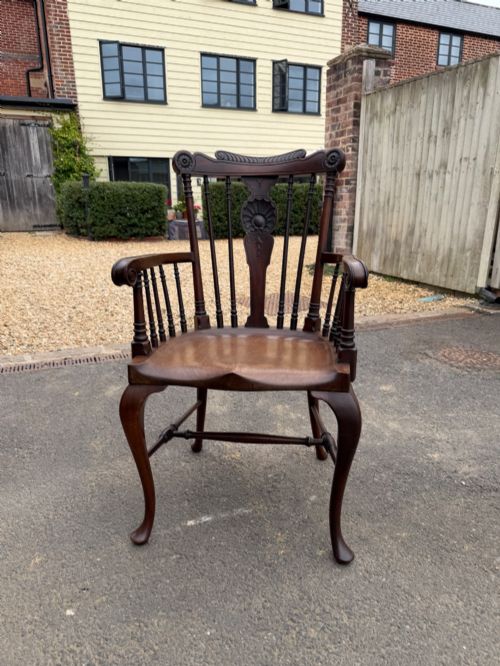
Carved shell armchairs encompass seating framed in rich hardwoods like mahogany and walnut, carrying decorative shell motifs rooted in Georgian and Victorian tastes. Buyers examining this selection encounter everything from sturdy nineteenth century library seating to early twentieth century revival pieces inspired by Queen Anne and George III designs.
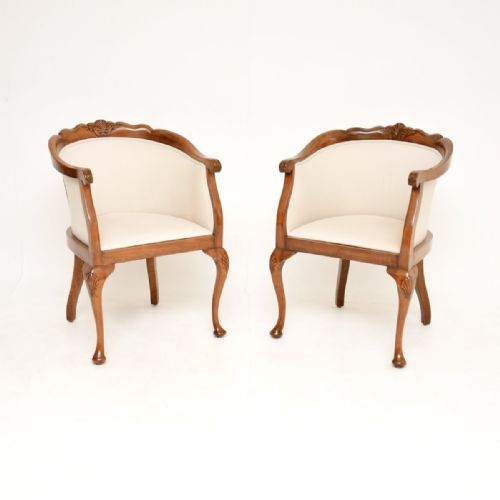
The assortment includes barrel backed armchairs, revolving desk chairs, and intimate childs armchairs, alongside pairs designed for symmetry in a study or drawing room. Alongside traditional European forms, occasional pieces incorporate intricate inlaid materials that reflect diverse regional traditions from the turn of the twentieth century.
Most examples rely on solid timber construction paired with upholstered pads, tapestry, leather, or textile coverings that soften the rigid lines of the carved frames. These chairs serve as both practical seating and focal points of historical design, bridging the gap between utilitarian comfort and ornamental sculpture.
How they were made
Traditional cabinet makers shaped these frames from dense hardwoods, predominantly selecting walnut and mahogany for their strength and capacity to hold crisp hand-carved details. Woodworkers utilised mortise and tenon joints to guarantee structural stability across high-stress points like the arm supports and back legs.
Surface ornamentation often involved careful hand-chiselling to define the fluted ridges of a shell motif along the crest rail or back splat. Workshops also integrated contrasting elements such as nacre shell inlay, securing mother-of-pearl fragments directly into carved channels within fruitwood or walnut structures.
Upholstery techniques varied from traditional horsehair stuffing secured with webbing to sprung bases covered in patterned fabric, tapestry, or leather. Showwood frames left polished timber exposed around the perimeter, while fully upholstered tub chairs prioritised continuous padded curves from the backrest down to the arms.
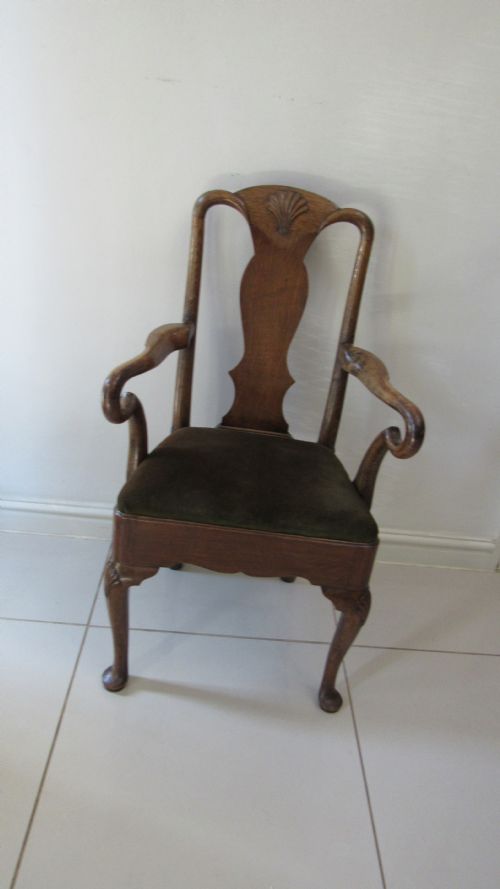
Even the smallest household members needed proper seating, as proven by the charming childs armchair included among the full-sized library and desk chairs.
What varies in quality
The standard of carving dictates much of the visual hierarchy among these chairs, separating crisp, deeply undercut shell motifs from softer, shallower machine-cut interpretations. Master carvers achieved symmetry and naturalistic flow in the ribs of a shell, whereas lesser examples display flat, uniform detailing.
Timber selection and grain matching further distinguish finer productions from utilitarian workshop output, particularly in how well the polished surfaces show off the natural figuring of walnut or mahogany. Superior joinery remains tight and uncompromised over decades of use, maintaining structural integrity without relying on excessive modern fasteners.
The integration of secondary materials, such as precision-cut nacre inlay or hand-stitched tapestry upholstery, elevates a piece beyond standard domestic furniture. Quality manifests in the harmonious proportion between the carved showwood frame and the supportive padding beneath the fabric.
The Carved Shell Armchairs Glossary
- Showwood
- Timber framing left visible around the upholstered elements of a chair, allowing the polished grain and carved details to remain on display.
- Barrel back
- A seating form where the backrest curves continuously around in a semi-circle to enclose the sitter, often padded for added comfort.
- Nacre
- The iridescent internal layer of mollusc shells, frequently utilised for decorative inlay work in nineteenth century and Middle Eastern furniture.
- Tub armchair
- A fully upholstered seating style featuring low, curved arms that merge seamlessly into a rounded backrest, resembling an open tub.
- X-frame
- A structural furniture base formed by intersecting diagonal timbers that create a cross shape when viewed from the side.
Carved Shell Armchairs: Frequently Asked Questions
How do I identify a revival chair?
Revival pieces often combine historical motifs like Queen Anne cabriole legs or George III shell carvings with manufacturing techniques and timber finishes typical of the late nineteenth or early twentieth century.
Closer inspection of the internal framing, secondary woods, and hardware usually reveals the true age of construction beneath an older stylistic disguise.
How should I care for showwood frames?
Polished timber frames require gentle dusting with a dry cloth and occasional application of appropriate furniture wax to nourish the wood and maintain its natural lustre.
Avoid placing antique seating in direct sunlight or near heat sources to prevent the timber from drying out or splitting.
Can I use these chairs daily?
Many of these sturdy hardwood chairs are well-suited for regular use, provided the frame joinery remains solid and the internal webbing or upholstery is secure.
Lighter occasional chairs or delicate inlaid pieces benefit from more mindful placement where heavy daily wear is less likely.