

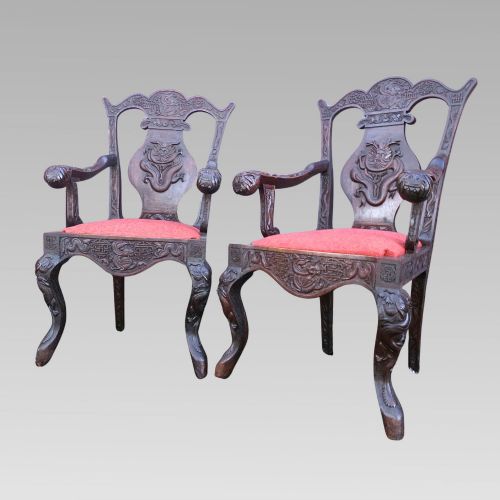


Carved Rosewood Arm Chair
These carved rosewood arm chair examples offer dense tropical hardwood and sculptural detail, bringing substantial presence and deep reddish-brown warmth to a room.
Carved Rosewood Arm Chair
A carved rosewood arm chair typically presents as a nineteenth-century seating piece, spanning Regency, William IV, and Victorian periods. The most common form on this page is the open or showwood armchair, frequently featuring upholstered components in velvet, fabric, or leather.
Beyond standard domestic seating, the selection includes specialised forms such as library armchairs, desk chairs, and elbow chairs. Influences stretch across stylistic boundaries, encompassing French Louis Philippe designs alongside Anglo-Indian colonial pieces and Qing Dynasty craftsmanship.
Assessing quality in rosewood seating
The standard of carving distinguishes routine production from superior workshop output, where crisp relief work on the crest rail and arms demonstrates skilled hand tool use. Depth and fluidity in floral or scroll motifs indicate the carver's mastery over the dense timber.
Structural integrity and timber selection further separate pieces, particularly where secondary woods support the primary rosewood veneer or solid construction. The refinement of turnings on legs and the integration of brass inlay determine the overall finish of the piece.
Some nineteenth-century armchairs include hidden castors tucked beneath scrolled feet, allowing heavy rosewood frames to glide across carpets without warning.
Gillows
The Carved Rosewood Arm Chair Glossary
- Rosewood
- A dense, heavy tropical hardwood valued for its rich dark colour and prominent grain patterns. It takes a high polish and provides a durable foundation for detailed carving.
- Showwood
- Unupholstered wooden framing left visible around the padded elements of an armchair. This exposed timber typically bears the primary carved ornamentation of the piece.
- Elbow chair
- An occasional chair featuring armrests, often scaled slightly smaller than a full armchair. These pieces frequently served at desks or around the perimeter of a formal room.
- Parcel gilt
- A decorative technique applying thin gold leaf or gilt paint to specific carved highlights on a wooden surface. It contrasts sharply against the dark rosewood grain.
- Cabriole leg
- A furniture leg that curves outward in a convex arc before tapering inward in a concave sweep. This classical form appears frequently on Victorian seating supports.
Carved Rosewood Arm Chair: Frequently Asked Questions
What periods do these armchairs date from?
The pieces span the eighteenth, nineteenth, and early twentieth centuries, with the majority originating during the Regency, William IV, and Victorian eras.
Craftsmanship reflects the shifting design preferences of these periods, moving from classical brass-inlaid Regency lines to heavily carved Victorian showwood frames.
How do I care for rosewood furniture?
Maintain the timber by keeping the chair away from direct heat sources and strong sunlight, which can dry out dense tropical hardwoods and fade the finish.
Apply a traditional beeswax polish sparingly to nourish the wood surface and preserve the natural sheen of the grain.
What is an Anglo-Indian chair?
Anglo-Indian pieces reflect furniture made in India during the colonial period, frequently utilising dense regional timbers like padauk and rosewood.
These chairs combine European seating forms with intricate local carving traditions, resulting in highly detailed floral or figural motifs.
Are these chairs suitable for daily use?
Most of these seating pieces are structurally sound for regular sitting, provided the underlying joinery and upholstery webbing remain stable.
Library armchairs and desk chairs were built specifically for functional daily utility, though delicate showwood frames benefit from measured handling.