
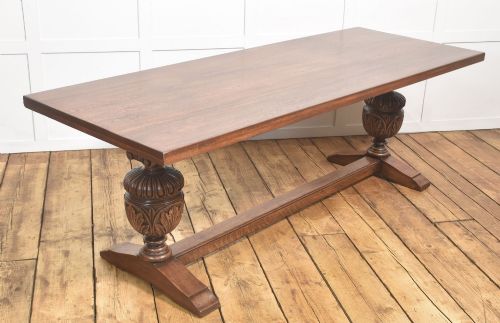
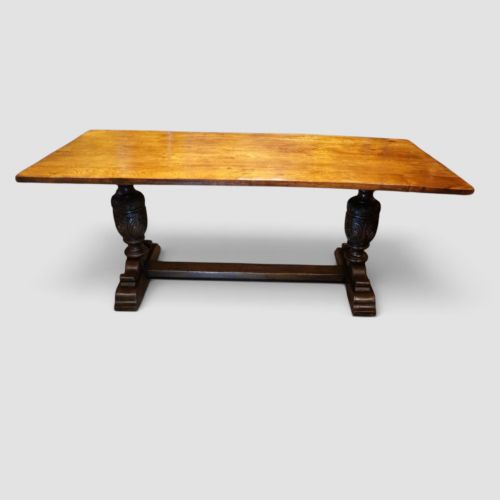
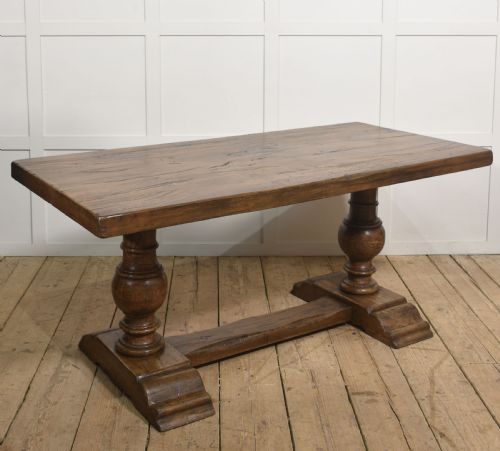


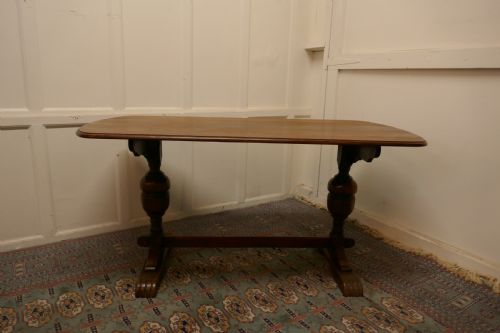




Carved Pedestal Trestle Table
A carved pedestal trestle table brings sturdy timber and classical form into a room, offering a functional surface rooted in centuries of cabinetmaking tradition.
Carved Pedestal Trestle Table
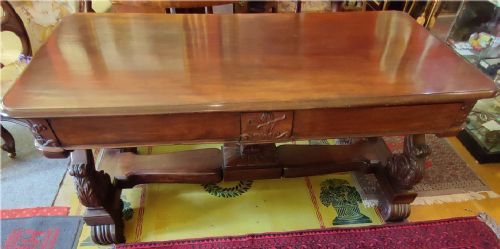
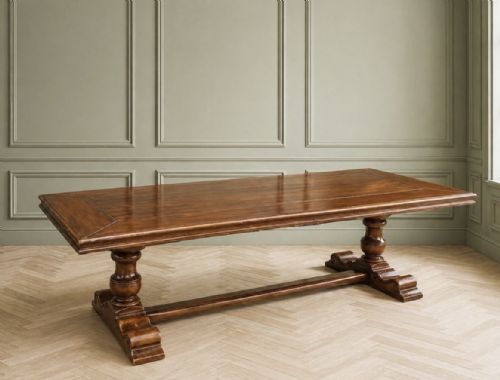
A carved pedestal trestle table represents a robust category of furniture designed primarily for dining, writing, or central room placement. When exploring this phrase, buyers encounter various domestic forms including refectory dining tables, library tables, and centre tables.
The pieces appearing on this page span several distinct periods, with nineteenth-century examples and early twentieth-century revivals predominating. Historic iterations draw heavily upon Jacobean, Tudor, Renaissance, and Regency stylistic traditions.
Makers adapted these forms for different domestic settings, producing long refectory formats alongside more compact writing desks and kidney-shaped tables. Solid timber construction dominates the selection, though occasional veneer work appears on specific nineteenth-century pieces.
Materials and construction methods
Cabinetmakers relied on sturdy hardwoods, predominantly oak, mahogany, walnut, and rosewood, to construct these large surfaces. Solid oak and walnut form the backbone of the heavier refectory and farmhouse styles, while mahogany and rosewood frequently serve finer library and centre tables.
Structural integrity depended upon traditional joinery techniques suited to supporting heavy timbers over wide spans. Carved detailing on pedestals, legs, and aprons demonstrates the hand-chiselled work characteristic of revival and period workshops.
Listings feature woods including oak, mahogany, walnut, and rosewood, spanning periods from the nineteenth century through the 1930s.
Distinguishing quality in construction and material
Quality rests upon the selection of timber and the depth of hand-carving executed on the pedestals and supports. Dense, well-figured oak, rich mahogany, and finely grained walnut denote superior examples compared to simpler utility pieces.
The crispness of the carved ornamentation distinguishes master workshops from standard production. Well-proportioned framing and sound structural joinery ensure that the table remains stable and balanced across its lifespan.
Currie And Co·Gillows
The Carved Pedestal Trestle Table Glossary
- Refectory table
- A long dining table traditionally used in communal dining halls and adapted for domestic dining rooms. These examples feature substantial length and sturdy underframes.
- Centre table
- A freestanding table designed to sit in the middle of a room rather than against a wall. They showcase finished work on all sides.
- Trestle
- A supporting framework consisting of a horizontal beam supported by two pairs of sloping legs. This construction provides strong floor contact and leg clearance.
- Regency
- An English design period spanning the early nineteenth century defined by classical restraint and archaeological influence. Pieces from this era often utilise mahogany or rosewood.
- Jacobean Revival
- A nineteenth and early twentieth-century style imitating seventeenth-century English furniture. It employs dark oak, heavy turning, and deep geometric carving.
Carved Pedestal Trestle Table: Frequently Asked Questions
How do I date a carved pedestal trestle table?
Dating relies on identifying the primary wood species, construction marks, and stylistic vocabulary present in the carved elements. Nineteenth-century pieces often display distinct Regency or Dutch characteristics, whereas early twentieth-century examples frequently follow Jacobean or Tudor revival idioms.
Examining the underside and joint construction provides further clues to the manufacturing era. Machine-cut components point towards later periods, while hand-finished joinery suggests earlier craftsmanship.
Where should I place a centre table?
A centre table works best positioned in the middle of a spacious room, entrance hall, or library where it can be viewed from all angles. Because these pieces are finished on every side, they serve as focal points rather than resting against a wall.
Ensure adequate clearance around the perimeter of the table to allow comfortable movement and seating access. Pairing the surface with a central lighting fixture enhances its visual presence in the space.
What is the difference between a refectory and a library table?
Refectory tables traditionally offer long, narrow proportions intended for dining, supported by heavy trestles or sturdy legs. Library tables are generally designed for working or displaying volumes, sometimes featuring drawers or kidney-shaped tops.
While both utilise dense hardwoods like oak, walnut, or mahogany, library tables often lean towards refined Regency or Victorian styling. Refectory formats frequently emphasise rustic farmhouse or revival aesthetics.
How do I care for antique hardwood tables?
Maintaining antique hardwood requires shielding the surface from direct sunlight and excessive moisture fluctuations. Regular dusting with a soft, dry cloth preserves the polished finish without building up heavy chemical residues.
Applying a traditional beeswax periodically helps nourish older timber like oak and mahogany. Avoid placing hot or wet items directly onto the wood to protect the vintage surface.