






Carved Oak Settle Chest
These carved oak settle chest pieces combine robust seating with concealed storage, offering a practical country house staple that anchors an entrance hall.
Carved Oak Settle Chest
A carved oak settle chest brings together a high-backed seat or folding top bench with an integrated storage box beneath the squab. When you search for a carved oak settle chest, you meet heavy timber forms designed for draughty hallways and multipurpose rooms.
The pieces on this page span from the seventeenth century through the Victorian era up to the early twentieth century. Common stylistic expressions include Jacobean Revival, Gothic Revival, Flemish Baroque, and rustic farmhouse interpretations.
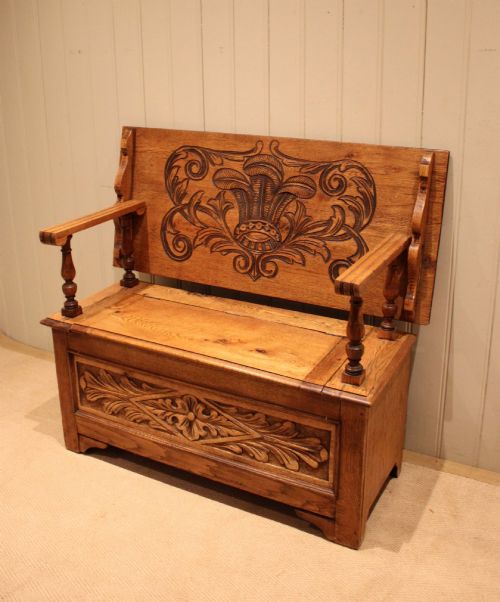
Makers adapted these dual-purpose seats into various configurations, including straight-back settles, hall benches, and monks benches with convertible tabletops. Solid oak construction dominates the inventory, frequently paired with brass or iron hardware.
Materials and construction
Solid oak forms the core structural material for these settles and chests, chosen for durability and dense grain. Craftsmen utilised traditional joinery techniques, framing panels into heavy stiles and rails to accommodate seasonal wood movement.
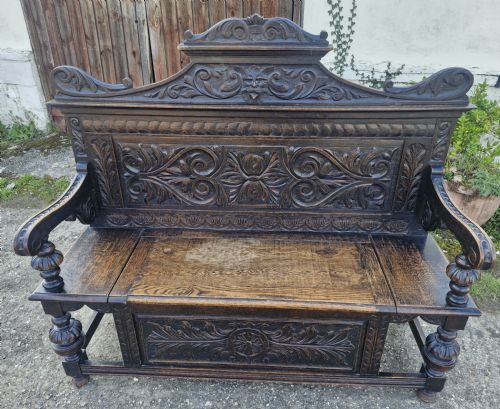
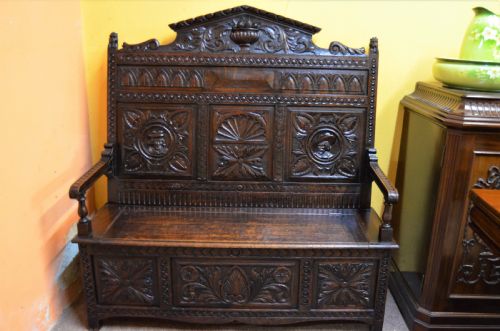
Carving provides the primary ornamentation across backs, friezes, and coffer fronts. Artisans employed chip carving, relief work, and panel moulding, occasionally incorporating distinct motifs such as the Green Man.
Listings feature solid oak combined with iron and brass hardware across forms like monks benches, hall benches, and straight-back settles.
Assessing quality and character
Quality rests in the depth and crispness of the timber carving and the integrity of the solid oak construction. Superior examples display thoughtful proportions and harmonious integration between the bench back and the lower chest base.
Surface finish and timber patination also divide pieces, with mature beeswax finishes showing the grain depth better than modern varnishes. Original iron or brass hinges and fittings add authenticity to older examples.
The Carved Oak Settle Chest Glossary
- Monks bench
- A multifunctional seat featuring a hinged back that folds down flat over the arms to form a table. This convertible design served domestic spaces where floor space was at a premium.
- Green Man
- A decorative architectural motif depicting a human face carved with leaves, vines, or branches sprouting from the mouth. It appears frequently on Victorian and revival oak furniture.
- Coffer
- A large wooden chest used historically for storing valuable items, textiles, or documents. In settle chests, this serves as the base compartment beneath the seat.
- Jacobean Revival
- A nineteenth-century design movement that copied or reinterpreted seventeenth-century English furniture forms. Pieces in this style typically feature dark finishes, geometric mouldings, and strapwork carving.
- Stile
- The vertical outer member of a panelled wooden frame. In sturdy oak seating, substantial stiles bear the weight of the backrest and arm assemblies.
Carved Oak Settle Chest: Frequently Asked Questions
What is a monks bench?
A monks bench is a dual-purpose piece of furniture where the backrest pivots or folds down to rest upon the arms, transforming the seating into a table surface. The base beneath remains a box chest for storage.
Such convertible items suited smaller historical dwellings by consolidating two heavy household items into a single footprint.
How do I date a carved oak settle?
Dating relies on examining the construction methods, tool marks, and stylistic vocabulary of the carving. Seventeenth-century examples often display pegged mortise and tenon joints with hand-split panels, while Victorian revival pieces show more uniform machine-sawn timber.
Hardware types like hand-forged iron hinges versus mass-produced brass screws also help establish the approximate period of manufacture.
Where should I place a hall settle?
A hall settle works best against a solid wall in an entryway, boot room, or large landing where its high back can block draughts. The internal chest provides practical concealed storage for shoes, blankets, or winter accessories.
Ensure there is enough clearance in front of the piece if you choose a convertible monks bench model that opens into a table.
Are these pieces made of solid oak?
The inventory consists predominantly of solid oak and heavy timber construction. Carpenters used thick planks for the seat boards, lid panels, and structural framework to withstand heavy daily use.
Secondary woods may occasionally appear in hidden structural areas such as internal baseboards or drawer linings on related coffer forms.