
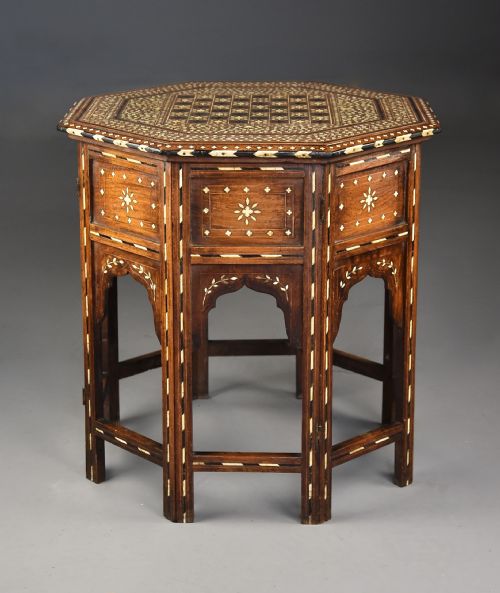
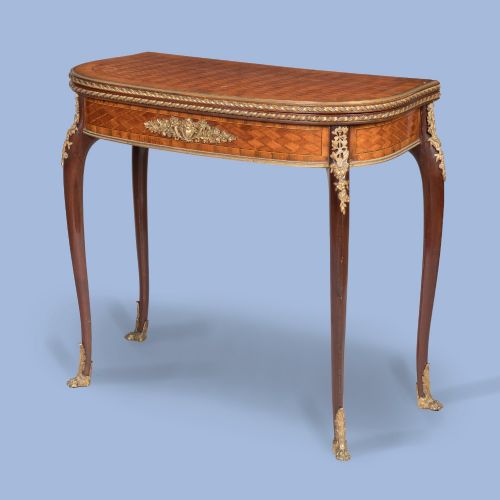


Carved Marquetry Games Table
A carved marquetry games table brings intricate floral and geometric wood veneers together with a fold-over or chess-topped surface designed for evening leisure.
Carved Marquetry Games Table
A carved marquetry games table combines the dual purpose of a functional social surface with decorative inlay work, spanning the eighteenth to the early twentieth century. These pieces emerge predominantly in Victorian iterations alongside Dutch Baroque and Georgian forms, reflecting shifting domestic pastimes.
Geographic origins vary widely across the selection, encompassing English Victorian workshops, French walnut and ormolu-mounted designs, and Anglo-Indian or Ceylonese specimens. Buyers encounter everything from serpentine-fronted burr walnut examples to Dutch floral marquetry pieces.
Assessing quality and execution
The precision of the marquetry inlay and the choice of timber figure set the best examples apart from standard production. Richly figured burr walnut and multi-wood veneers demand superior cabinetmaking skill to ensure the patterns align smoothly across folding leaves and curved serpentine edges.
Structural integrity in the pivoting or folding mechanisms determines daily usability in antique games tables. Fine examples maintain tight joints, smooth rotation on centre tables, and crisp hand-carving that remains sharp without softening from excessive past restoration.
Victorian and nineteenth-century pieces form the largest chronological grouping, supplemented by eighteenth-century Georgian and Dutch examples.
The Carved Marquetry Games Table Glossary
- Marquetry inlay
- Decorative patterns formed by fitting small pieces of wood veneer into a timber ground. This technique creates pictorial or geometric designs across tabletops.
- Burr walnut
- Timber taken from the growth excrescence of a walnut tree, producing swirling, highly decorative grain patterns. Cabinetmakers prize this wood for Victorian tabletop surfaces.
- Tunbridge Ware
- Small-scale mosaic woodwork comprising tiny wood blocks assembled to form geometric or floral motifs. It frequently decorates nineteenth-century English games tables.
- Ormolu
- Gilt bronze mounts applied to furniture for decorative enrichment. French revival tables often utilise these cast metal ornaments along the edges and legs.
- Serpentine shape
- A undulating curved line featuring a convex centre flanked by concave sides. This profile appears frequently on the skirts of mid-nineteenth-century card tables.
Carved Marquetry Games Table: Frequently Asked Questions
How do you use a games table?
These tables typically feature a hinged top that folds open to double the surface area for card games, or lifts to reveal a recessed well for chess and backgammon. Many designs incorporate hidden compartments or workboxes beneath the playing surface for storage.
In period interiors, they functioned as versatile furniture pieces that stood against a wall when closed and moved into the room for evening entertainment.
What is the difference between a card table and a games table?
A card table specifically references a surface designed for card playing, usually equipped with a fold-over top lined with baize, felt, or leather. A games table encompasses a broader category that may include integrated chessboards, backgammon boards, or multi-use surfaces.
Both forms share similar cabinetmaking techniques from the eighteenth and nineteenth centuries, though chess-specific tables often feature fixed marquetry inlay on the top.
How do I date a Victorian marquetry table?
Dating relies on identifying the combination of wood species, carcass construction, and prevailing revival styles such as Louis XV or Dutch Baroque. Mid-nineteenth-century examples often showcase burr walnut veneers paired with heavy pedestal bases or carved cabriole legs.
Examining secondary timbers inside drawers and the style of brass hinges provides additional chronological indicators for pieces spanning the eighteen-fifties to the eighteen-eighties.
Can I use an antique games table daily?
These tables withstand normal domestic use provided they receive careful treatment regarding moisture, direct sunlight, and weight distribution on folding leaves. The delicate hinges and pivot mechanisms on card tables require gentle handling when opening and closing.
Maintaining stable room humidity protects the underlying veneer and marquetry inlay from shrinking or lifting over time.