
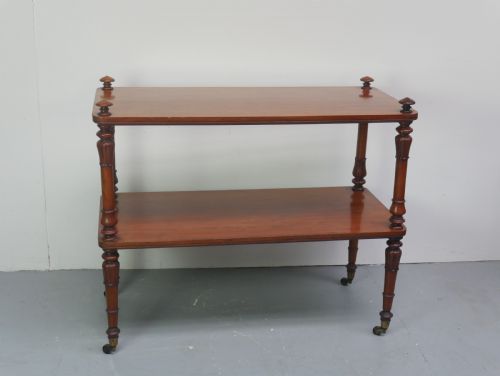


Carved Mahogany Dinner Server
These carved mahogany dinner server pieces bring robust timber and tiered utility to any dining room.
Carved Mahogany Dinner Server
A carved mahogany dinner server stands as a substantial dining room furnishing designed for holding dishes and serving food. The pieces matching this search phrase include Victorian and nineteenth-century examples alongside William IV and George IV forms.
Most entries on this page take the shape of three-tier buffets, serving tables, sideboards, or telescopic dumb waiters. These functional items reflect the dining customs of the nineteenth century, utilising dense timber to support heavy service vessels.
Origins point primarily to English cabinet-making traditions from around eighteen-fifty to eighteen-eighty. Buyers meet pieces ranging from simple two-shelf side tables to elaborate multi-tiered display stands fitted with brass elements.
How they were made
Makers shaped these servers using solid and veneered mahogany, a dense tropical timber prized for its deep reddish-brown grain. Workshops turned supports and carved decorative edges by hand to achieve the distinct profiles seen across the period.
Hardware components incorporate cast brass details and occasionally ceramic castors to ease movement across heavy carpets. Construction methods rely on traditional joinery to support multiple stacked tiers without sagging under weight.
Every listing on this page uses mahogany as the primary material, spanning the nineteenth century with Victorian, William IV, and George IV styles.
What varies in quality
The standard of a carved mahogany dinner server depends on the depth and crispness of its woodwork ornamentation. Subtly turned uprights and well-proportioned tiered shelves separate superior cabinet-making from simpler workshop production.
Proportion and structural integrity dictate the standing of a piece within its period. Examples retaining original brass fittings and smooth telescopic mechanisms demonstrate higher original craftsmanship.
Gillows of Lancaster and London·Maple and Co
The Carved Mahogany Dinner Server Glossary
- Mahogany
- A durable tropical hardwood with a rich reddish-brown colour that darkens with age. It serves as the primary material for the pieces found on this page.
- Dumb waiter
- A multi-tiered serving stand with shelves used for holding dishes during a meal. These tiers often feature raised edges or turned supports.
- Buffet
- A sideboard or serving table designed for the presentation and service of food. They appear frequently in nineteenth-century dining room layouts.
- Telescopic
- A descriptor for stands or dumb waiters possessing an adjustable central shaft. This mechanism allowed users to alter the height of individual shelves.
- William IV
- A British design style spanning the eighteen-thirties, characterised by robust classical revival motifs. Furniture from this period employs heavy scrolls and bold turnings.
Carved Mahogany Dinner Server: Frequently Asked Questions
What is a tiered server used for?
These pieces held extra dishes, glassware, and serving platters during large Victorian dinner parties. They kept dining tables clear while keeping food and drink within easy reach.
Today they function as display furniture or practical side tables in dining rooms and hallways. Their multiple shelves offer substantial surface area for objects without taking up excessive floor space.
How do I identify a Victorian piece?
Victorian servers often feature heavier proportions, dark mahogany timber, and distinct carved details like scrolls or rope-twist edges. Many include maker stamps or brass castors typical of the mid to late nineteenth century.
Earlier examples from the George IV or William IV periods display slightly different classical revival motifs. Comparing shelf configurations and turning styles helps clarify the decade of manufacture.
Are these servers difficult to maintain?
Mahogany requires basic care using soft cloths and periodic waxing to protect the timber grain from drying out. Avoiding direct sunlight and sudden temperature changes preserves the finish.
The structural weight of the wood means joints stay stable under normal conditions. Regular checks of any brass castors or telescopic mechanisms ensure smooth operation.
What is a telescopic dumb waiter?
A telescopic dumb waiter incorporates a central adjustable column that allows the upper tiers to raise or lower. This mechanical feature gave Victorian hosts flexibility during service.
Such pieces represent more complex cabinet-making than fixed-shelf variants. They remain sought after for their mechanical ingenuity and versatility.