


Carved Bone Inlaid Chair
A carved bone inlaid chair brings intricate geometric detail and historic craft to a room, offering striking focal seating.
Carved Bone Inlaid Chair
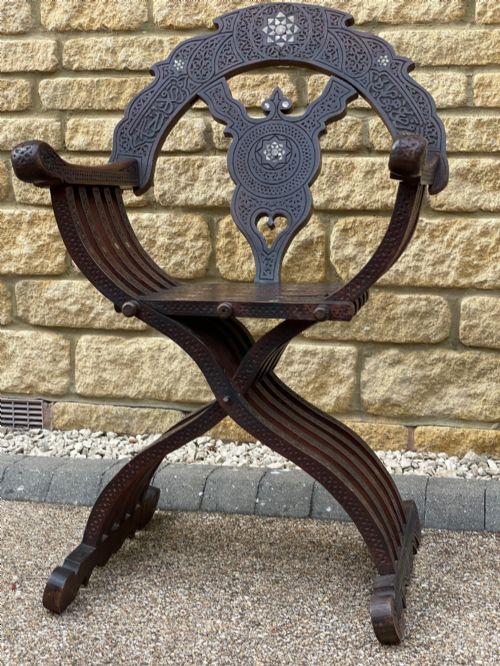
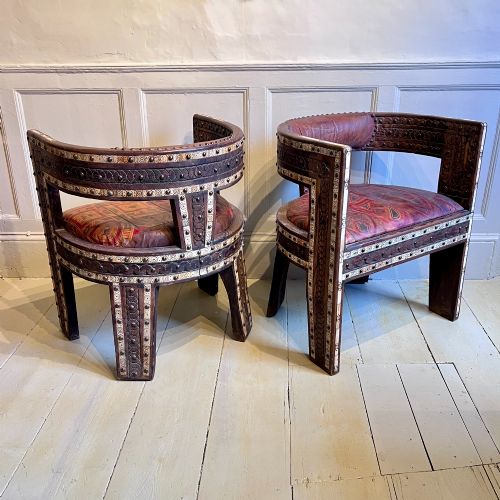
A carved bone inlaid chair combines dense timber framing with contrasting pale bone elements, creating intricate geometric or floral surface patterns. When exploring a carved bone inlaid chair, buyers encounter diverse regional traditions ranging from Syrian and Moorish workshops to Portuguese and Italian iterations. Forms span from folding campaign models and corner seats to grand armchairs featuring pierced panels and turned woodwork.
The regional variety seen in these listings reflects distinct aesthetic lineages, including Moorish Revival, Syrian Ottoman, and Renaissance Revival styles. Many examples incorporate intricate Mashrabiya woodwork alongside the signature bone and mother-of-pearl embellishments. These pieces serve primarily as accent seating or decorative focal points in traditional and eclectic interiors alike.
Materials and construction methods
The foundation of these pieces relies on dark or dense timbers such as walnut and various hardwoods, providing a sturdy structural base for detailed surface work. Artisans meticulously carved the wooden frames with fluting, crest rails, and pierced motifs before applying decorative elements. This structural carpentry supported the complex joinery required for folding mechanisms, armchairs, and corner seating forms.
Surface ornamentation centres on the integration of carved bone and mother-of-pearl pieces, often secured into recessed channels within the wood. Additional detailing occasionally includes leather upholstery and brass elements, enhancing the tactile and visual contrast of the design. The interplay between dark timber and pale inlay remains the defining technical hallmark across these regional workshops.
The inventory encompasses diverse forms, including folding campaign chairs, corner chairs, and matching armchair pairs.
Factors of distinction
Quality rests upon the precision of the joinery and the density of the carved surface decoration, where tighter geometric alignment denotes superior workshop output. The intricacy of the pierced woodwork, such as Mashrabiya panels or carved crest rails, further distinguishes finer examples from simpler production. The harmonious integration of bone and mother-of-pearl inlay without excessive gaps or replacement sections marks the higher tier of execution.
The choice of primary timber also influences the standing of a piece, with select walnut framing offering greater structural integrity than generic hardwoods. Furthermore, the coherence of the stylistic vocabulary - whether adhering strictly to Moorish Revival or Syrian Ottoman traditions - reflects the deliberate skill of the maker.
Liberty and Co
The Carved Bone Inlaid Chair Glossary
- Mashrabiya
- A traditional architectural element of turned wood lattices, often incorporated into the panels of these chairs to create intricate geometric screens.
- Mother-of-Pearl
- An iridescent organic material harvested from shell, utilised alongside bone inlay to add shimmering contrast to the wooden surfaces.
- Savonarola Chair
- A type of folding chair formed from multiple curved wooden slats intersecting in an X-shape, frequently associated with Renaissance and Revival styles.
- Campaign Chair
- A portable folding chair originally designed for military use in the field, adapted here into decorative domestic seating with carved embellishments.
- Crest Rail
- The topmost horizontal member of a chair back, often heavily carved with pierced details or decorative bone button decorations.
Carved Bone Inlaid Chair: Frequently Asked Questions
Where were these chairs made?
The pieces originate from diverse workshops spanning Syria, Egypt, North Africa, and Southern Europe, reflecting distinct regional artisan traditions.
Craftsmen in Damascus, Cairo, and various European centres applied local woodworking and inlay techniques to create these characteristic seating forms.
How do I care for bone inlay?
Maintain the timber and bone elements by keeping the chair away from direct heat sources and sudden humidity fluctuations to prevent wood movement.
Apply natural wax sparingly to nourish the hardwood while dusting the intricate inlay gently with a soft, dry cloth.
Are folding chairs sturdy?
Campaign and folding chairs utilise hinged or intersecting slat constructions designed for portability while maintaining structural stability under normal seating use.
Careful alignment of the X-frame or folding mechanism ensures the chair locks securely into position when opened for display or sitting.
How do I date these chairs?
Dating relies on examining the timber species, the style of carving, and the specific geometric patterns characteristic of nineteenth-century revival movements or earlier periods.
Structural wear patterns and the type of adhesives or fixings used behind the bone inlay also provide clues to the age of the piece.