


Moorish Style Armchairs
Moorish style armchairs bring exotic geometric complexity and striking inlaid surfaces into a room, offering rich historical character for the collector.
Moorish Style Armchairs
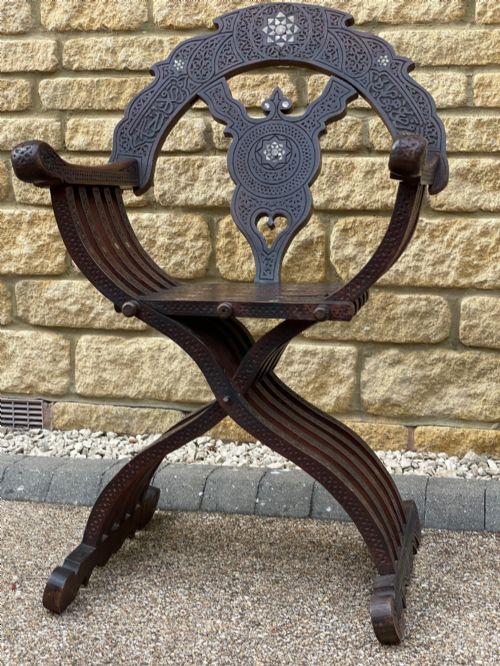
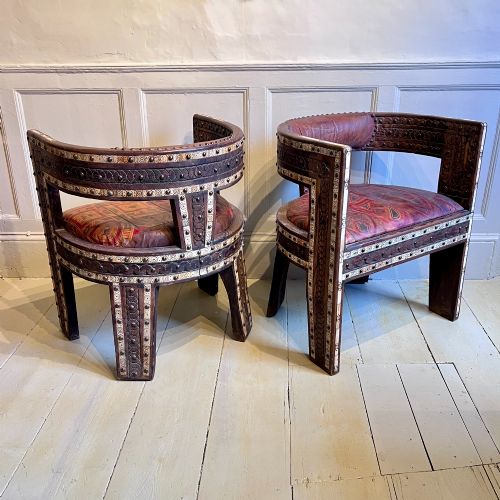
Moorish style armchairs encompass ornate seating rooted in North African, Spanish, and Middle Eastern traditions, frequently appearing as Syrian, Moroccan, or Andalusian examples from the nineteenth and early twentieth centuries. These pieces arrive in various forms including corner chairs, folding X-frame structures, conversation seats, and paired armchairs.
The aesthetic bridges several related design movements, drawing upon Moorish Revival, Syrian Ottoman, Anglo-Moorish, and Hispano-Moresque vocabularies. Such armchairs serve as dramatic focal points in domestic interiors, blending architectural woodwork with intimate seating design.
How they were made
Maker's workshops construct these armchairs from dense timbers such as walnut, fruitwood, and various North African hardwoods, often incorporating complex folding X-frame or hip-joint mechanics. Artisans shape the wooden framework through intricate carving and precise joinery.
Surface ornamentation relies heavily on contrasting materials, embedding bone, brass, and mother-of-pearl or nacre-shell into geometric recesses. Certain regional variants also employ painted decoration or detailed Mashrabiya lattice panels to create texture and depth.
Folding X-frame mechanisms allowed Victorian travellers to pack up their exotic seating when changing desert camps or London lodgings.
What varies in quality
The standard of an armchair depends largely on the precision of the joinery and the density of the surface inlay. Examples featuring extensive mother-of-pearl or bone work across every visible surface demand exceptional technical skill from the maker.
Structural integrity also separates standard production from superior pieces, particularly in complex folding frameworks or delicate Mashrabiya panels. The harmony between the carved wooden armature and the inlaid elements dictates the overall visual success of the chair.
Liberty and Co
The Moorish Style Armchairs Glossary
- Mashrabiya
- A traditional architectural element adapted into furniture as turned wooden lattice panels. These intricate screens form decorative backrests and structural sides.
- Nacre-shell
- Iridescent inner layer of mollusc shell used for inlay work. This material catches the light to provide luminous contrast against dark hardwood.
- X-frame
- A folding structural form derived from ancient folding chair designs. This scissors-action base supports a flexible or rigid seat.
- Hispano-Moresque
- A design style reflecting the cross-cultural artistic exchange between Islamic Spain and Christian Europe. Pieces bearing this label often feature geometric strapwork and turned elements.
- Anglo-Moorish
- A late nineteenth-century aesthetic combining British furniture forms with Islamic decorative motifs. These hybrid objects catered to Victorian tastes for exotic interiors.
Moorish Style Armchairs: Frequently Asked Questions
What is a moorish style armchair?
These armchairs are ornate seats influenced by Islamic design traditions from Spain, North Africa, and the Middle East. They are typically built from dark hardwoods and heavily embellished with inlay.
Craftsmen frequently used bone, mother-of-pearl, and intricate turned woodwork to create striking geometric patterns across the frame and backrest.
How do I date an inlaid armchair?
Dating relies upon examining the timber species, the style of the inlay work, and the structural engineering of the chair. Most antique examples date from the late nineteenth or early twentieth century.
Historical context is also provided by stylistic crossover labels such as Anglo-Moorish or Moorish Revival, which flourished during the Victorian and Edwardian eras.
Where were these chairs originally placed?
In period interiors, such seating was often deployed in drawing rooms, smoking rooms, or hallways designed to display exotic tastes. Their dramatic appearance made them conversation pieces.
Specialist forms like corner chairs and conversation seats were specifically arranged to facilitate domestic social gatherings in nineteenth-century homes.
How do I live with inlaid furniture?
Living with these chairs requires maintaining stable indoor humidity to protect the delicate wooden frames and prevent the natural inlay materials from loosening. Regular dusting keeps the intricate surfaces clear.
Positioning the chairs away from direct heat sources and strong sunlight preserves both the timber finish and the lustre of the embedded mother-of-pearl or bone.