
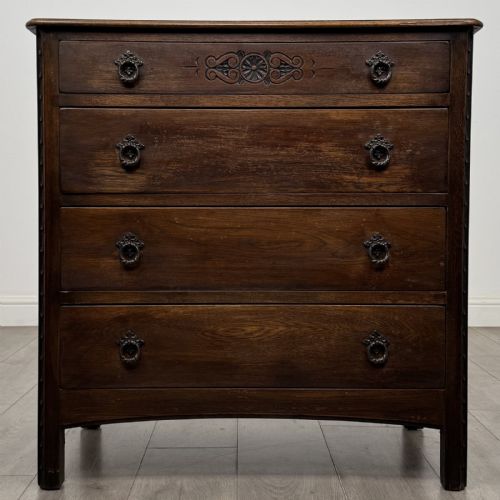
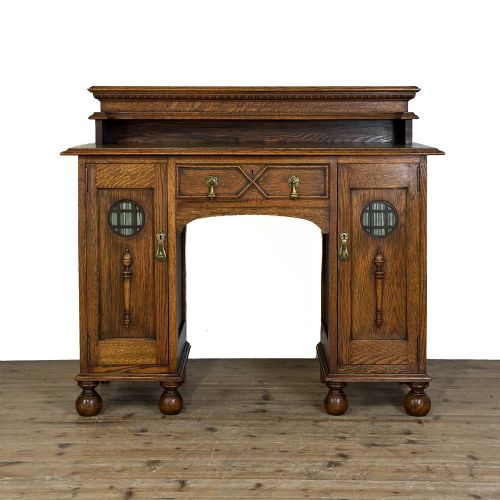
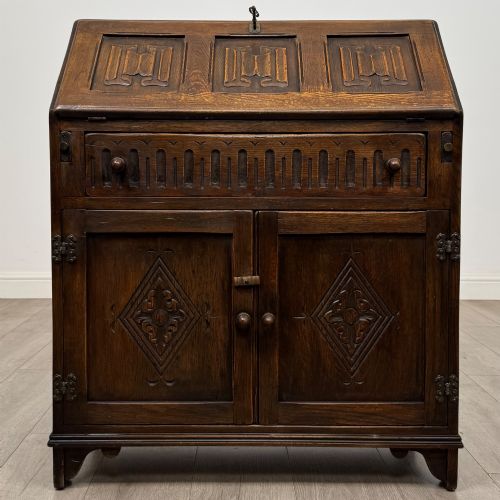
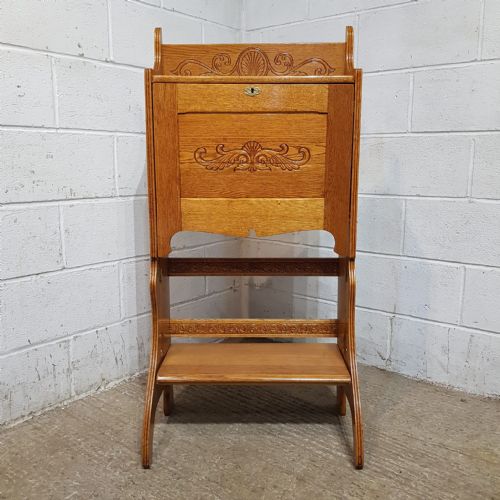
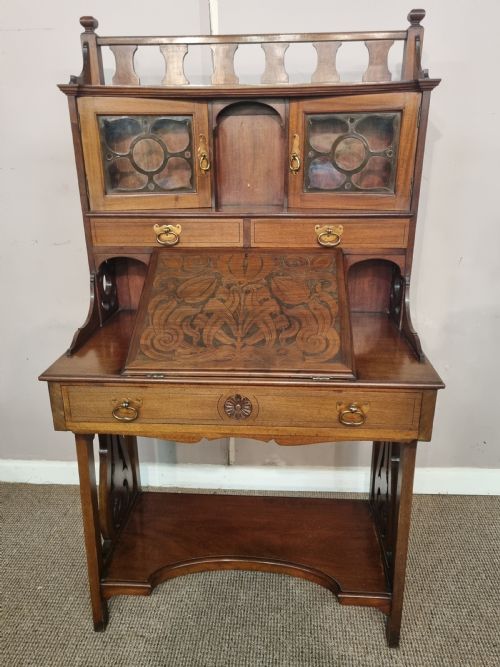


Carved Arts Crafts Bureau
A carved arts crafts bureau brings hand-worked detail and utilitarian function together, offering a dedicated writing surface wrapped in movement-defined character.
Carved Arts Crafts Bureau
When you search for a carved arts crafts bureau, you are looking at practical writing furniture shaped by late nineteenth and early twentieth century ideals. These pieces range from compact writing desks to larger bureau bookcases, housing fall-front writing flaps and internal compartments.
You are most likely to meet oak examples on this page, often spanning the Edwardian era and the year nineteen hundred. The forms incorporate stylistic echoes from Tudor Revival, Jacobean Revival, and Art Nouveau alongside straightforward movement principles.
Makers and designers working within these traditions utilised solid timbers and expressive hardware to create functional workspaces. The resulting items combine cabinetmaking traditions with hand-carved motifs suited to domestic studies and libraries.
Materials and construction methods
Carpenters and cabinetmakers built these writing furniture forms primarily in oak and mahogany, relying on sturdy timber frames to support falling writing surfaces and internal drawers. Metal elements such as brass handles and copper plates appeared as functional fixtures that added contrast to the wood.
Surface treatment relied heavily on carved decoration, which distinguished standard cabinetwork from movement pieces. Joinery techniques prioritized visible construction honesty, linking structural integrity directly to the aesthetic of the piece.
One piece hides a carved wooden mouse signature inside its drawer construction.
Distinctions in quality
Quality in these writing pieces rests upon the precision of the joinery and the depth of the hand-carved elements. Pieces associated with named workshops or specific designers demonstrate superior timber selection and more considered proportions.
The integration of original hardware, such as brass hinges and copper escutcheons, separates standard production items from more distinguished examples. Refinement in internal drawer configuration and writing surface stability further defines the upper tier of the range.
Morris & Co·George W Jack·Robert Mouseman Thompson·Peter Waals·Liberty & Co·Gregory & Co of London
The Carved Arts Crafts Bureau Glossary
- Bureau
- A writing desk featuring a sloping hinged lid that drops down to form a writing surface, enclosing small drawers and pigeonholes. This form provides concealed storage for stationery and correspondence.
- Escritoire
- A small writing cabinet or desk used for letters and personal papers. It often incorporates interior compartments and vertical proportions.
- Linenfold
- A style of carved wooden panelling that resembles folded fabric, frequently utilised on late nineteenth and early twentieth century cabinet doors. This decorative motif reflects medieval textile traditions revived during the period.
- Davenport
- A small compact writing desk featuring a sloping desktop and drawers opening to the side. The design combines writing space with enclosed drawer storage.
- Arts and Crafts
- A design movement valuing hand craftsmanship, vernacular traditions, and simple forms over mass production. This ethos influenced furniture construction throughout the late nineteenth and early twentieth centuries.
Carved Arts Crafts Bureau: Frequently Asked Questions
What is a carved arts crafts bureau?
A carved arts crafts bureau is a drop-front writing desk decorated with hand-carved motifs reflecting movement ideals. These pieces combine practical storage compartments with dedicated writing surfaces.
They appear primarily in oak and mahogany across late nineteenth and early twentieth century periods, serving as both workspaces and decorative furniture.
How do you use a bureau?
The hinged writing flap lowers to create a flat writing surface while concealing interior pigeonholes and small drawers. This setup organises correspondence and stationery within a compact footprint.
Lifting and locking the flap secures the contents and restores the cabinet front when writing tasks conclude.
How do I identify the period?
Period identification relies upon timber selection, hardware styles, and structural characteristics. Edwardian and nineteen-hundred pieces often exhibit specific revival influences like Jacobean or Tudor details.
Construction marks and material combinations help distinguish turn-of-the-century cabinetwork from later reproductions.
Where should I place it?
These writing desks suit studies, living rooms, or quiet corners where a compact workspace is required. Their finished backs and panelled sides allow them to sit flush against walls or within room arrangements.
Positioning them away from direct heat sources protects the timber and preserves the movement of the writing flap.