





Carlton House Table
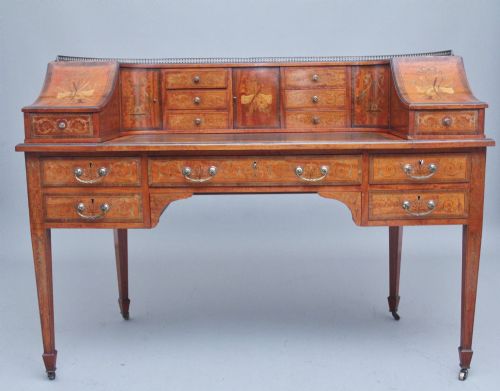
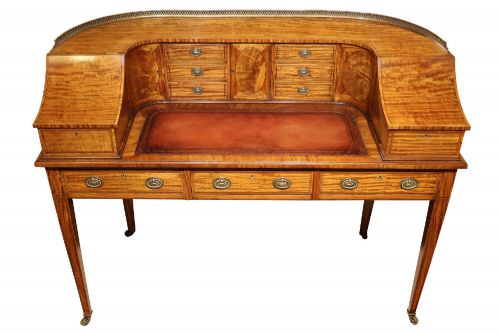
A carlton house table is a refined writing desk defined by its horseshoe superstructure of small drawers and compartments, offering an organised workspace of distinct elegance.
Carlton House Table
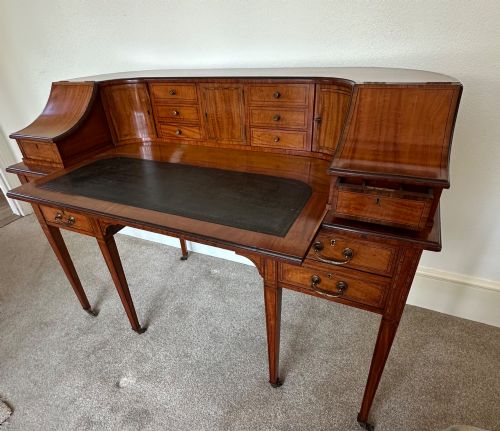
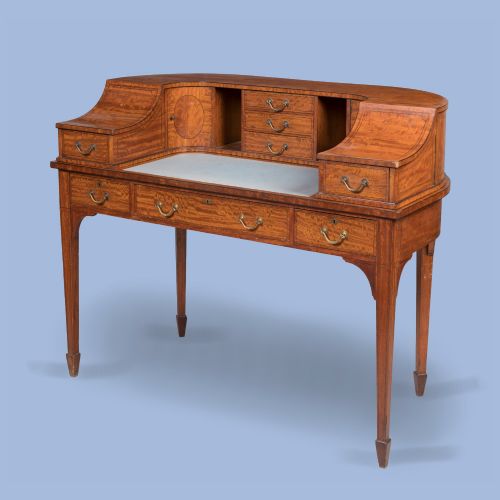
A carlton house table is primarily a writing desk featuring a characteristic curved superstructure enclosing the rear and sides with tiered small drawers and pigeonholes. Buyers examining this page will most frequently encounter Edwardian and Victorian examples, alongside pieces from the nineteenth century and earlier Georgian roots.
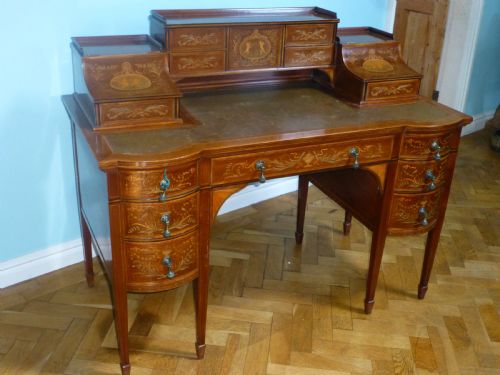
The objects listed range from satinwood and mahogany writing desks to pieces finished with marquetry inlay, wood inlay, and painted decoration. Most extant examples belong to the Sheraton Revival style, echoing late eighteenth-century Neoclassical design principles with slender proportions and decorative banding.
Makers and designers referenced in the archive and current listings include notable firms such as Edwards and Roberts, Gillows of Lancaster, and Maple of London, alongside pieces after designs by George Hepplewhite.
Materials and Construction
Construction relies heavily on fine cabinet timbers, with satinwood and mahogany forming the primary carcases, complemented by secondary woods such as oak for drawer linings. Craftsmen utilised intricate wood inlay, marquetry, and kingswood crossbanding to embellish the curved superstructures and writing surfaces.
Writing surfaces are frequently inset with panels of leather, providing a durable and traditional medium for correspondence. Original brass handles and finely fitted drawers with oak linings are characteristic technical details found across the surviving examples.
Carlton House Table Retail Price Guide 2026
Typical asking prices for carlton house table among the pieces listed under this phrase on Sellingantiques today, from the lower quarter to the upper quarter. They describe what is for sale here now, not the wider market.
Some Edwardian writing desks managed to squeeze dozens of tiny drawers into a horseshoe curve, proving Victorians loved a cubbyhole.
Gradations in Quality
Quality in a carlton house table is determined by the selection of timber veneers and the precision of the marquetry or wood inlay across the curved superstructure. Pieces featuring figured satinwood, dense mahogany, and meticulous floral painted details represent the higher end of the range.
The integrity of the internal drawers, the retention of original brass hardware, and the subtlety of Sheraton Revival or Neoclassical proportions distinguish superior cabinetmaking from standard production.
Edwards and Roberts·Gillows of Lancaster·Maple of London·George Hepplewhite·Druce and Co
The Carlton House Table Glossary
- Superstructure
- The tiered arrangement of small drawers and compartments built in a horseshoe curve above the main writing surface. This defining feature provides specialised storage for correspondence and stationery.
- Satinwood
- A lustrous tropical hardwood native to Ceylon and India, prized for its golden yellow colour and reflective grain. It was widely utilised by cabinetmakers during the Sheraton Revival period.
- Marquetry
- The art of applying pieces of veneer to a structure to form decorative patterns and pictorial designs. Craftsmen used various tinted and natural woods to create floral or neoclassical motifs.
- Crossbanding
- A border technique where veneer is laid so that the grain runs at right angles to the surrounding wood. This frames the primary timber panels on drawer fronts and tabletops.
- Sheraton Revival
- A late nineteenth and early twentieth-century design movement inspired by the furniture of George Sheraton. It is characterised by slender proportions, satinwood, and delicate inlay.
Carlton House Table: Frequently Asked Questions
What is a carlton house table?
A carlton house table is a specialised writing desk featuring a distinctive curved superstructure of small drawers and pigeonholes enclosing the rear and sides of the writing surface.
The form originated in the eighteenth century and was frequently revived during the Victorian and Edwardian periods using fine timbers like satinwood and mahogany.
How do I identify an Edwardian example?
Edwardian examples often utilise bright satinwood, delicate floral painted decoration, and refined wood inlay reflecting Sheraton Revival tastes.
They frequently date around nineteen hundred and combine lighter timbers with traditional craftsmanship such as oak-lined drawers.
Where was the design first used?
The form is traditionally associated with Carlton House, the London residence of the Prince Regent during the late eighteenth century.
Later cabinetmakers reproduced and adapted the architectural writing desk style during the nineteenth and early twentieth centuries.
What woods were used for these desks?
Cabinetmakers primarily used satinwood and mahogany as the main structural and decorative timbers, often enhanced by kingswood crossbanding.
Internal elements such as drawer linings were typically constructed from oak, while writing surfaces were frequently inset with leather.